. 2013 Feb 8;339(6120):711-5.
doi: 10.1126/science.1230624. Epub 2013 Jan 10.

Rif1 prevents resection of DNA breaks and promotes immunoglobulin class switching

Affiliations

Rif1 prevents resection of DNA breaks and promotes immunoglobulin class switching

Michela Di Virgilio et al. Science. .

Abstract

DNA double-strand breaks (DSBs) represent a threat to the genome because they can lead to the loss of genetic information and chromosome rearrangements. The DNA repair protein p53 binding protein 1 (53BP1) protects the genome by limiting nucleolytic processing of DSBs by a mechanism that requires its phosphorylation, but whether 53BP1 does so directly is not known. Here, we identify Rap1-interacting factor 1 (Rif1) as an ATM (ataxia-telangiectasia mutated) phosphorylation-dependent interactor of 53BP1 and show that absence of Rif1 results in 5'-3' DNA-end resection in mice. Consistent with enhanced DNA resection, Rif1 deficiency impairs DNA repair in the G(1) and S phases of the cell cycle, interferes with class switch recombination in B lymphocytes, and leads to accumulation of chromosome DSBs.


Figures

Fig. 1
Fig. 1. Identification of phospho-dependent 53BP1 interactors
Graph shows the H/(H+L) ratio distribution of proteins identified by SILAC. Error bars represent the standard deviation of the H/(H+L) mean value for all the peptides identified for each individual protein (only proteins with 4 peptides were included). “H/(H+L)” and “σ” are the mean (0.57) and SD (0.09) of the distribution, respectively. H: heavy; L: light.
Fig. 2
Fig. 2. Rif1 interaction with 53BP1 is phospho-, damage- and ATM-dependent
(A) Western blot analysis of anti-Flag immuno-precipitates from irradiated Trp53bp1−/− B lymphocytes infected with empty vector (vec), 53BP1DB, or 53BP1DB28A virus. Triangles indicate 3-fold dilution. Data are representative of two independent experiments. (B) Western blot analysis of anti-Flag immunoprecipitates from Trp53bp1−/− B cells infected with empty vector or 53BP1DB. Cells were either left untreated or irradiated (50 Gy, 45 min recovery) in the presence or absence of the ATM kinase inhibitor KU55933 (ATMi). Triangles indicate 3-fold dilution. Data are representative of two independent experiments. (C) Immunofluorescent staining for 53BP1 (Flag) and Rif1 in irradiated Trp53bp1−/− iMEFs reconstituted with 53BP1DB or 53BP1DB28A retroviruses (4). Magnification, 100X; Scale bars, 5 μm. Data are representative of two independent experiments.
Fig. 3
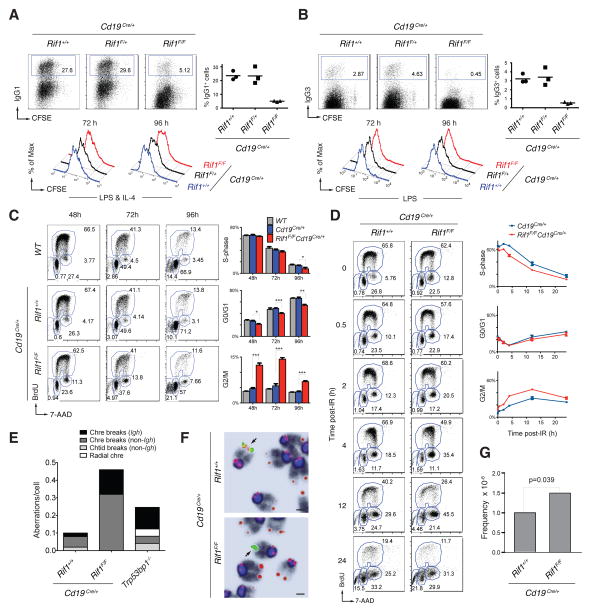
Fig. 3. Rif1 deficiency impairs class switch recombination, and causes Igh and genome instability in primary B cells
(A) Left: CSR to IgG1 96 hr post-stimulation of B lymphocytes with LPS and IL-4. Right: summary dot plot for three independent experiments (n = 3 mice per genotype). Mean values are: 23.6% for Cd19Cre/+, 23.4% for Rif1F/+Cd19Cre/+, and 5.0% for Rif1F/FCd19Cre/+ (P <0.008 with the paired student’s t-test). Bottom: B cell proliferation by carboxyfluorescein succinimidyl ester (CFSE) dilution. Data are representative of three independent experiments. (B) Same as in (A) but for CSR to IgG3 after stimulation with LPS alone. Mean values are: 3.2% for Cd19Cre/+, 3.4% for Rif1F/+Cd19Cre/+, and 0.5% for Rif1F/FCd19Cre/+ (P <0.008). (C) Left: Cell cycle analysis of primary B cells after stimulation with LPS and IL-4. Right: Summary histograms for S-phase, G0/G1 and G2/M cells from two independent experiments (n = 4 mice per genotype). Error bars indicate SEM. * 0.01 < P < 0.05, ** 0.001 < P < 0.01, *** P < 0.001. (D) Left: Cell cycle analysis of LPS- and IL-4-stimulated splenocytes at the indicated times post-irradiation (6 Gy). Right: Summary graphs for S-phase, G0/G1 and G2/M cells from two independent experiments (n = 3 mice per genotype). Error bars indicate SD. (E) Analysis of genomic instability in metaphases from B cell cultures. Chtid: chromatid; Chre: chromosome. Data are representative of two independent experiments (n = 50 metaphases analyzed per genotype per experiment). (F) Examples of Igh-associated aberrations in Rif1F/FCd19Cre/+ B cells. Chromosomes were hybridized with an Igh Cα probe (green; centromeric of Cγ1) and a telomere sequence-specific probe (red), and counterstained with DAPI (dark blue/black). Magnification, 63×; Scale bars, 1 μm. (G) Frequency of c-myc/Igh translocations in activated B cells. Graph shows combined results from 3 mice per genotype.
Fig. 4
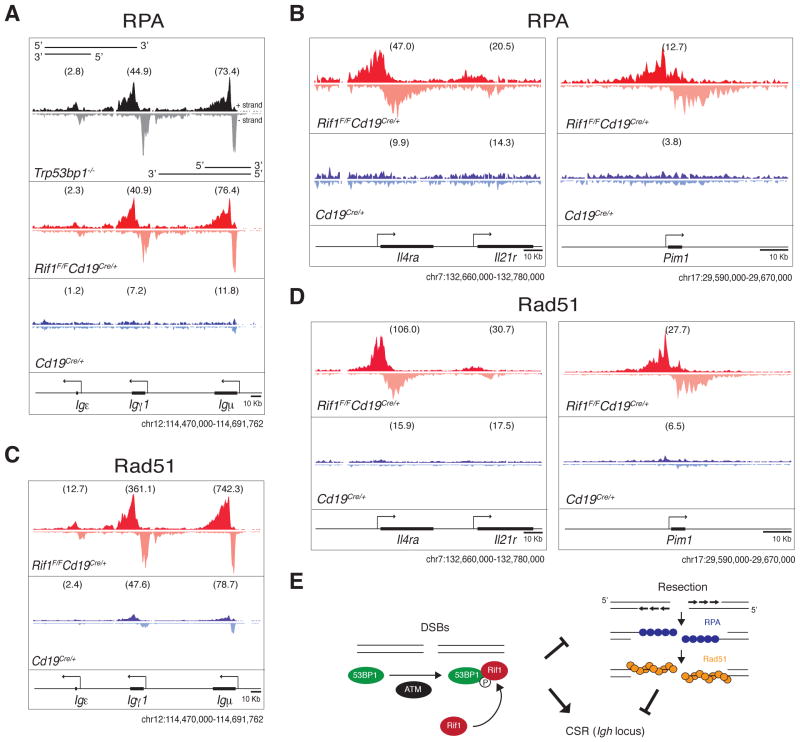
Fig. 4. Rif1 prevents resection of DNA ends at sites of AID-induced DNA damage
(A) to (D) RPA and Rad51 occupancy at the Igh locus (A and C) and at non-Igh AID targets genes (B and D) in B cells activated to undergo class switching. ChIP-seq libraries were resolved into upper (+) and lower (-) DNA strands to show RPA and Rad51 association with sense and antisense strands. Within a specified genomic window, graphs have the same scale and show tag density. Deep-sequencing samples were normalized per library size, and TPM (Tags Per Million) values were calculated for each genic region as indicated in Materials and Methods and shown in parenthesis. Data are representative of two independent experiments for RPA ChIP-seq and one for Rad51. (E) Model of Rif1 recruitment and DNA end protection at DSBs. DNA damage activates ATM, which phosphorylates many targets, including 53BP1. This event recruits Rif1 to 53BP1 at the DSB, where it inhibits DNA resection. The extensive resection in the absence of Rif1 impairs CSR at the Igh locus.

Comment in

References

    1. Adams MM, Carpenter PB. Tying the loose ends together in DNA double strand break repair with 53BP1. Cell division. 2006;1:19. - PMC - PubMed
    1. Lukas J, Lukas C, Bartek J. More than just a focus: The chromatin response to DNA damage and its role in genome integrity maintenance. Nat Cell Biol. 2011 Oct;13:1161. - PubMed
    1. Noon AT, Goodarzi AA. 53BP1-mediated DNA double strand break repair: insert bad pun here. DNA Repair (Amst) 2011 Oct 10;10:1071. - PubMed
    1. Bothmer A, et al. Regulation of DNA end joining, resection, and immunoglobulin class switch recombination by 53BP1. Mol Cell. 2011 May 6;42:319. - PMC - PubMed
    1. Difilippantonio S, et al. 53BP1 facilitates long-range DNA end-joining during V(D)J recombination. Nature. 2008 Nov 27;456:529. - PMC - PubMed

Publication types

MeSH terms

Associated data