. 2013;8(1):e53084.
doi: 10.1371/journal.pone.0053084. Epub 2013 Jan 7.

Evidence for horizontal transmission of secondary endosymbionts in the Bemisia tabaci cryptic species complex

Affiliations

Evidence for horizontal transmission of secondary endosymbionts in the Bemisia tabaci cryptic species complex

Muhammad Z Ahmed et al. PLoS One. 2013.

Abstract

Bemisia tabaci (Hemiptera: Aleyrodidae) is a globally distributed pest composed of at least 34 morphologically indistinguishable cryptic species. At least seven species of endosymbiont have been found infecting some or all members of the complex. The origin(s) of the associations between specific endosymbionts and their whitefly hosts is unknown. Infection is normally vertical, but horizontal transmission does occur and is one way for new infections to be introduced into individuals. The relationships between the different members of the cryptic species complex and the endosymbionts have not been well explored. In this study, the phylogenies of different cryptic species of the host with those of their endosymbionts were compared. Of particular interest was whether there was evidence for both coevolution and horizontal transmission. Congruence was observed for the primary endosymbiont, Portiera aleyrodidarum, and partial incongruence in the case of two secondary endosymbionts, Arsenophonus and Cardinium and incongruence for a third, Wolbachia. The patterns observed for the primary endosymbiont supported cospeciation with the host while the patterns for the secondary endosymbionts, and especially Wolbachia showed evidence of host shifts and extinctions through horizontal transmission rather than cospeciation. Of particular note is the observation of several very recent host shift events in China between exotic invader and indigenous members of the complex. These shifts were from indigenous members of the complex to the invader as well as from the invader to indigenous relatives.


Conflict of interest statement

Competing Interests: The authors have declared that no competing interests exist.

Figures

Figure 1
Figure 1. Phylogenies of the host B. tabaci cryptic species and their P-endosymbionts.
A. Phylogenetic tree reconstruction based on mtCOI sequences (length = 830 bp) of host B. tabaci cryptic species using ML analysis under the HKY+G substitution model. The bootstrap values are indicated. Bemisia afer (GU 220055) is used as outgroup. Accession numbers for Btab1-19 submitted to GenBank are JX428681–JX428696. All mtCOI sequences of host B. tabaci cryptic species used in this study were clustered with other blast references sequences from GenBank and their ML phylogenetic reconstruction is shown Fig. S1A. B. Phylogenetic tree reconstruction based on 16S rRNA gene sequences (length = 1100 bp) of P-endosymbionts of B. tabaci cryptic species using ML analysis under the HKY+G substitution model. The bootstrap values are indicated. Trialeurodes vaporariorum (AF400483) is used as the outgroup. Accession numbers for Ptab1-Ptab16 submitted to GenBank are JX428713–JX428731. All 16S sequences of P-endosymbionts used in this study were clustered with other blast references sequences from GenBank and their ML phylogenetic reconstruction is shown Fig.. S1B.
Figure 2
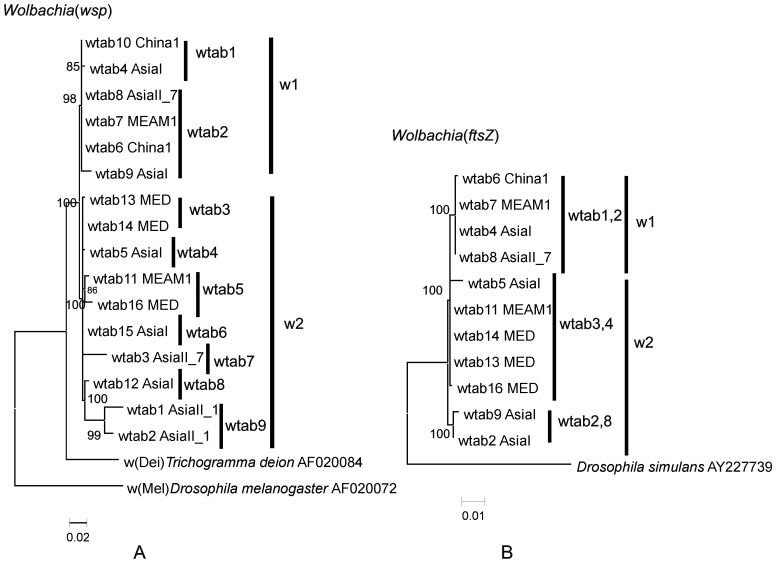
Figure 2. Phylogenies of the S-endosymbiont Wolbachia.
A. Phylogenetic tree reconstruction based on wsp gene sequences (length = 480 bp) of Wolbachia of B. tabaci cryptic species using maximum-likelihood analysis under the T92 substitution model. The bootstrap values are indicated. Trichogramma deion (AF020084) and Drosophila melanogaster (AF020072) are used as outgroups. Accession numbers for wtab1-16 submitted to GenBank are JX428697–JX428712. All wsp sequences of Wolbachia used in this study were clustered with other blast references sequences from GenBank and their ML phylogenetic reconstruction is shown Fig. C. B. Phylogenetic tree reconstruction based on ftsZ gene sequences (length = 850) of Wolbachia of B. tabaci cryptic species using ML analysis under the TN93 substitution model. The bootstrap values are indicated. Drosophila simulans in case of ftsZ gene (AY227739) is used as the outgroup. Accession numbers for sequences used in the tree are JX428732–JX428742. All ftsZ sequences of Wolbachia used in this study were clustered with other blast references sequences from GenBank and their ML phylogenetic reconstruction is shown Fig. S1D.
Figure 3
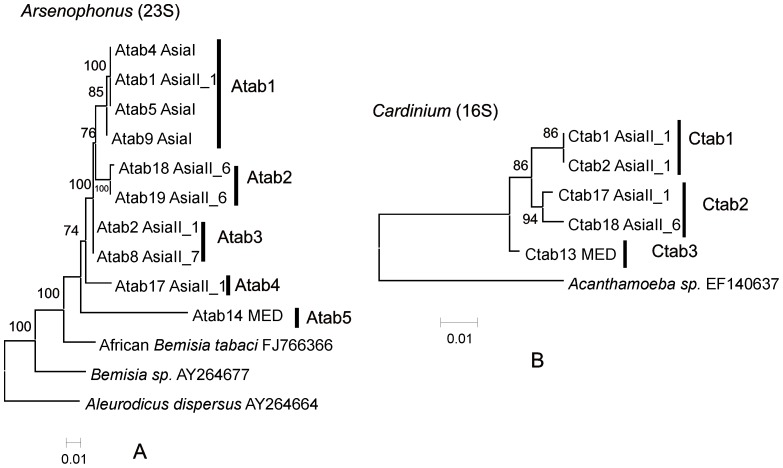
Figure 3. Phylogenies of the S-endosymbionts Arsenophonus and Cardinium.
A. Phylogenetic tree reconstruction based on 23S rRNA gene sequences (length = 550 bp) of Arsenophonus of B. tabaci cryptic species using ML analysis under the HKY+G substitution model. The bootstrap values are indicated. African B. tabaci (FJ66366), Bemisia sp. (AY264677) and Aleurodicus disperses (AY264664) are used as the outgroups. Accession numbers for sequences used in the tree are JX428666–JX428675. All 23S sequences of Arsenophonus used in this study were clustered with other blast references sequences from GenBank and their ML phylogenetic reconstruction is shown Fig. S1E. B. Phylogenetic tree reconstruction based on 16S rRNA gene sequences (length = 400) of Cardinium of B. tabaci cryptic species using MLd analysis under the K2 substitution model. The bootstrap values are indicated. Acanthamoeba sp. (EF140637) is used as the out group. Accession numbers for sequences used in the tree are JX428676–JX428680. All 16S sequences of Cardinium used in this study were clustered with other blast references sequences from GenBank and their ML phylogenetic reconstruction is shown Fig. S1F.
Figure 4
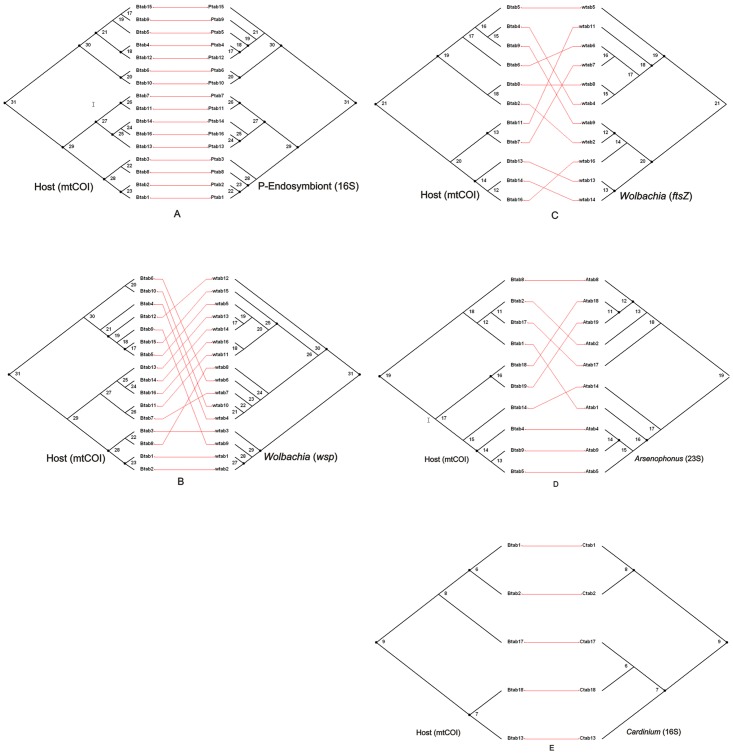
Figure 4. Comparisons of B. tabaci cryptic species and endosymbionts ML phylogenies.
Black dots show cospeciation points. A. Host B. tabaci mtCOI versus P-endosymbiont, P. aleyrodidarum 16S rRNA gene. B. Host B. tabaci mtCOI versus S-endosymbiont, Wolbachia wsp. C. Host B. tabaci mtCOI versus S-endosymbiont, Wolbachia ftsZ genes. D. Host B. tabaci mtCOI versus S-endosymbionts, Arsenophonus 23S rRNA gene. E. Host B. tabaci mtCOI versus S-endosymbionts, Cardinium 16S rRNA gene.

References

    1. Moran NA, Baumann P (2000) Bacterial endosymbionts in animals. Curr Opin Microbiol 3: 270–275. - PubMed
    1. Baumann P (2005) Biology of bacteriocyte-associated endosymbionts of plant sap-sucking insects. Ann Rev Microbiol 59: 155–189. - PubMed
    1. Moran NA, Telang A (1998) Bacteriocyte-associated symbionts of insects: a variety of insect groups harbor ancient prokaryotic endosymbionts. BioScience 48: 295–304.
    1. Buchner P (1965) Endosymbiosis of animals with plant microorganisms, p. 332–338. John Wiley and Sons Interscience, New York, N.Y.
    1. Costa HS, Westcot DM, Ullman DE, Rosell R, Brown JK, et al. (1995) Morphological variation in Bemisia endosymbionts. Protoplasma 189: 194–202.

Publication types

LinkOut - more resources