Serum polyfluoroalkyl concentrations, asthma outcomes, and immunological markers in a case-control study of Taiwanese children
- PMID: 23309686
- PMCID: PMC3620752
- DOI: 10.1289/ehp.1205351
Serum polyfluoroalkyl concentrations, asthma outcomes, and immunological markers in a case-control study of Taiwanese children
Abstract
Background: Perfluorinated compounds (PFCs) are ubiquitous pollutants. Experimental data suggest that they may be associated with adverse health outcomes, including asthma. However, there is little supporting epidemiological evidence.
Methods: A total of 231 asthmatic children and 225 nonasthmatic controls, all from northern Taiwan, were recruited in the Genetic and Biomarkers study for Childhood Asthma. Structure questionnaires were administered by face-to-face interview. Serum concentrations of 11 PFCs and levels of immunological markers were also measured. Associations of PFC quartiles with concentrations of immunological markers and asthma outcomes were estimated using multivariable regression models.
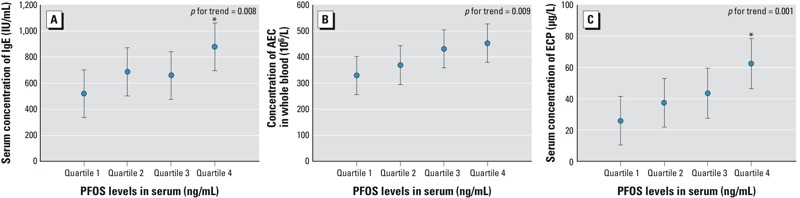
Results: Nine PFCs were detectable in most children (≥ 84.4%), of which perfluorooctane sulfonate (PFOS) was the most abundant (median serum concentrations of 33.9 ng/mL in asthmatics and 28.9 ng/mL in controls). Adjusted odds ratios for asthma among those with the highest versus lowest quartile of PFC exposure ranged from 1.81 (95% CI: 1.02, 3.23) for the perfluorododecanoic acid (PFDoA) to 4.05 (95% CI: 2.21, 7.42) for perfluorooctanic acid (PFOA). PFOS, PFOA, and subsets of the other PFCs were positively associated with serum IgE concentrations, absolute eosinophil counts (AEC), eosinophilic cationic protein (ECP) concentrations, and asthma severity scores among asthmatics.
Conclusions: This study suggests an association between PFC exposure and juvenile asthma. Because of widespread exposure to these chemicals, these findings may be of potential public health concern.
Conflict of interest statement
The views expressed in this article are those of the authors and do not necessarily represent those of the funding source. The funding source had no role in the design or analysis of the study publication.
The authors declare they have no actual or potential competing financial interests.
Figures
References
-
- Akbari O, Stock P, DeKruyff RH, Umetsu DT. Role of regulatory T cells in allergy and asthma. Curr Opin Immunol. 2003;15:627–633. - PubMed
-
- Anderson-Mahoney P, Kotlerman J, Takhar H, Gray D, Dahlgren J. Self-reported health effects among community residents exposed to perfluorooctanoate. New Solut. 2008;18:129–143. - PubMed
-
- Bao J, Liu W, Liu L, Jin Y, Dai J, Ran X, et al. Perfluorinated compounds in the environment and the blood of residents living near fluorochemical plants in Fuxin, China. Environ Sci Technol. 2011;45:8075–8080. - PubMed
-
- Braissant O, Wahli W. Differential expression of peroxisome proliferator-activated receptor-alpha, -beta, and -gamma during rat embryonic development. Endocrinology. 1998;139:2748–2754. - PubMed
-
- Chen HH, Wang JY, Jan RL, Liu YH, Liu LF. Reliability and validity of childhood asthma control test in a population of Chinese asthmatic children. Qual Life Res. 2008;17:585–593. - PubMed
Publication types
MeSH terms
Substances
LinkOut - more resources
Full Text Sources
Other Literature Sources
Medical
Miscellaneous