


Evaluation of a new fluorescence quantitative PCR test for diagnosing Helicobacter pylori infection in children
- PMID: 23311469
- PMCID: PMC3598558
- DOI: 10.1186/1471-230X-13-7
Evaluation of a new fluorescence quantitative PCR test for diagnosing Helicobacter pylori infection in children
Abstract
Background: Numerous diagnostic tests are available to detect Helicobactor pylori (H. pylori). There has been no single test available to detect H. pylori infection reliably. We evaluated the accuracy of a new fluorescence quantitative PCR (fqPCR) for H. pylori detection in children.
Methods: Gastric biopsy specimens from 138 children with gastritis were sent for routine histology exam, rapid urease test (RUT) and fqPCR. 13C-urea breath test (13C-UBT) was carried out prior to endoscopic procedure. Gastric fluids and dental plaques were also collected for fqPCR analysis.
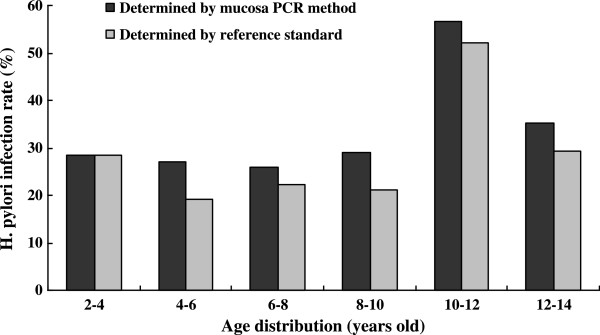
Results: 38 children (27.5%) were considered positive for H. pylori infection by gold standard (concordant positive results on 2 or more tests). The remaining 100 children (72.5%) were considered negative for H. pylori. Gastric mucosa fqPCR not only detected all 38 H. pylori positive patients but also detected 8 (8%) of the 100 gold standard-negative children or 11 (10.7%) of the 103 routine histology-negative samples. Therefore, gastric mucosa fqPCR identified 46 children (33.3%) with H. pylori infection, significantly higher than gold standard or routine histology (P<0.01). Both gastric fluid and dental plaque fqPCR only detected 32 (23.2%) and 30 (21.7%) children with H. pylori infection respectively and was significantly less sensitive than mucosa fqPCR (P<0.05) but was as sensitive as non-invasive UBT.
Conclusions: Gastric mucosa fqPCR was more sensitive than routine histology, RUT, 13C-UBT alone or in combination to detect H. pylori infection in children with chronic gastritis. Either gastric fluid or dental plaque PCR is as reliable as 13C-UBT for H. pylori detection.
Figures
References
-
- Frenck RW Jr, Fathy HM, Sherif M, Mohran Z, El Mohammedy H, Francis W, Rockabrand D, Mounir BI, Rozmajzl P, Frierson HF. Sensitivity and specificity of various tests for the diagnosis of Helicobacter pylori in Egyptian children. Pediatrics. 2006;118:e1195–1202. doi: 10.1542/peds.2005-2925. - DOI - PubMed
-
- Koletzko S, Jones NL, Goodman KJ, Gold B, Rowland M, Cadranel S, Chong S, Colletti RB, Casswall T, Elitsur Y, Guarner J, Kalach N, Madrazo A, Megraud F, Oderda G. H pylori Working Groups of ESPGHAN and NASPGHAN: evidence-based guidelines from ESPGHAN and NASPGHAN for Helicobacter pylori infection in children. J Pediatr Gastroenterol Nutr. 2011;53:230–243. - PubMed
Publication types
MeSH terms
Substances
LinkOut - more resources
Full Text Sources
Other Literature Sources
Medical
