. 2013 Apr;53(2):399-408.
doi: 10.1016/j.bone.2012.12.048. Epub 2013 Jan 10.

Isozyme profile and tissue-origin of alkaline phosphatases in mouse serum

Affiliations

Isozyme profile and tissue-origin of alkaline phosphatases in mouse serum

Cecilia Halling Linder et al. Bone. 2013 Apr.

Abstract

Mouse serum alkaline phosphatase (ALP) is frequently measured and interpreted in mammalian bone research. However, little is known about the circulating ALPs in mice and their relation to human ALP isozymes and isoforms. Mouse ALP was extracted from liver, kidney, intestine, and bone from vertebra, femur and calvaria tissues. Serum from mixed strains of wild-type (WT) mice and from individual ALP knockout strains were investigated, i.e., Alpl(-/-) (a.k.a. Akp2 encoding tissue-nonspecific ALP or TNALP), Akp3(-/-) (encoding duodenum-specific intestinal ALP or dIALP), and Alpi(-/-) (a.k.a. Akp6 encoding global intestinal ALP or gIALP). The ALP isozymes and isoforms were identified by various techniques and quantified by high-performance liquid chromatography. Results from the WT and knockout mouse models revealed identical bone-specific ALP isoforms (B/I, B1, and B2) as found in human serum, but in addition mouse serum contains the B1x isoform only detected earlier in patients with chronic kidney disease and in human bone tissue. The two murine intestinal isozymes, dIALP and gIALP, were also identified in mouse serum. All four bone-specific ALP isoforms (B/I, B1x, B1, and B2) were identified in mouse bones, in good correspondence with those found in human bones. All mouse tissues, except liver and colon, contained significant ALP activities. This is a notable difference as human liver contains vast amounts of ALP. Histochemical staining, Northern and Western blot analyses confirmed undetectable ALP expression in liver tissue. ALP activity staining showed some positive staining in the bile canaliculi for BALB/c and FVB/N WT mice, but not in C57Bl/6 and ICR mice. Taken together, while the main source of ALP in human serum originates from bone and liver, and a small fraction from intestine (<5%), mouse serum consists mostly of bone ALP, including all four isoforms, B/I, B1x, B1, and B2, and two intestinal ALP isozymes dIALP and gIALP. We suggest that the genetic nomenclature for the Alpl gene in mice (i.e., ALP liver) should be reconsidered since murine liver has undetectable amounts of ALP activity. These findings should pave the way for the development of user-friendly assays measuring circulating bone-specific ALP in mouse models used in bone and mineral research.


Conflict of interest statement

Conflict of interest statement

The authors have no conflict of interest to disclose.

Figures

Fig. 1
Fig. 1
Chromatographic ALP profiles of human serum, mouse serum, WT and knockout mouse serum. Total ALP activities, peak identities and retention times are as follows: Human serum: Total ALP 2.0 μkat/L, B/I 4.88 min, B1 6.92 min, B2 10.47 min, L1 13.92 min, L2 16.05 and L3 17.93 min. Mouse serum: Total ALP 3.6 μkat/L, B/I 4.87 min, B1x 5.95 min, B1 7.10 min, B2 10.28 min and IALP (Alpi) 16.72 min. Akp3+/+: Total ALP 1.3 μkat/L, B/I 4.92 min, B1x 5.87 min, B1 6.72 min, B2 12.68 min and IALP (Alpi) 19.35. Akp3−/−: Total ALP 1.7 μkat/L, B/I 4.93 min, B1x 5.87 min, B1 6.73 min, B2 12.23 min and IALP (Alpi) 19.13 min. Alpi+/+: Total ALP 6.17 μkat/L, B1x (including B/I) 5.83 min, B1 7.03 min, B2 12.33 min and IALP (Alpi) 17.95 min. Alpi−/−: Total ALP 3.9 μkat/L, B1x (including B/I) 5.85 min, B1 7.07 min and B2 12.20 min. Alpl+/+: Total ALP 28.5 μkat/L, B/I 5.15 min, B1x 6.12 min, B1 7.63 min and B2 13.05 min. Alpl+/−: Total ALP 13.2 μkat/L, B/I 5.12 min, B1x 6.27 min, B1 7.68 and B2 13.05 min. Alpl−/−: Total ALP 0.05 μkat/L.
Fig. 2
Fig. 2
Chromatographic ALP profiles of tissue extracts from mouse intestinal segments. Total ALP activities and retention times are as follows: Segment 1 (duodenum): Total ALP 240 μkat/L, 5.33 min, 6.95 min and 10.40 min. Segment 2 (jejunum): Total ALP 39.8 μkat/L, 11.67 min. Segment 3 (jejunum): Total ALP 20.90 μkat/L, 11.43 min. Segment 4 (ileum): Total ALP 16.30 μkat/L, 11.62 min. These results confirm that mice have more than one IALP isozyme and/or isoform originating from the Akp3 and Alpi genes.
Fig. 3
Fig. 3
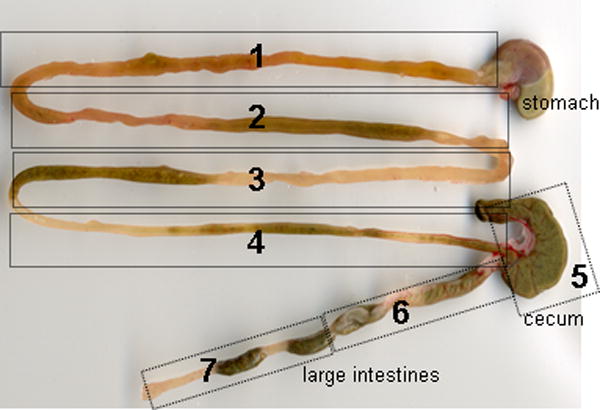
(Top panel) ALP activities in pooled tissue extracts from 20 WT mice. (Middle panel) ALP activities in pooled tissue extracts from intestinal segments of 8 WT mice. (Bottom panel) Intestine of WT mouse. Segment 1 contains the major part of duodenum; segments 2 and 3 are jejunum; segment 4 is ileum; segment 5 is cecum; segments 6 and 7 contains colon.
Fig. 3
Fig. 3
(Top panel) ALP activities in pooled tissue extracts from 20 WT mice. (Middle panel) ALP activities in pooled tissue extracts from intestinal segments of 8 WT mice. (Bottom panel) Intestine of WT mouse. Segment 1 contains the major part of duodenum; segments 2 and 3 are jejunum; segment 4 is ileum; segment 5 is cecum; segments 6 and 7 contains colon.
Fig. 4
Fig. 4
ALP histochemical staining of liver tissues from four WT mice strains: (A, B) C57Bl/6; (C, D) BALB/c; (E, F) FVB/N; and (G, H) ICR. (I, J) ApoE-TNALP Tg (+) expressing human TNALP under control of a liver-specific promoter (positive control). Some portal arteries in the portal triad showed ALP activity in all of the four strains analyzed (black arrowheads). In C57Bl/6 and ICR mice, no ALP activity was detected in other cells, while in BALB/c and FVB/N mice, bile canaliculi showed faint but clear ALP activity (open arrowheads). Hepatocytes of ApoE-TNALP Tg (+) were strongly positive as well as their bile canaliculi. PV = portal vein. BD = Bile duct. A, C, E, G and I: Scale bar 100 μm. B, D, F, H and J: Scale bar 50 μm.
Fig. 5
Fig. 5
Northern and Western blot analysis of four WT mice strains. (Left panel) Northern blot analysis. Each lane was loaded with 20 μg of total RNA. Total RNA from D3 ES cells was included as a positive control. The mouse TNALP gene was expressed at high levels in kidney and ES cells, while only trace amounts of mRNA were detected in the liver samples. (Right panel) Western blot analysis. Each lane was loaded with 100 μg of protein except that the ApoE-TNALP Tg (+) sample was 75 μg. Mouse TNALP was not detected significantly in liver samples from the four WT mice strains, while human TNALP was highly expressed in the liver from ApoE-TNALP Tg (+) mice and mouse TNALP was detected in normal kidney.
Fig. 6
Fig. 6
Migration of ALP from mouse tissue extracts in a native gel. (A) kidney, (B) intestine, (C) femur, (D) vertebra, and (E) calvaria. * = ALP treated with neuraminidase prior to sample application. After treatment with neuraminidase, all three bone samples migrated a more similar distance as the kidney and intestinal samples, which indicates that the differences in migration is due to terminal sialic acid residues.
Fig. 7
Fig. 7
Dose-dependent lectin precipitation on the different tissue samples; (◆) calvaria, (■) femur, (▲) vertebra, (×) intestine, (○) kidney, (●) serum. Each data point is expressed as a mean of six samples. (Top panel) WGA, 1 and 3 mg/mL; (middle panel) Con A, 4 and 8 mg/mL; (bottom panel) PNA, 2 and 5 mg/mL. These data show that circulating mouse serum consists of some IALP but mostly of bone ALP with terminal sialic acid residues.
Fig. 8
Fig. 8
Heat inactivation of mouse tissue samples from pooled extract of 20 WT mice; incubation at 56°C for 10 min, and incubation at 65°C for 15 min. Inhibition with 100 μM tetramisole, 10 mM L-homoarginine, and 3.3 M urea and 10 mM L-phenylalanine. These data show that circulating mouse serum consists mostly of bone ALP and some IALP, which is in agreement with the WT mouse serum HPLC profile in Fig. 1.
Fig. 9
Fig. 9
Mouse serum ALP, from mixed strains of WT mice, separated on an anion-exchange Q-Sepharose column with a 0.05–0.2 M sodium acetate gradient. Fractions, with approximately 3.0 mL, were collected and analyzed with respect to ALP activity. HPLC analysis of the late eluting peak (fraction 94), showed one single peak with a retention time corresponding to the late eluting peak for serum from WT mouse (Fig. 1). Taken together, these results demonstrate that the late eluting peak from WT mice is IALP originating from the Alpi gene.

References

    1. McComb RB, Bowers GN, Jr, Posen S. Alkaline phosphatase. New York, NY, USA: Plenum Press; 1979.
    1. Millán JL. From biology to applications in medicine and biotechnology. Weinheim, Germany: WILEY-VCH Verlag GmgH & Co. KGaA; 2006. Mammalian alkaline phosphatase.
    1. Alatalo SL, Peng Z, Janckila AJ, Kaija H, Vihko P, Väänänen HK, et al. A novel immunoassay for the determination of tartrate-resistant acid phosphatase 5b from rat serum. J Bone Miner Res. 2003;18:134–9. - PubMed
    1. Srivastava AK, Bhattacharyya S, Castillo G, Miyakoshi N, Mohan S, Baylink DJ. Development and evaluation of C-telopeptide enzyme-linked immunoassay for measurement of bone resorption in mouse serum. Bone. 2000;27:529–33. - PubMed
    1. Hoegh-Andersen P, Tanko LB, Andersen TL, Lundberg CV, Mo JA, Heegaard AM, et al. Ovariectomized rats as a model of postmenopausal osteoarthritis: validation and application. Arthritis Res Ther. 2004;6:R169–80. - PMC - PubMed

Publication types

LinkOut - more resources