. 2013 May;227(2):263-72.
doi: 10.1007/s00213-012-2960-1. Epub 2013 Jan 13.

Multigenerational effects of adolescent morphine exposure on dopamine D2 receptor function

Affiliations

Multigenerational effects of adolescent morphine exposure on dopamine D2 receptor function

John J Byrnes et al. Psychopharmacology (Berl). 2013 May.

Abstract

Rationale: The use and misuse of prescription opiates in adolescent populations, and in particular, adolescent female populations, has increased dramatically in the past two decades. Given the significant role that opioids play in neuroendocrine function, exposure to opiates during this critical developmental period could have significant consequences for the female, as well as her offspring.

Objectives: In the current set of studies, we utilized the female rat to model the transgenerational impact of adolescent opiate exposure.

Methods: We examined locomotor sensitization in response to the dopamine D2/D3 receptor agonist quinpirole in the adult male progeny (F1 and F2 generations) of females exposed to morphine during adolescence. All females were drug-free for at least 3 weeks prior to conception, eliminating the possibility of direct fetal exposure to morphine.

Results: Both F1 and F2 progeny of morphine-exposed females demonstrated attenuated locomotor sensitization following repeated quinpirole administration. These behavioral effects were coupled with increased quinpirole-induced corticosterone secretion and upregulated kappa opioid receptor and dopamine D2 receptor (D2R) gene expression within the nucleus accumbens.

Conclusions: These results suggest significant modifications in response to repeated D2R activation in the progeny of females exposed to opiates during adolescence. Given the significant role that the D2R plays in psychopathology, adolescent opiate exposure could shift the vulnerability of future offspring to psychological disorders, including addiction. Moreover, that effects are also observed in the F2 generation suggests that adolescent opiate exposure can trigger transgenerational epigenetic modifications impacting systems critical for motivated behavior.


Figures
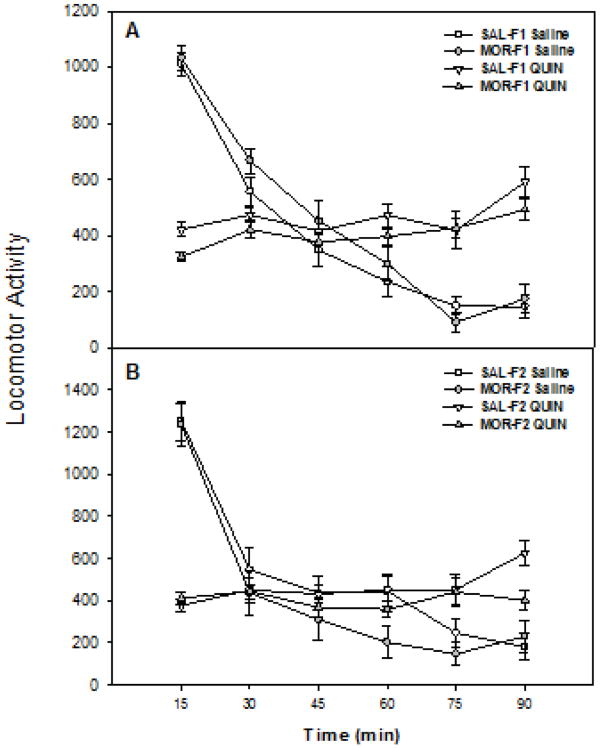
Figure 1
Figure 1
Upper Panel: Acute locomotor effects of quinpirole in F1 male offspring of females exposed to morphine or saline during adolescence. Adult F1 males were tested for locomotor activity following treatment with quinpirole (0.5 mg/kg, sc) or its 0.9% saline vehicle. Data are mean (± SEM) locomotor activity (beam breaks) over 90 min of testing for groups of 6-10 animals (p<0.001 for main effects of time and a drug × time interaction). Lower Panel: Acute locomotor effects of quinpirole in F2 male offspring of females exposed to morphine or saline during adolescence. Adult F2 males were tested for locomotor activity following treatment with quinpirole (0.5 mg/kg, sc) or its 0.9% saline vehicle. Data are mean (± SEM) locomotor activity (beam breaks) for groups of 9-14 animals (p<0.001 for main effects of time and a drug × time interaction).
Figure 2
Figure 2
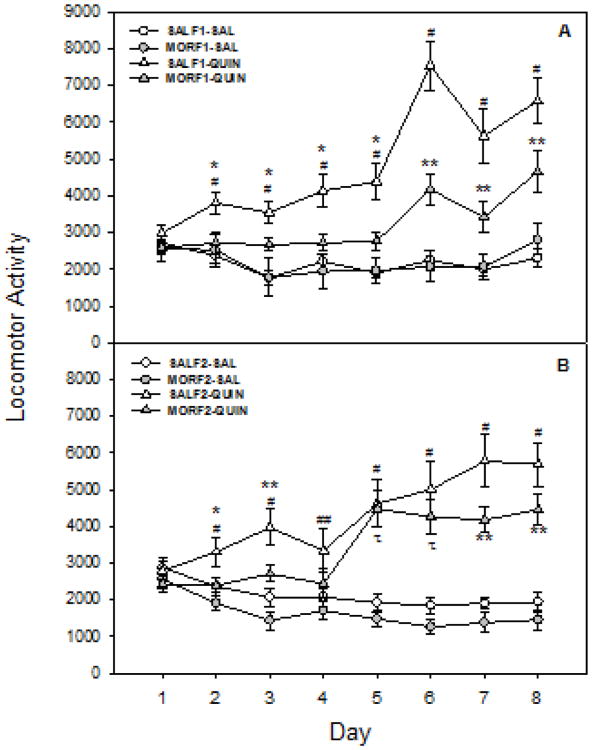
Locomotor effects of repeated quinpirole in F1 and F2 male offspring of females exposed to morphine or saline during adolescence. Adult males were tested for locomotor activity following daily treatment with quinpirole (0.5 mg/kg, sc) or its 0.9% saline vehicle. Data represent mean locomotor activity (beam breaks/90 min) ± SEM across 8 days. Upper Panel: Locomotor activity in F1 males (n = 6-10/group). Lower Panel: Locomotor in F2 males (n = 9-14). * vs SAL-quin; **p<0.05 vs SAL-sal and MOR-sal; *** vs all other groups: all p's < 0.05.
Figure 3
Figure 3
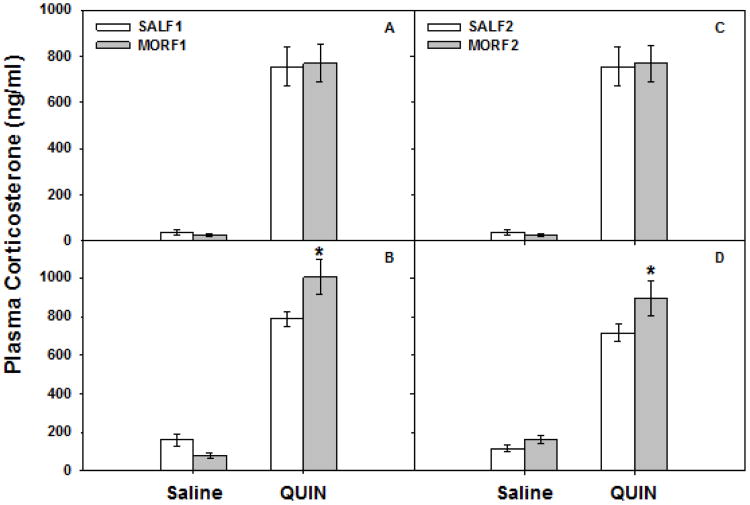
Panels A and B: Plasma corticosterone in F1 offspring of females exposed to morphine during adolescence. Adult male F1 offspring were treated acutely (once) or repeatedly (8 times) with quinpirole (0.5 mg/kg, sc) or its 0.9% saline vehicle. Corticosterone was determined in plasma collected 90 min after the acute (panel A) or repeated (panel B) treatment. Data are corticosterone (ng/ml) ± SEM for groups of 5-10 animals. Panels C and D. Plasma corticosterone in F2 offspring of females exposed to morphine during adolescence. Adult male F2 offspring were treated acutely (once) or repeatedly (8 times) with quinpirole (0.5 mg/kg, sc) or its 0.9% saline vehicle. Corticosterone was determined in plasma collected 90 min after the acute (panel C) or repeated (panel D) treatments. Data are corticosterone (ng/ml) ± SEM for groups of 5-7 animals. *p<0.05 vs SAL-quin.
Figure 4
Figure 4
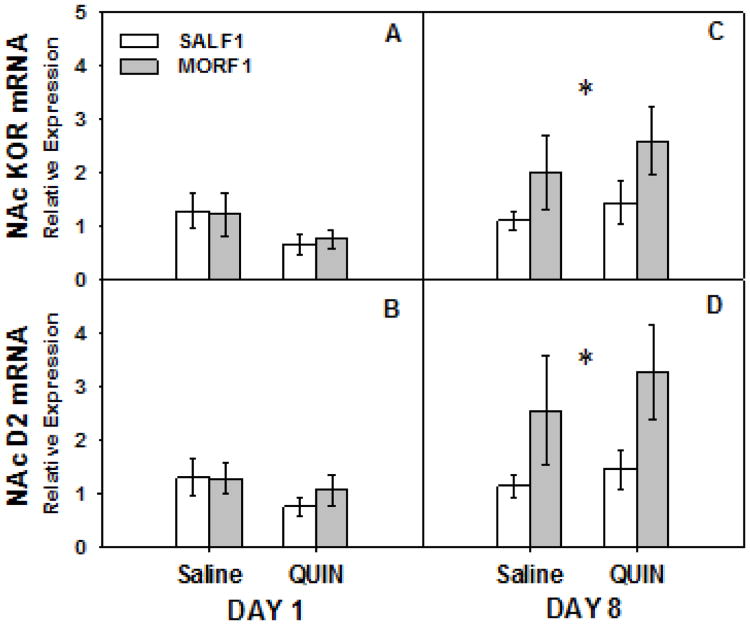
NAc KOR and D2 mRNA following acute (Panels A and B) and repeated (panels C and D) quinpirole treatment in F1 offspring of females exposed to morphine during adolescence. Adult male F1 offspring were treated acutely (once) or repeatedly (8 times) with quinpirole (0.5 mg/kg, sc) or its 0.9% saline vehicle. The NAc was collected and prepared for quantitative PCR 90 min after the acute or repeated treatments. Data are relative expression of NAc KOR (panels A and C) and D2 mRNA (Panels B and D) for groups of 5-9 animals. *p < 0.05 main effect of maternal drug history.
Figure 5
Figure 5
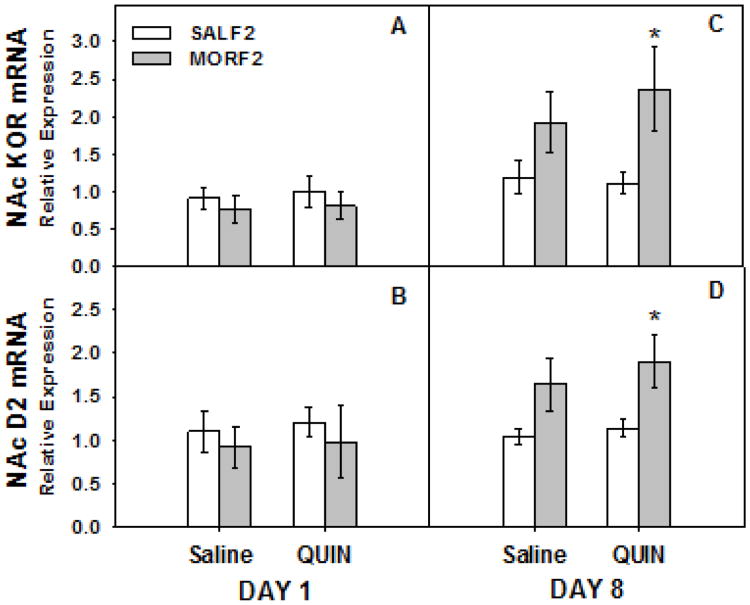
NAc KOR and D2 mRNA following acute and repeated quinpirole treatment in F2 offspring of females exposed to morphine during adolescence. Adult male F2 offspring were treated acutely (once) or repeatedly (8 times) with quinpirole (0.5 mg/kg, sc) or its 0.9% saline vehicle. The NAc was collected and prepared for quantitative PCR 90 min after the acute or repeated treatments. Data are relative expression of NAc KOR (panels A and C) and D2 mRNA (panels B and D) for groups of 6-14 animals. *p<0.05 main effect of maternal drug history.

References

    1. Becker JB, Hu M. Sex differences in drug abuse. Front Neuroendocrinol. 2008;29:36–47. - PMC - PubMed
    1. Byrnes EM. Chronic morphine exposure during puberty decreases postpartum prolactin secretion in adult female rats. Pharmacol Biochem Behav. 2005a;80:445–51. - PubMed
    1. Byrnes EM. Transgenerational consequences of adolescent morphine exposure in female rats: effects on anxiety-like behaviors and morphine sensitization in adult offspring. Psychopharmacology (Berl) 2005b;182:537–44. - PubMed
    1. Byrnes EM. Chronic morphine exposure during puberty induces long-lasting changes in opioid-related mRNA expression in the mediobasal hypothalamus. Brain Res. 2008;1190:186–92. - PubMed
    1. Byrnes JJ, Babb JA, Scanlan VF, Byrnes EM. Adolescent opioid exposure in female rats: transgenerational effects on morphine analgesia and anxiety-like behavior in adult offspring. Behav Brain Res. 2011;218:200–5. - PMC - PubMed

Publication types

MeSH terms

LinkOut - more resources