. 2013 Apr;56(4):901-10.
doi: 10.1007/s00125-012-2814-8. Epub 2013 Jan 12.

Aldosterone deficiency prevents high-fat-feeding-induced hyperglycaemia and adipocyte dysfunction in mice

Affiliations

Aldosterone deficiency prevents high-fat-feeding-induced hyperglycaemia and adipocyte dysfunction in mice

P Luo et al. Diabetologia. 2013 Apr.

Abstract

Aims/hypothesis: Obesity is associated with aldosterone excess, hypertension and the metabolic syndrome, but the relative contribution of aldosterone to obesity-related complications is debated. We previously demonstrated that aldosterone impairs insulin secretion, and that genetic aldosterone deficiency increases glucose-stimulated insulin secretion in vivo. We hypothesised that elimination of endogenous aldosterone would prevent obesity-induced insulin resistance and hyperglycaemia.

Methods: Wild-type and aldosterone synthase-deficient (As (-/-)) mice were fed a high-fat (HF) or normal chow diet for 12 weeks. We assessed insulin sensitivity and insulin secretion using clamp methodology and circulating plasma adipokines, and examined adipose tissue via histology.

Results: HF diet induced weight gain similarly in the two groups, but As (-/-) mice were protected from blood glucose elevation. HF diet impaired insulin sensitivity similarly in As (-/-) and wild-type mice, assessed by hyperinsulinaemic-euglycaemic clamps. Fasting and glucose-stimulated insulin were higher in HF-fed As (-/-) mice than in wild-type controls. Although there was no difference in insulin sensitivity during HF feeding in As (-/-) mice compared with wild-type controls, fat mass, adipocyte size and adiponectin increased, while adipose macrophage infiltration decreased. HF feeding significantly increased hepatic steatosis and triacylglycerol content in wild-type mice, which was attenuated in aldosterone-deficient mice.

Conclusions/interpretation: These studies demonstrate that obesity induces insulin resistance independently of aldosterone and adipose tissue inflammation, and suggest a novel role for aldosterone in promoting obesity-induced beta cell dysfunction, hepatic steatosis and adipose tissue inflammation.


Conflict of interest statement

Duality of interest All other authors report that there is no duality of interest associated with this manuscript.

Figures

Fig. 1
Fig. 1
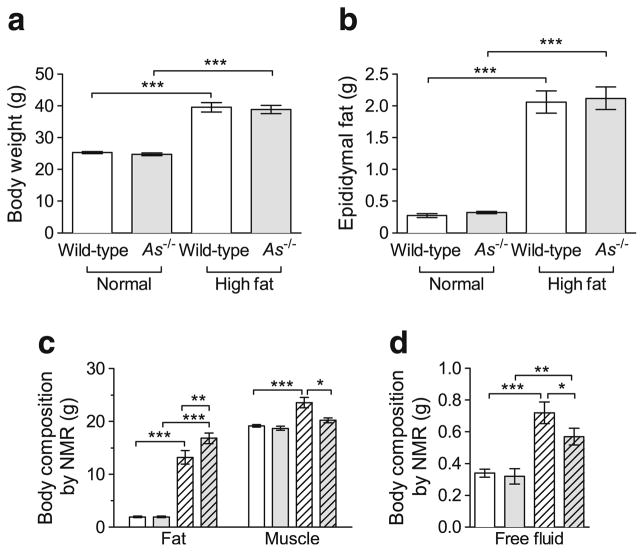
Aldosterone deficiency does not prevent diet-induced obesity. Body weight increased significantly during HF feeding in both genotypes (a). Epididymal fat weight increased similarly in both genotypes (b). Fat mass and free fluid assessed by NMR increased in both genotypes during HF feeding (c, d), although muscle mass increased in wild-type mice but not in As−/− mice during HF feeding (c). White bar, wild-type; grey bar, As−/−; hatched bars, HF diet. *p<0.05, **p≤0.01, ***p≤0.001
Fig. 2
Fig. 2
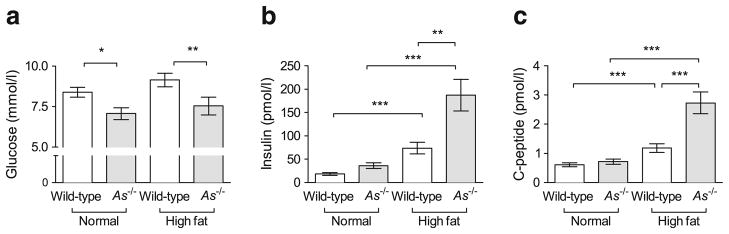
Effect of genetic aldosterone deficiency on fasting glucose and insulin during HF feeding. HF feeding had significantly increased blood glucose after a 5 h morning fast in wild-type, but not in As−/−, mice (a). Fasting plasma insulin had significantly increased in both genotypes but to a greater extent in As−/− (b). Fasting plasma C-peptide data paralleled those of insulin (c). *p<0.05, **p≤0.01, ***p≤0.001
Fig. 3
Fig. 3
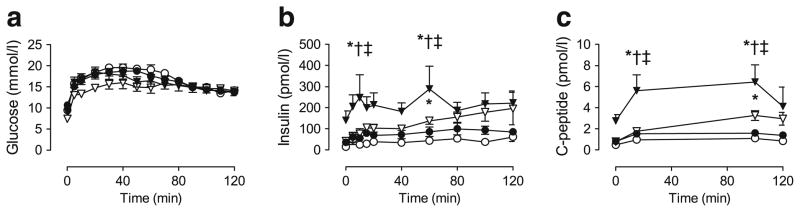
Glucose-stimulated insulin secretion is increased in aldosterone-deficient mice during normal chow and HF feeding. During hyperglycaemic clamp conditions, glucose was infused to achieve equivalent hyperglycaemia in normal-chow-fed wild-type (white circles) and aldosterone-deficient (white triangles) mice and HF-fed wild-type (black circles) and As−/− mice (black triangles) (a). Plasma insulin (b) and C-peptide (c) concentrations were significantly higher in As−/− mice during either normal chow or HF feeding than in wild-type. *p≤0.05 vs wild-type; p≤0.05 vs wild-type + HF; p≤0.05 vs As−/−
Fig. 4
Fig. 4
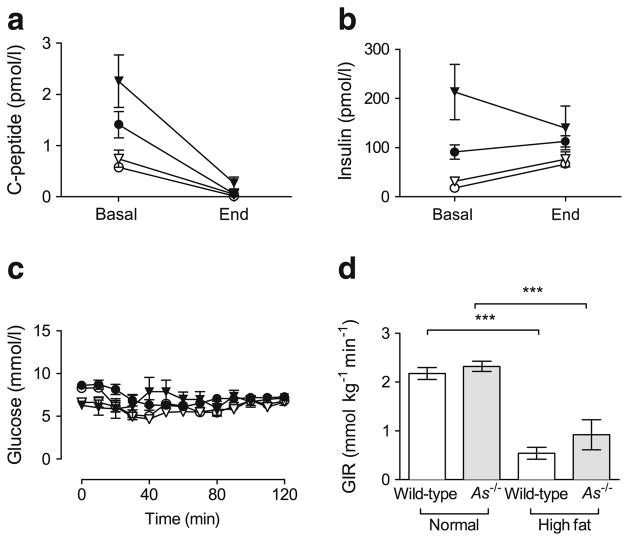
HF feeding produces insulin resistance independently of aldosterone. Somatostatin-modified hyperinsulinaemic–euglycaemic clamps were used to abolish baseline differences in insulin secretion between wild-type and As−/− mice during HF feeding. Before the clamp, plasma C-peptide (a, basal) and insulin (b, basal) varied among groups at basal time points (white circle, normal chow wild-type; white triangle, normal chow As−/−; black circle, HF-fed wild-type; black triangle, HF-fed As−/−). Somatostatin suppressed endogenous insulin secretion, demonstrated by C-peptide in all groups (a, end), and equivalent plasma insulin was achieved between genotypes (b, End). Blood glucose was maintained at 6.9 mmol/l (125 mg/dl) (c). HF feeding significantly decreased insulin sensitivity in both wild-type and As−/− mice, demonstrated by the GIR required to maintain euglycaemia (d). ***p≤0.001
Fig. 5
Fig. 5
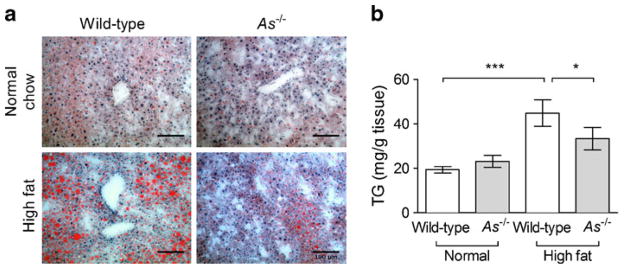
Aldosterone deficiency attenuates obesity-induced hepatic steatosis. Fat deposition increased during HF feeding in wild-type liver, but appeared to be less in As−/− mice (a, Oil Red O staining; scale bar=100 μm). Liver triacylglycerol (TG) content increased significantly during HF feeding in wild-type mice, but was attenuated in As−/− mice (b). *p<0.05, ***p≤0.001
Fig. 6
Fig. 6
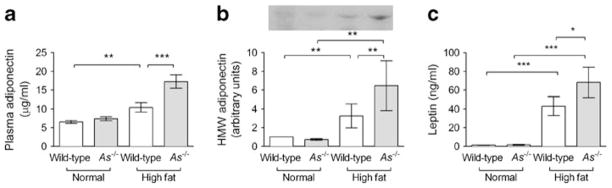
Obesity-induced adipokine dysfunction is prevented in aldosterone-deficient mice. Plasma adiponectin increased during HF feeding to a greater extent in As−/− than wild-type mice (a). Quantification of adiponectin oligomers revealed a selective increase in HMW adiponectin during HF feeding, which increased to a greater extent in As−/− mice. A representative western blot of plasma HMW adiponectin oligomers is shown (b). Plasma leptin increased significantly during HF feeding, to a greater extent in As−/− than wild-type mice (c). *p<0.05, **p≤0.01, ***p≤0.001
Fig. 7
Fig. 7
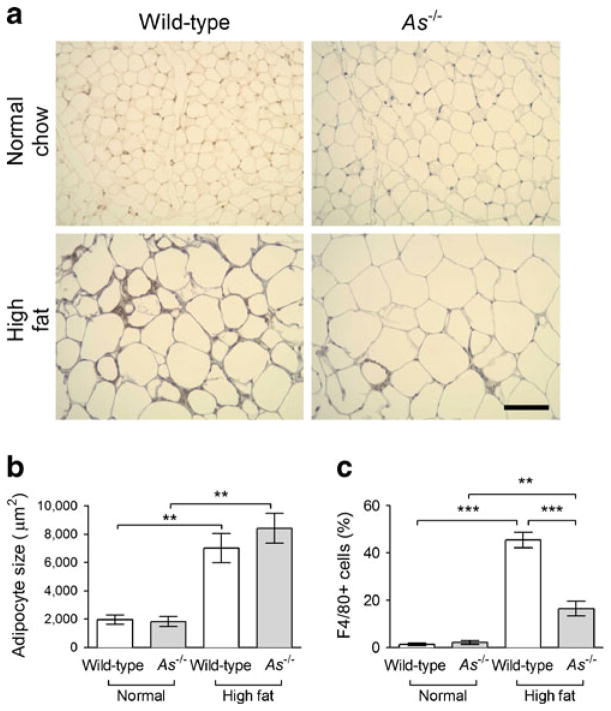
Aldosterone deficiency attenuated HF-feeding-induced adipose tissue macrophage infiltration but not adipocyte hypertrophy. HF feeding increased F4/80 positivity in wild-type mouse epididymal fat tissues but appeared to be less in As−/− mice (a, diaminobenzidine staining; scale bar 100 μm). Adipocyte size increased significantly and similarly in wild-type and As−/− mice during HF feeding (b). HF feeding markedly increased the percentage of F4/80-positive macrophages within the adipose tissue in wild-type mice, but this effect was attenuated in As−/− mice (c). **p≤0.01, ***p≤0.001

References

    1. Bentley-Lewis R, Adler GK, Perlstein T, et al. Body mass index predicts aldosterone production in normotensive adults on a high-salt diet. J Clin Endocrinol Metab. 2007;92:4472–4475. - PMC - PubMed
    1. Goodfriend TL, Kelley DE, Goodpaster BH, Winters SJ. Visceral obesity and insulin resistance are associated with plasma aldosterone levels in women. Obes Res. 1999;7:355–362. - PubMed
    1. Vasan RS, Evans JC, Larson MG, et al. Serum aldosterone and the incidence of hypertension in nonhypertensive persons. N Engl J Med. 2004;351:33–41. - PubMed
    1. Ingelsson E, Pencina MJ, Tofler GH, et al. Multimarker approach to evaluate the incidence of the metabolic syndrome and longitudinal changes in metabolic risk factors: the Framingham Offspring Study. Circulation. 2007;116:984–992. - PubMed
    1. Sowers JR, Whaley-Connell A, Epstein M. Narrative review: the emerging clinical implications of the role of aldosterone in the metabolic syndrome and resistant hypertension. Ann Intern Med. 2009;150:776–783. - PMC - PubMed

Publication types

MeSH terms