. 2013 Mar;30(3):333-40.
doi: 10.1007/s10815-012-9925-5. Epub 2013 Jan 15.

Follicular fluid hydrogen peroxide and lipid hydroperoxide in bovine antral follicles of various size, atresia, and dominance status

Affiliations

Follicular fluid hydrogen peroxide and lipid hydroperoxide in bovine antral follicles of various size, atresia, and dominance status

Margo L Hennet et al. J Assist Reprod Genet. 2013 Mar.

Abstract

Purpose: To avoid inducing a state of oxidative stress (OS), assisted reproductive technologies (ART) must maintain a balance of reactive oxygen species (ROS) and antioxidants during the in vitro culture of oocytes. However, oocyte requirements and tolerance thresholds for ROS during in vivo development are still unclear. Previous studies have examined ROS levels in follicular fluid (FF) using pooled samples or according to follicle size. This study sought to examine two OS markers, lipid hydroperoxides (LPO) and hydrogen peroxide (H2O2), in FF of individually sampled follicles from bovine ovary pairs according to follicle size, atresia, and dominance status.

Methods: TUNEL and cleaved Caspase-3 labeling were used to identify apoptotic granulosa cells and determine follicle atresia status. LPO were measured directly for the first time in FF.

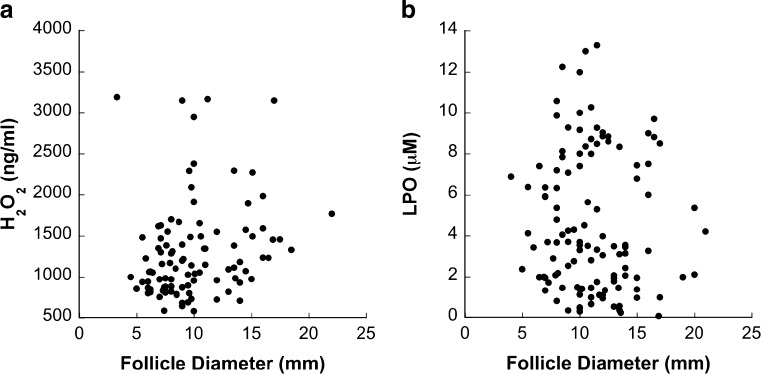
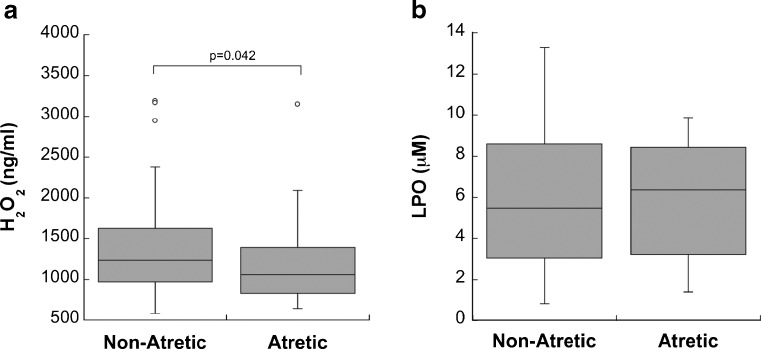
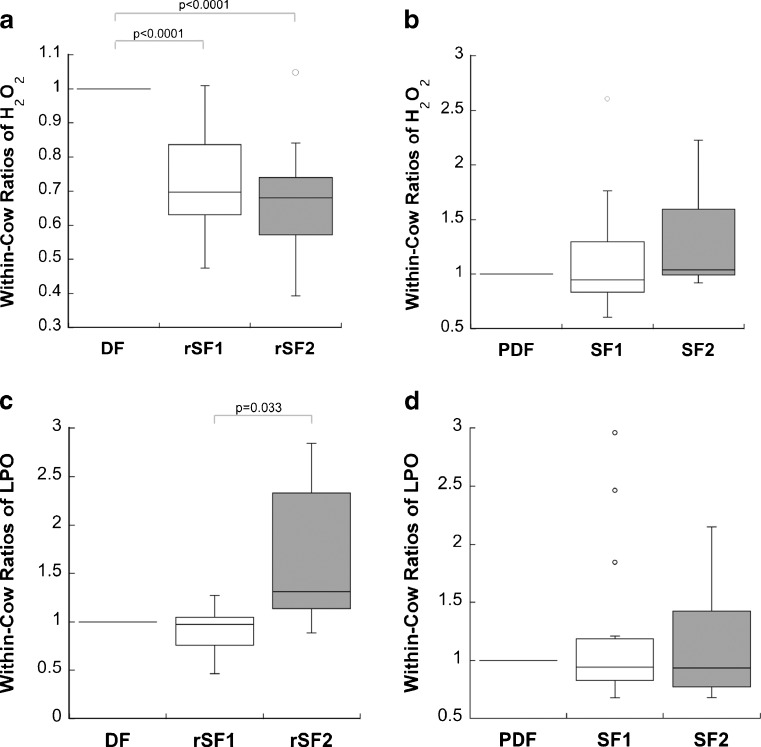
Results: Non-atretic follicles and dominant follicles contained more FF H2O2 than atretic follicles and corresponding subordinate follicles, respectively. FF LPO did not vary in relation to atretic status, and no difference existed between dominant and subordinate follicles. However, FF LPO was significantly lower in first subordinate follicles than in the second subordinate follicles from each ovary pair. Neither H2O2 nor LPO levels correlated with follicle size.

Conclusions: These data provide clear evidence that the events of antral folliculogenesis are relevant to ROS dynamics in vivo. Furthermore, such studies will help to optimize in vitro conditions for oocyte culture protocols, particularly when combined with a comparison of oocyte quality with respect to source follicle characteristics.


Figures

Fig. 1
Fig. 1
Detection of total DNA (blue), TUNEL (green), and cleaved Caspase-3 (red) in granulosa cells from three different antral follicles (ac). These three examples show an increased proportion of apoptotic cells from panels a through c, with no detectable apoptosis in a. Scale bar: 10 μm
Fig. 2
Fig. 2
H2O2 (a) and LPO (b) concentrations in follicular fluid across antral follicle growth (n = 103 and 117, respectively). There was no significant correlation between follicle size and H2O2 or LPO concentration
Fig. 3
Fig. 3
A comparison of H2O2 (a) and LPO (b) concentrations in non-atretic and atretic follicles. H2O2 concentration was significantly higher in non-atretic follicles than in atretic follicles (p = 0.042, n = 53 non-atretic follicles, n = 50 atretic follicles). There was no significant difference in LPO concentration between non-atretic and atretic follicles (n = 54 non-atretic follicles, n = 24 atretic follicles)
Fig. 4
Fig. 4
Proportional within-cow comparisons of H2O2 or LPO concentrations with respect to follicle dominance status. Ratios were derived for each follicle trio using the H2O2 or LPO concentration in the largest follicle as the base value. Dominant follicles (DF) are followed by regressing subordinate follicles (rSF1, rSF2) in (A) and (C), while partially dominant follicles (PDF) are followed by subordinate follicles (SF1, SF2) in (B) and (D). H2O2 concentrations were significantly higher in dominant follicles compared to their corresponding subordinate follicles (p < 0.0001 for both subordinate follicles, n = 14 cows) (a), whereas H2O2 concentrations in partially dominant follicles did not significantly differ from that in their subordinate follicles (n = 15 cows) (b). No significant difference existed in LPO concentrations between dominant follicles and the corresponding subordinate follicles (n = 7 cows). However, a significant difference in LPO concentration was found in these follicle sets between the largest subordinate follicles and the smaller subordinate follicles (p = 0.033) (c). No difference existed between partially dominant follicles and their subordinates (n = 15 cows) (d)

References

    1. Hennet ML, Combelles CMH. The antral follicle: a microenvironment for oocyte differentiation. Int J Dev Biol. 2013;In Press - PubMed
    1. Scaramuzzi RJ, Baird DT, Campbell BK, Driancourt MA, Dupont J, Fortune JE, et al. Regulation of folliculogenesis and the determination of ovulation rate in ruminants. Reprod Fertil Dev. 2011;23:444–67. doi: 10.1071/RD09161. - DOI - PubMed
    1. Nogueira D, Sadeu JC, Montagut J. In vitro oocyte maturation: current status. Semin Reprod Med. 2012;30:199–213. doi: 10.1055/s-0032-1311522. - DOI - PubMed
    1. Combelles CM, Gupta S, Agarwal A. Could oxidative stress influence the in-vitro maturation of oocytes? Reprod Biomed Online. 2009;18:864–80. doi: 10.1016/S1472-6483(10)60038-7. - DOI - PMC - PubMed
    1. Combelles CMH, Hennet ML. Oxidative stress in assisted reproductive technologies. In: Agarwal A, Rizk B, Aziz N, editors. Studies on women’s health: oxidative stress in applied basic research and clinical practice. New York: Humana Press, Springer Science and Business Media; 2013. pp. 205–36.

Publication types