. 2013 Feb;8(2):297-312.
doi: 10.1002/cmdc.201200520. Epub 2013 Jan 11.

Structure-activity relationship study reveals ML240 and ML241 as potent and selective inhibitors of p97 ATPase

Affiliations
Free PMC article

Structure-activity relationship study reveals ML240 and ML241 as potent and selective inhibitors of p97 ATPase

Tsui-Fen Chou et al. ChemMedChem. 2013 Feb.
Free PMC article

Abstract

To discover more potent p97 inhibitors, we carried out a structure-activity relationship study of the quinazoline scaffold previously identified from our HTS campaigns. Two improved inhibitors, ML240 and ML241, inhibit p97 ATPase with IC(50) values of 100 nM. Both compounds inhibited degradation of a p97-dependent but not a p97-independent proteasome substrate in a dual-reporter cell line. They also impaired the endoplasmic-reticulum-associated degradation (ERAD) pathway. Unexpectedly, ML240 potently stimulated accumulation of LC3-II within minutes, inhibited cancer cell growth, and rapidly mobilized the executioner caspases 3 and 7, whereas ML241 did not. The behavior of ML240 suggests that disruption of the protein homeostasis function of p97 leads to more rapid activation of apoptosis than is observed with a proteasome inhibitor. Further characterization revealed that ML240 has broad antiproliferative activity toward the NCI-60 panel of cancer cell lines, but slightly lower activity toward normal cells. ML240 also synergizes with the proteasome inhibitor MG132 to kill multiple colon cancer cell lines. Meanwhile, both probes have low off-target activity toward a panel of protein kinases and central nervous system targets. Our results nominate ML240 as a promising starting point for the development of a novel agent for the chemotherapy of cancer, and provide a rationale for developing pathway-specific p97 inhibitors.


Figures

Figure 1
Figure 1
Structures and p97 inhibitory activities for the HTS hit compounds 1 and DBeQ. IC50 values for inhibition of p97 ATPase activity and degradation of p97-dependent reporter (UbG76V–GFP) are shown.
Figure 2
Figure 2
Summary of the SAR leading to the discovery of ML240 and ML241: 200 analogues were tested, mainly exploring changes to R1 and R2.
Scheme 1
Scheme 1
General synthetic route to DBeQ analogues. Reagents and conditions: a) R2R3NH, Et3N, CH3CN, RT, 16 h; b) R4R5NH, CH3CN, microwave irradiation, 180 °C, 1 h.
Figure 3
Figure 3
Structures and p97 inhibitory activities for key analogues in the development of ML240 and ML241. IC50 values for inhibition of p97 ATPase activity and degradation of p97-dependent reporter UbG76V–GFP are shown.
Figure 4
Figure 4
ML240 and ML241 impair the endoplasmic-reticulum-associated degradation (ERAD) pathway, and only ML240 impairs the autophagy pathway and induces apoptosis. a) SW403 cells were treated with DMSO or compounds for 2 h. The indicated proteins were evaluated by immunoblotting cytosolic (Cyto) and nuclear plus membrane (NM) fractions. b) HEK293 cells stably expressing TCRα–GFP were used to determine the effect of ML240 and ML241 on the ERAD pathway. Cells were treated with MG132, washed, and then incubated in the presence of cycloheximide plus compounds for 2.5 h. The indicated proteins were evaluated by immunoblotting cytosolic (Cyto), nuclear plus membrane (NM) and insoluble (Ins) fractions. c) HEK293 cells were transfected with wild-type CFTR cDNA and treated with DMSO or compounds for 5 h. Cytosolic fractions were immunoblotted to detect CFTR, GAPDH, and LC3. d) HEK293 cells were transfected with F508Δ CFTR cDNA and treated with DMSO or compounds for 5 h. Cytosolic fractions were immunoblotted to detect CFTR, α-tubulin, and p21. e) HCT116 cells were treated with ML240 (10 μm) for 0–40 min, and samples were immunoblotted to detect the indicated proteins (ATF4: nuclear plus membrane fraction, p27 and LC3: cytosolic fraction). f) U2OS cells were transfected with negative control siRNA (NC) or p97 siRNA (10 nm) for 72 h, and degradation of the indicated proteins was determined by immunoblotting of total cell extracts after addition of cycloheximide (CHX) for 0, 1, and 2 h. g) HT29 cells were incubated with ML240 (0.4, 2, or 5 μm) for 0 to 23 h. The levels of the indicated proteins were determined by immunoblotting. (ATF4, CHOP, p27, and p21: nuclear plus membrane fraction, and LC3: cytosolic fraction).
Figure 5
Figure 5
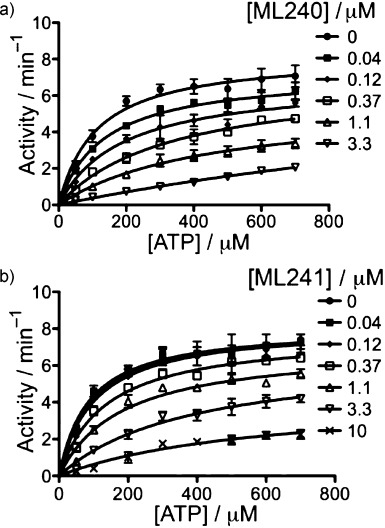
Michaelis–Menten plots for inhibition of p97 ATPase activity by a) ML240 and b) ML241.
Figure 6
Figure 6
ML240 induces activation of caspases 3 and 7 and apoptosis. a) MIN and CIN colon cancer lines were treated with ML240 (1.1, 3.3, 10, or 20 μm) for 7 h prior to determination of caspase 3 and 7 activities in cell extract. Caspase 3 and 7 activities were normalized to the intensity of DMSO treated cells. b) HCT116 cells were incubated with 10 μm DBeQ, ML240, STS (staurosporine) or 20 μm bortezomib for 3, 7, 10, or 20 h prior to determination of caspase 3 and 7 activities in the cell extract. c) Same as panel b, except HT29 cells were used. d) Colon cancer cell lines were treated with ML240 (10 μm) plus either DMSO, CHX (50 μm), MG132 (10 μm), Z-VAD (25 μm), or Nec-1 (20 μm) for 7 h prior to determination of caspase 3 and 7 activities in the cell extract. e) Same as panel d, except cellular viability was determined using CellTiter-Glo. f) Viability of HCT15 cells was determined using CellTiter-Glo after co-treatment with various concentrations of ML240 (0–20 μm) plus either DMSO, CHX (50 μm), MG132 (10 μm), Z-VAD (25 μm), or Nec-1 (20 μm) for 7 h.
Figure 7
Figure 7
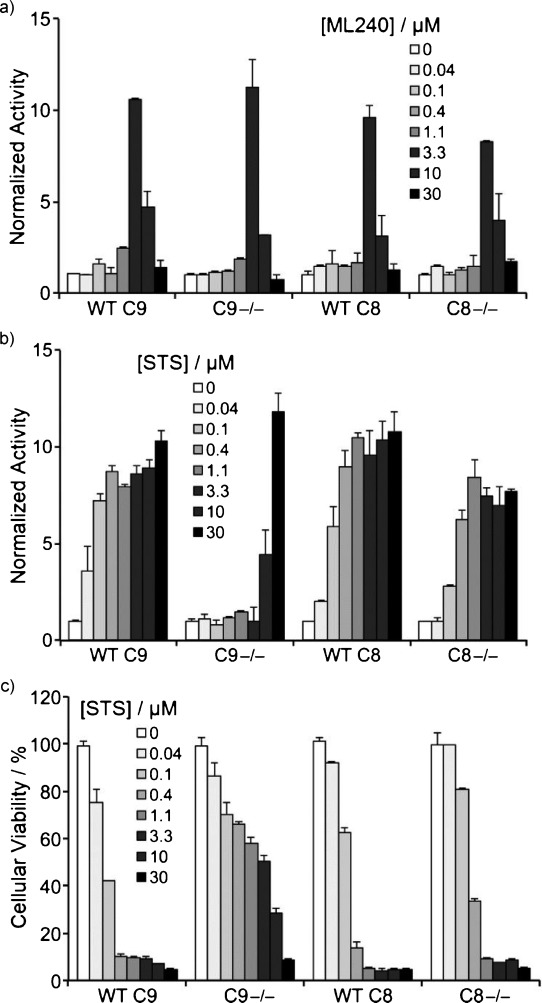
Cell death induced by ML240 is independent of caspases 8 and 9. Jurkat cells deficient in caspase 9 (C9−/−), C9−/− reconstituted with caspase 9 cDNA (WT C9), deficient in caspase 8 (C8−/−), or the parental clone (WT C8) were exposed to the indicated concentrations of a) ML240 or b) staurosporine (STS) for 8.5 h prior to determination of caspase 3 and 7 activities in the cell extract, and caspase 3 and 7 activities were normalized to the intensity of DMSO treated cells. c) Same as panel b, except incubation was for 24 h prior to determining cellular viability.
Figure 8
Figure 8
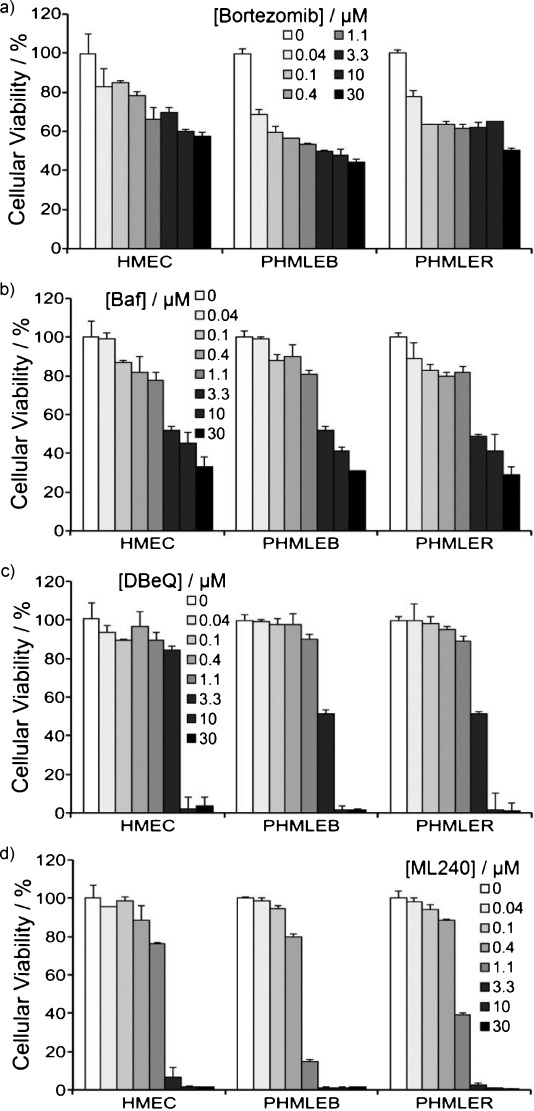
ML240 and DBeQ exhibit a modest therapeutic index. HMEC (primary human mammary epithelial cells), PHMLEB (sv40 and hTert immortalized), and PHMLER (H-Ras tumorigenic) cells were incubated with the indicated concentrations of a) bortezomib, b) bafilomycin (Baf), c) DBeQ, or d) ML240 for 24 h. Cellular viability was determined using CellTiter-Glo. Cellular viability was normalized to DMSO treated cells.
Figure 9
Figure 9
Binding affinity (Ki [nm]) for DBeQ, ML240, and ML241 toward 43 CNS-relevant targets.

References

    1. Giaever G, et al. Nature. 2002;418:387–391. - PubMed
    1. Müller JM, Deinhardt K, Rosewell I, Warren G, Shima DT. Biochem. Biophys. Res. Commun. 2007;354:459–465. - PubMed
    1. Kondo H, Rabouille C, Newman R, Levine TP, Pappin D, Freemont P, Warren G. Nature. 1997;388:75–78. - PubMed
    1. Golbik R, Lupas AN, Koretke KK, Baumeister W, Peters J. Biol. Chem. 1999;380:1049–1062. - PubMed
    1. Rabouille C, Levine TP, Peters JM, Warren G. Cell. 1995;82:905–914. - PubMed

Publication types

MeSH terms