. 2013 Mar;195(6):1335-45.
doi: 10.1128/JB.02176-12. Epub 2013 Jan 11.

Antibiotic resistance acquired through a DNA damage-inducible response in Acinetobacter baumannii

Affiliations

Antibiotic resistance acquired through a DNA damage-inducible response in Acinetobacter baumannii

Matthew D Norton et al. J Bacteriol. 2013 Mar.

Abstract

Acinetobacter baumannii is an emerging nosocomial, opportunistic pathogen that survives desiccation and quickly acquires resistance to multiple antibiotics. Escherichia coli gains antibiotic resistances by expressing genes involved in a global response to DNA damage. Therefore, we asked whether A. baumannii does the same through a yet undetermined DNA damage response akin to the E. coli paradigm. We found that recA and all of the multiple error-prone DNA polymerase V (Pol V) genes, those organized as umuDC operons and unlinked, are induced upon DNA damage in a RecA-mediated fashion. Consequently, we found that the frequency of rifampin-resistant (Rif(r)) mutants is dramatically increased upon UV treatment, alkylation damage, and desiccation, also in a RecA-mediated manner. However, in the recA insertion knockout strain, in which we could measure the recA transcript, we found that recA was induced by DNA damage, while uvrA and one of the unlinked umuC genes were somewhat derepressed in the absence of DNA damage. Thus, the mechanism regulating the A. baumannii DNA damage response is likely different from that in E. coli. Notably, it appears that the number of DNA Pol V genes may directly contribute to desiccation-induced mutagenesis. Sequences of the rpoB gene from desiccation-induced Rif(r) mutants showed a signature that was consistent with E. coli DNA polymerase V-generated base-pair substitutions and that matched that of sequenced A. baumannii clinical Rif(r) isolates. These data strongly support an A. baumannii DNA damage-inducible response that directly contributes to antibiotic resistance acquisition, particularly in hospitals where A. baumannii desiccates and tenaciously survives on equipment and surfaces.


Figures
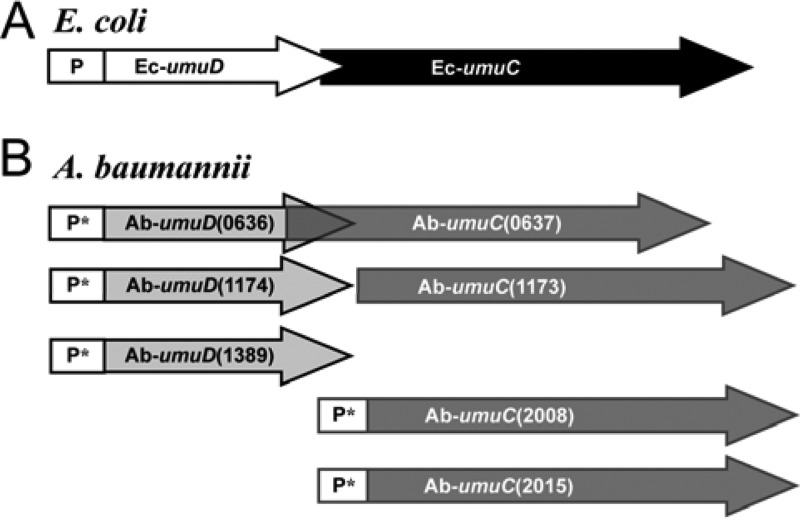
Fig 1
Fig 1
The A. baumannii ATCC 17978 predicted umuC and umuD genes are organized differently in A. baumannii ATCC 17978 than they are in E. coli. (A) There is one umuDC operon in the E. coli (Ec) chromosome in which the umuD ORF is expressed approximately 10-fold better than umuC due to a −1 frameshift between the two ORFs (17). This frameshift in the gene is depicted as overlapping arrows. (B) A. baumannii ATCC 17978 (Ab) has two putative umuDC operons in an organization similar to the one in E. coli, but within the umuDC(0636 to 0637) operon there is an overlap between the umuD and umuC genes of 20 nucleotides (depicted by overlapping arrows). In the umuDC(1174 to 1173) operon, we find no overlap between the two predicted genes. There are also two unlinked predicted umuC genes and one unlinked predicted umuD gene. For easier identification, locus tags (“A1S_” is not included before the numbers) are included as part of each A. baumannii gene name. Arrows represent predicted ORFs, and white boxes represent promoter (P) or putative promoter (P*) regions.
Fig 2
Fig 2
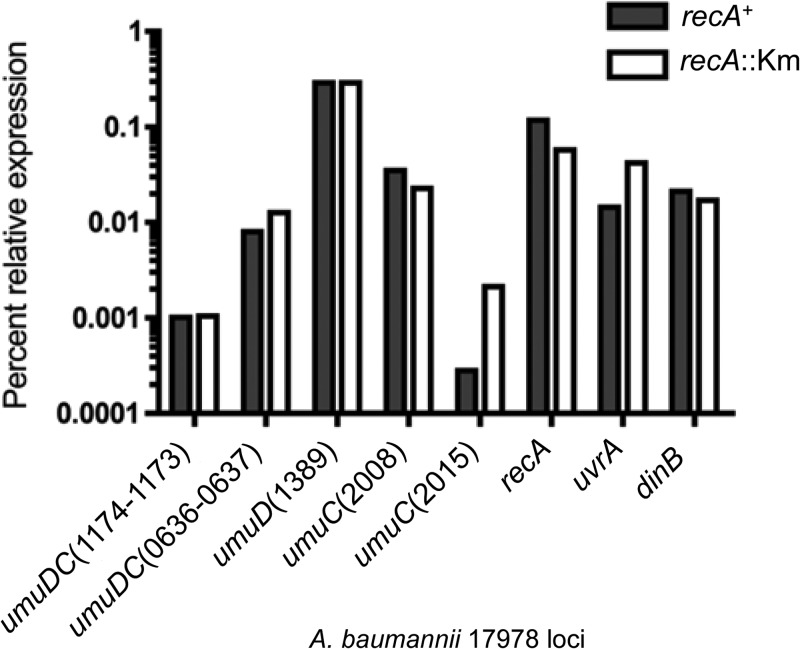
Representative, evolutionarily conserved DNA damage response genes are expressed in A. baumannii ATCC 17978. The predicted genes encoding DNA damage response genes are all expressed in the recA+ strain, though at different levels. The relative expression of each gene is shown as a percentage of the level of expression of 16S rRNA, a standard housekeeping gene. In the recA::Km strain, most genes analyzed had no detectable change in relative basal-level gene expression. Some genes showed modest detectable decreases and modest to moderate increases in expression, which suggests a role for RecA in gene regulation. Semiquantitative RT-PCR was performed on total RNA purified from untreated cultures of A. baumannii ATCC 17978. See Materials and Methods for details of this experimental procedure. Gene-specific RT-PCR primers were used to amplify approximately 300 bp of either the unique junctions between the umuD and umuC genes organized as operons or unique sequences of the unlinked genes. Locus tags from the A. baumannii ATCC 17978 genome (“A1S_” is not included before the numbers) are included as part of the umuD and umuC names. Data from a representative experiment are shown.
Fig 3
Fig 3
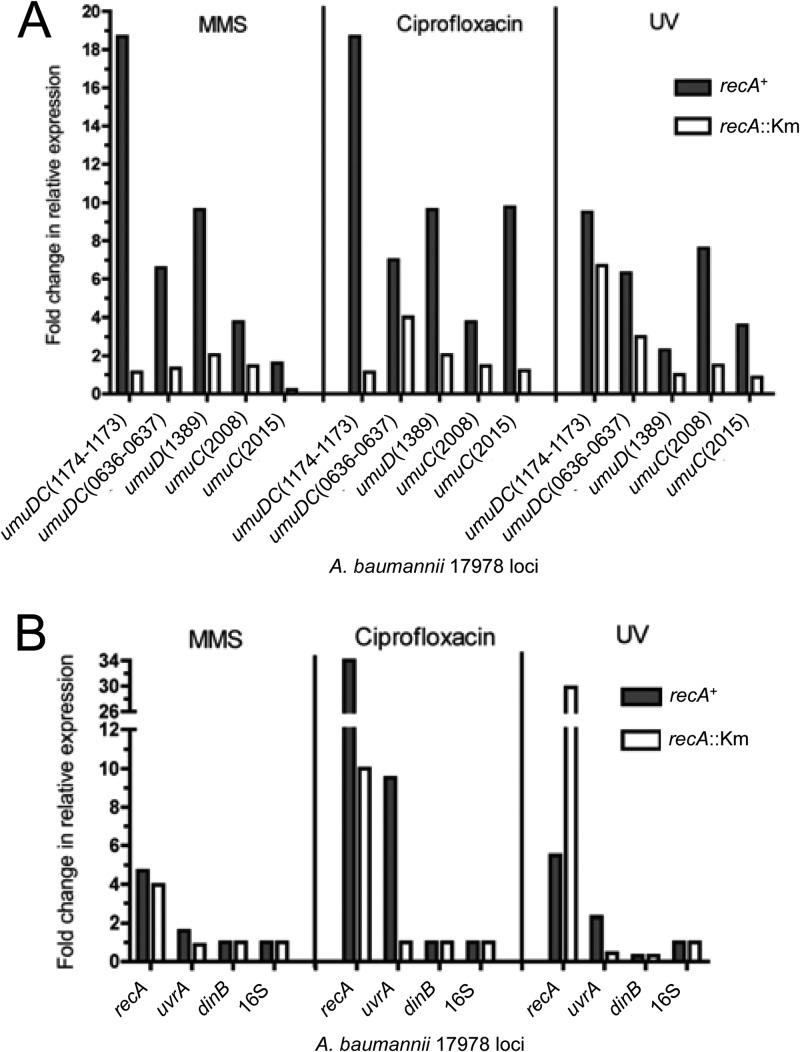
The predicted A. baumannii TLS DNA polymerases and other DNA damage response genes are induced by DNA damage and regulated by RecA. (A) Expression of putative DNA polymerase V genes. All umuD and umuC loci are upregulated upon MMS, ciprofloxacin, or UV light treatment in the recA+ strain. In the recA::Km strain, most genes have no change in expression, which is denoted as a fold change of 1. We also observed increased expression for some of the genes, though it was lower than that in the recA+ strain. (B) Expression of other DNA damage response genes. The three DNA-damaging conditions examined resulted in upregulation of recA and uvrA in the recA+ strain. uvrA is regulated by RecA, as shown by its high expression in the recA+ strain. Notably, a large increase in recA expression is seen in the UV-treated recA::Km strain. There is no increase in expression of dinB or the 16S rRNA control in either strain. The recA+ and recA::Km strains were treated with 25 mM and 1.5 mM MMS, respectively, for 1 h; 6 μg ml−1 and 1 μg ml−1 of ciprofloxacin, respectively, for 1 h; and 270 J m−2 and 5 J m−2 of UV light, respectively. Semiquantitative RT-PCR was performed on total RNA purified from treated and untreated cultures as described in the Fig. 2 legend and Materials and Methods. Locus tags from the A. baumannii ATCC 17978 genome (“A1S_” is not included before the numbers) are included as part of the gene names. Data from a representative experiment are shown.
Fig 4
Fig 4
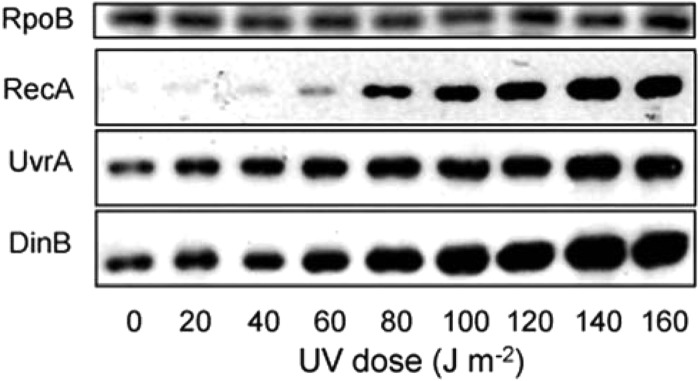
Intracellular concentrations of A. baumannii ATCC 17978 DNA damage-inducible proteins increase upon UV irradiation. At 160 J m−2, there was 40-fold more RecA protein, 2.5-fold more UvrA, and 3-fold more DinB than for the untreated samples, while RpoB remained constant. A. baumannii cultures were grown to exponential phase, as indicated in Materials and Methods, and irradiated with increasing amounts of UV (J m−2). Equal amounts of whole-cell lysates per treatment were probed with polyclonal anti-RecA, polyclonal anti-UvrA, polyclonal anti-DinB, and monoclonal anti-RpoB antibodies (refer to Materials and Methods). Antibodies used were raised against the E. coli proteins. A comparative experiment using the isogenic recA::Km strain could not be performed due to its extreme sensitivity to UV irradiation.
Fig 5
Fig 5
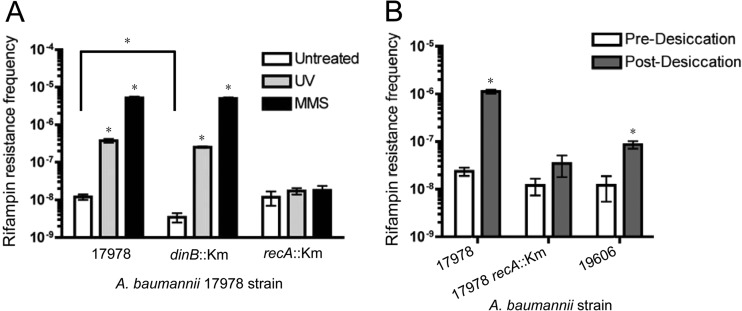
Mutation frequency is elevated upon treatment with DNA-damaging agents or upon desiccation in a recA-dependent manner. (A) The A. baumannii ATCC 17978 strain has a higher frequency of rifampin-resistant mutants upon both UV and MMS treatment than untreated cultures. There is no significant increase in induced mutation frequency for the isogenic recA::Km strain. The isogenic dinB::Km strain shows a modest but significant decrease (3.5-fold) in spontaneous mutants than the parental strain but has the same frequency of induced rifampin-resistant mutants as the parental strain upon both treatments. There is also no significant difference in the spontaneous mutation frequency between untreated recA::Km and dinB::Km strains. Error bars represent the standard errors of the means for at least 3 independently tested cultures, and statistical significance was determined using a Student t test. A statistically significant increase in mutation frequency between treated and untreated cultures (P ≤ 0.02) is indicated (*). (B) A. baumannii ATCC 17978 has a dramatically increased frequency of rifampin-resistant mutants after desiccation only in a recA+ background. The A. baumannii ATCC 17978 recA::Km strain showed no difference in predesiccation to postdesiccation rifampin-resistant mutants (P = 0.2). A. baumannii ATCC 19606, a strain containing fewer isogenic umuD and umuC genes than the A. baumannii ATCC 17978 strain, has an increased desiccation-induced Rifr frequency but fewer Rifr mutants than the A. baumannii ATCC 17978 recA+ strain. A statistically significant increase in mutation frequency between postdesiccation and predesiccation cultures (P < 0.01) is indicated (*). A. baumannii ATCC 17978 and ATCC 19606 cells were desiccated for 24 h, resulting in 3- to 5-fold killing compared to that for nondesiccated cells. Cells were then rehydrated in LB medium, outgrown, and deposited on plates with rifampin (100 μg ml−1). The recA::Km strain, treated for 6 h, was killed 15-fold compared to the level of killing for nondesiccated cells. A. baumannii ATCC 17978 recA+ cultures at 15-fold killing showed no difference in mutation frequency compared to that for the cultures that resulted in 3- to 5-fold killing (not shown). Error bars represent the standard errors of the means for at least 5 independently tested cultures. Statistical significance was determined using a Student t test.

References

    1. Bergogne-Berezin E, Friedman H, Bendinelli M. 2008. Acinetobacter biology and pathogenesis, vol xvi Springer-Verlag, New York, NY
    1. Gerischer U. 2008. Acinetobacter molecular biology. Caister Academic Press, Norfolk, United Kingdom
    1. Jawad A, Seifert H, Snelling AM, Heritage J, Hawkey PM. 1998. Survival of Acinetobacter baumannii on dry surfaces: comparison of outbreak and sporadic isolates. J. Clin. Microbiol. 36:1938–1941 - PMC - PubMed
    1. Kramer A, Schwebke I, Kampf G. 2006. How long do nosocomial pathogens persist on inanimate surfaces? A systematic review. BMC Infect. Dis. 6:130 doi:10.1186/1471-2334-6-130 - DOI - PMC - PubMed
    1. Neely AN. 2000. A survey of gram-negative bacteria survival on hospital fabrics and plastics. J. Burn Care Rehab. 21:523–527 - PubMed

Publication types

MeSH terms