. 2013 Mar 1;304(5):L342-9.
doi: 10.1152/ajplung.00151.2012. Epub 2013 Jan 11.

HMGB1 promotes neutrophil extracellular trap formation through interactions with Toll-like receptor 4

Affiliations

HMGB1 promotes neutrophil extracellular trap formation through interactions with Toll-like receptor 4

Jean-Marc Tadie et al. Am J Physiol Lung Cell Mol Physiol. .

Abstract

Although neutrophil extracellular traps (NETs) form to prevent dissemination of pathogenic microorganisms, excessive release of DNA and DNA-associated proteins can also perpetuate sterile inflammation. In this study, we found that the danger-associated molecular pattern protein high-mobility group box 1 (HMGB1) can induce NET formation. NET formation was found after exposure of wild-type and receptor for advanced glycation end products-deficient neutrophil to HMGB1, whereas deficiency of Toll-like receptor (TLR)4 diminished the ability of neutrophils to produce NETs. Incubation of neutrophils with HMGB1 significantly increased the amount of DNA and histone 3 released as well as intracellular histone 3 citrullination, a signaling event that precedes chromatin decondensation. In vivo, neutrophils isolated from bronchoalveolar lavages of mice exposed to LPS and HMGB1 showed consistently greater ability to produce NETs compared with pulmonary neutrophils from mice that received LPS alone. In contrast, mice treated with LPS and neutralizing antibody to HMGB1 had decreased amounts of the inflammatory cytokines TNF-α and macrophage inflammatory protein 2, as well as of free DNA and histone 3 in bronchoalveolar lavage fluids. Airway neutrophils from LPS-exposed mice that had been treated with anti-HMGB1 antibodies showed decreased citrullination of histone 3. These results demonstrate that interactions between HMGB1 and TLR4 enhance the formation of NETs and provide a novel mechanism through which HMGB1 may contribute to the severity of neutrophil-associated inflammatory conditions.


Figures
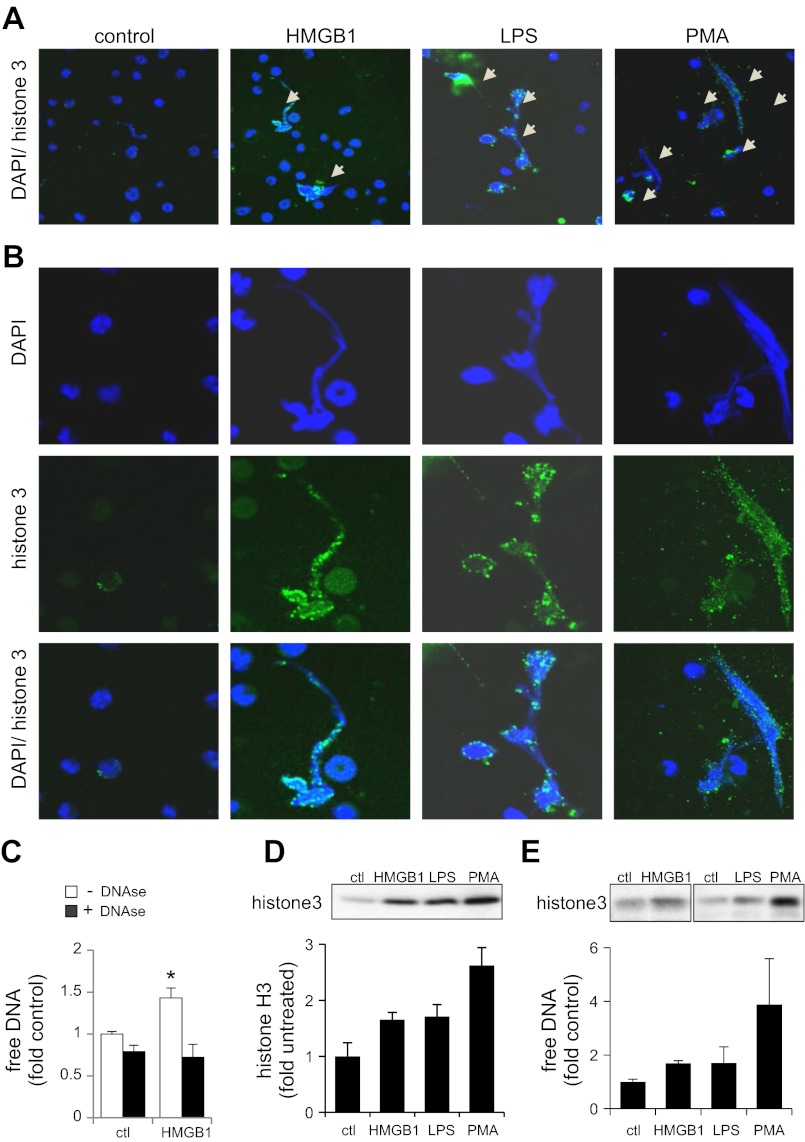
Fig. 1.
Fig. 1.
High-mobility group box 1 (HMGB1) induces neutrophil extracellular trap (NET) formation. Bone marrow neutrophils were incubated in 0.5% serum containing HMGB1 (0 or 300 ng/ml), LPS (100 ng/ml), or phorbol myristate acetate (PMA) (10 nM) for 3 h. A: representative images show merged neutrophil DNA (blue) and histone H3 (green) staining. Arrows show NET formation. B: image magnifications obtained from A with indication of NETs and extracellular histone H3. C: neutrophils were treated with HMGB1 (0 or 300 ng/ml) for 3 h followed by inclusion of DNAse (0 or 200 U/ml) for 30 min. Free DNA was then measured using Sytox Green probe. Means ± SD were obtained from 3 independent experiments. D: neutrophils were incubated with HMGB1 (0 or 300 ng/ml), LPS (100 ng/ml), or PMA (10 ng/ml) for 3 h followed by inclusion of DNAse (0 or 200 U/ml) in the cultures for additional 30 min. The culture supernatant was then collected for analysis by Western blot with antibodies to histone H3. Representative Western blots and means ± SD of band optical densitometry obtained from 2 independent experiments are shown. E: human neutrophils were treated as indicated in C followed by measurement of free DNA and Western blot analysis with antihistone 3 antibody. Means ± SD obtained from 2 experiments are shown. *P < 0.05
Fig. 2.
Fig. 2.
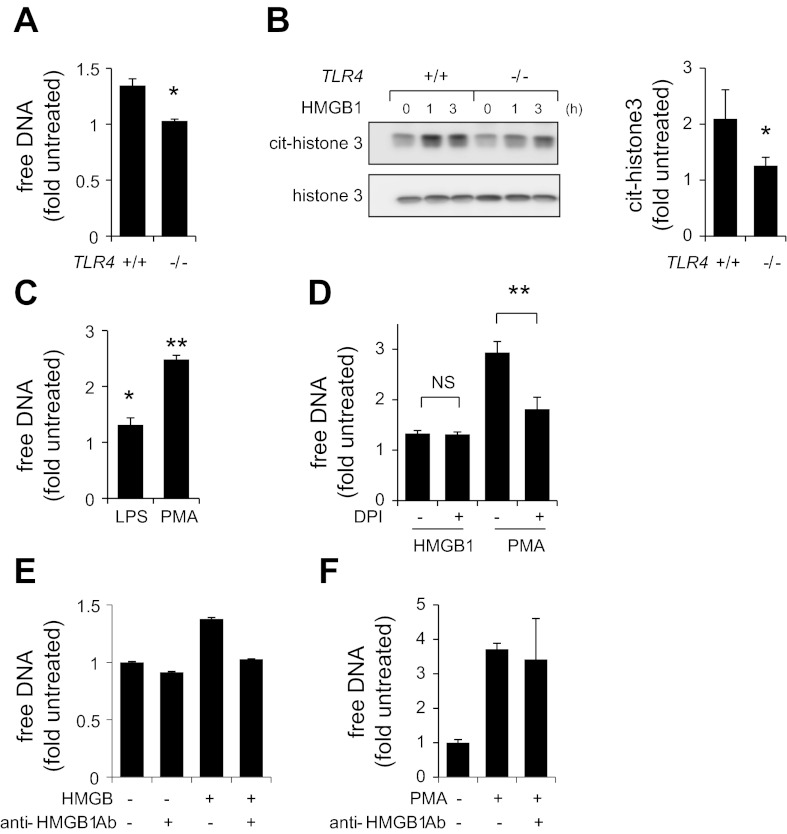
Toll-like receptor (TLR)4 deficiency diminished DNA release from HMGB1-treated neutrophils. A: free DNA was determined in culture medium collected from wild-type (TLR4+/+) or TLR4-deficient (TLR4−/−) neutrophils that were incubated with or without HMGB1 (300 ng/ml) for 3 h (means ± SD, n = 3; *P < 0.05 compared with untreated samples). B: TLR4+/+ or TLR4−/− neutrophils were treated with HMGB1 (300 ng/ml) for 0, 1, or 3 h. Representative Western blots and optical bend density show level of citrullinated histone 3 (cit-H3) and total amount of histone 3 (H3). Means ± SD were calculated after 3 h of exposure to HMGB1; n = 3; *P < 0.05 compared with untreated cells. C: neutrophils were treated with LPS (100 ng/ml) for 3 h or PMA (10 nM) for 3 h followed by measurement of free DNA (Means ± SD, n = 3; *P < 0.05, **P < 0.01 compared with untreated cells). D: free DNA in culture medium was determined after subsequent exposure of neutrophils to diphenyleneiodonium (DPI) (0 or 20 μM) for 3 min followed by treatment with HMGB1 (300 ng/ml) or PMA (10 nM) for 3 h. (Means ± SD, n = 3; **P < 0.01) NS, not significant. E: HMGB1 (0 or 300 ng) was incubated with anti-HMGB1 (neutralizing) antibody (0 or 10 μg) for 30 min at room temperature. Next, samples were incubated with neutrophils for additional 3 h followed by measurement of free DNA. F: neutrophils were treated with anti-HMGB1 (neutralizing) antibody (0 or 10 μg) or PMA (0 or 10 nM), or PMA and anti-HMGB1 antibody for 3 h. Free DNA was measured using Sytox Green.
Fig. 3.
Fig. 3.
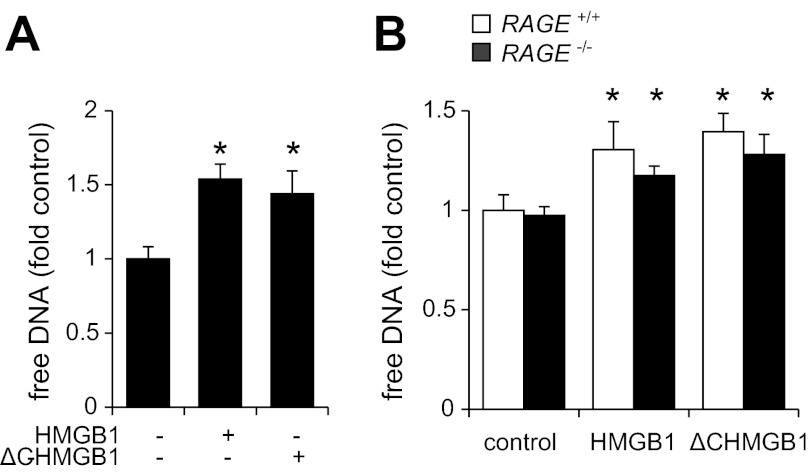
Effects of receptor for advanced glycation end products (RAGE) deficiency on HMGB1-mediated NET formation. Free DNA was determined after exposure of neutrophils to HMGB1 (0 or 300 ng/ml) or ΔC HMGB1 (0 or 300 ng/ml) for 3 h (A), or after treatment of wild-type (RAGE+/+) or RAGE-deficient (RAGE−/−) neutrophils with or without HMGB1 (300 ng/ml) for 3 h (B). Means ± SD, n = 3; *P < 0.05 compared with untreated sample (control).
Fig. 4.
Fig. 4.
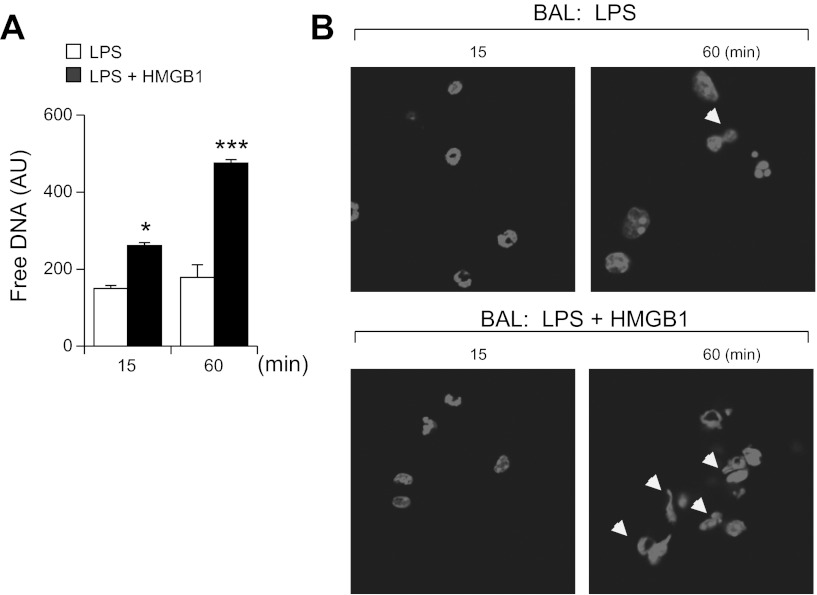
HMGB1 facilitates NET formation ex vivo. A: neutrophils in bronchoalveolar lavages (BALs) were collected 24 h after intratracheal administration of LPS (1 mg/kg) or LPS and HMGB1 (300 ng), and free DNA was determined in BAL neutrophils that were immediately incubated after isolation for 15 or 60 min followed by addition of Sytox probe for 5 min. Means ± SD, n = 3; *P < 0.05 or ***P < 0.001 compared with BALs of mice that were not subjected to HMGB1 administration. B: representative images show NET formation ex vivo (arrows) in BALs obtained from mice treated with LPS or LPS/HMGB1 as indicated in A. BAL neutrophils were incubated immediately after isolation for 15 and 60 min and then DNA stained with DAPI.
Fig. 5.
Fig. 5.
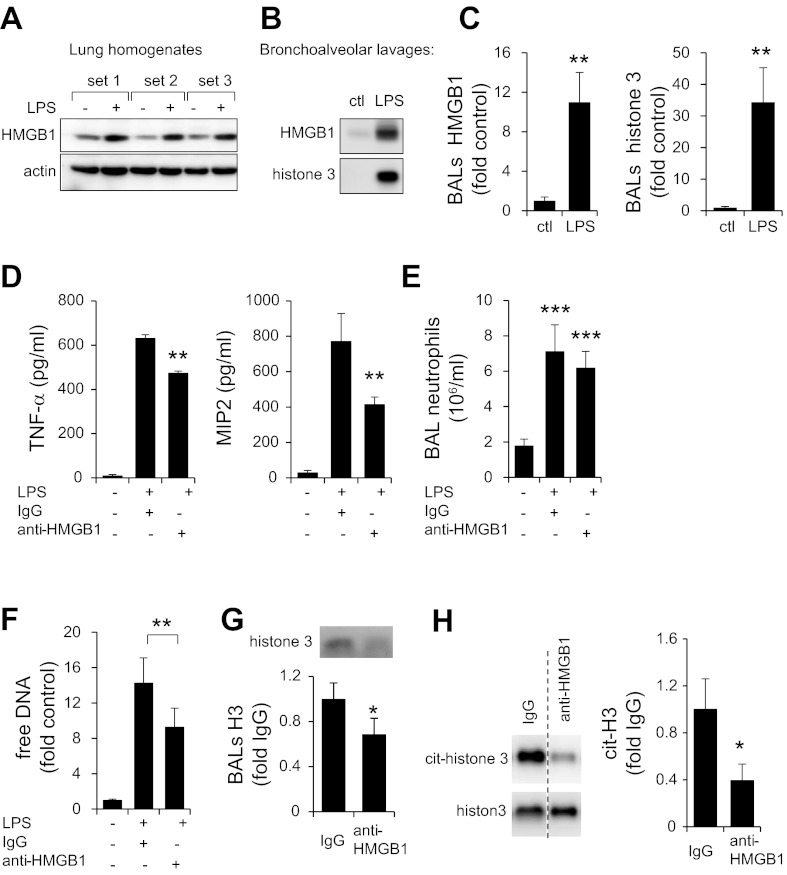
Effects of HMGB1-neutralizing antibody on NET formation. Representative Western blot and quantitative analysis show amount of HMGB1 and actin determined in whole lung homogenates (A), whereas amounts of HMGB1 and histone 3 detected in BALs obtained from control and mice subjected to LPS induced ALI are also shown (B and C). Lungs were harvested 24 h after saline (control) or LPS (i.t.) administration. D and E: levels of TNF-α and macrophage inflammatory protein (MIP)2 cytokines (D) and numbers of neutrophils (E) were measured in BALs of control mice (saline) or mice that received LPS and IgG or LPS and HMGB1-neutralizing antibody. Means ± SD, n = 4; **P < 0.05, ***P < 0.001. F: free DNA in BAL neutrophils using Sytox Green probe. Means ± SD, n = 3; **P < 0.05. G: representative Western blots and quantitative analysis show amounts of histone 3 found in BALs obtained 24 h after exposure of mice to LPS and treatment with IgG or anti-HMGB1 antibodies. H: Western blot of citrullinated histone 3 (cit-histone 3) and total histone 3 determined in cell extracts that were prepared from BAL neutrophils isolated from mice subjected to LPS (i.t.) and anti-HMGB1 antibody (i.p.) or LPS (i.t.) and IgG (i.p.) administration. Means ± SD, n = 4; *P < 0.05 compared with LPS- and IgG-treated cells.

References

    1. Andersson U, Tracey KJ. HMGB1 is a therapeutic target for sterile inflammation and infection. Annu Rev Immunol 29: 139–162, 2011 - PMC - PubMed
    1. Bae HB, Zmijewski JW, Deshane JS, Tadie JM, Chaplin DD, Takashima S, Abraham E. AMP-activated protein kinase enhances the phagocytic ability of macrophages and neutrophils. FASEB J 25: 4358–4368, 2011 - PMC - PubMed
    1. Banerjee S, Friggeri A, Liu G, Abraham E. The C-terminal acidic tail is responsible for the inhibitory effects of HMGB1 on efferocytosis. J Leukoc Biol 88: 973–979, 2010 - PMC - PubMed
    1. Barnay-Verdier S, Fattoum L, Borde C, Kaveri S, Gibot S, Marechal V. Emergence of autoantibodies to HMGB1 is associated with survival in patients with septic shock. Intens Care Med 37: 957–962, 2011 - PubMed
    1. Berthelot F, Fattoum L, Casulli S, Gozlan J, Marechal V, Elbim C. The effect of HMGB1, a damage-associated molecular pattern molecule, on polymorphonuclear neutrophil migration depends on its concentration. J Innate Immun 4: 41–58, 2012 - PubMed

Publication types

MeSH terms

LinkOut - more resources