


The role of fear of movement in subacute whiplash-associated disorders grades I and II
- PMID: 23318127
- PMCID: PMC3582794
- DOI: 10.1016/j.pain.2012.11.011
The role of fear of movement in subacute whiplash-associated disorders grades I and II
Abstract
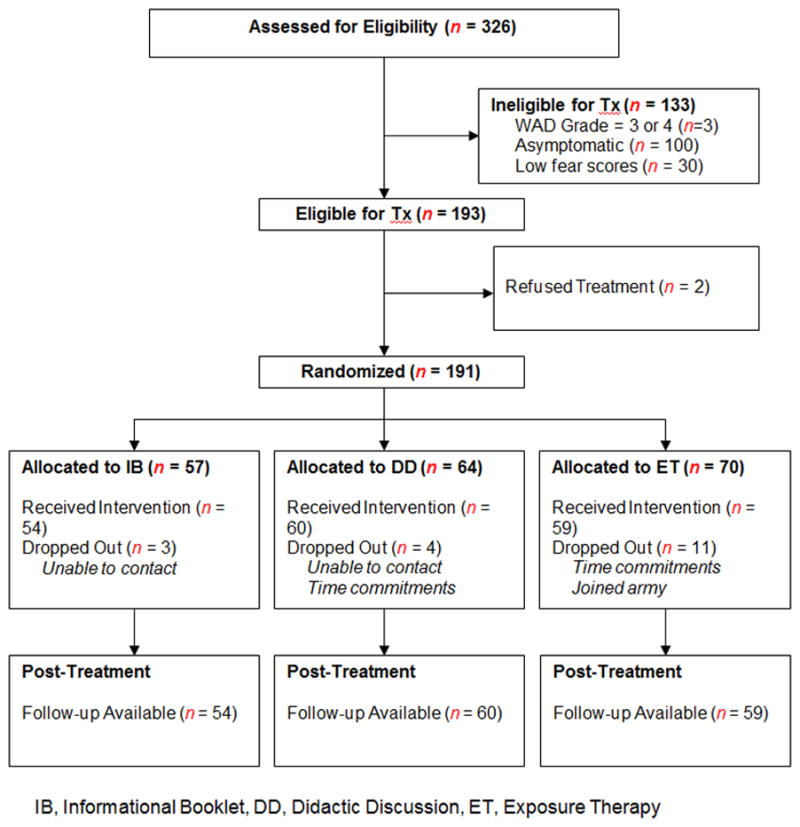
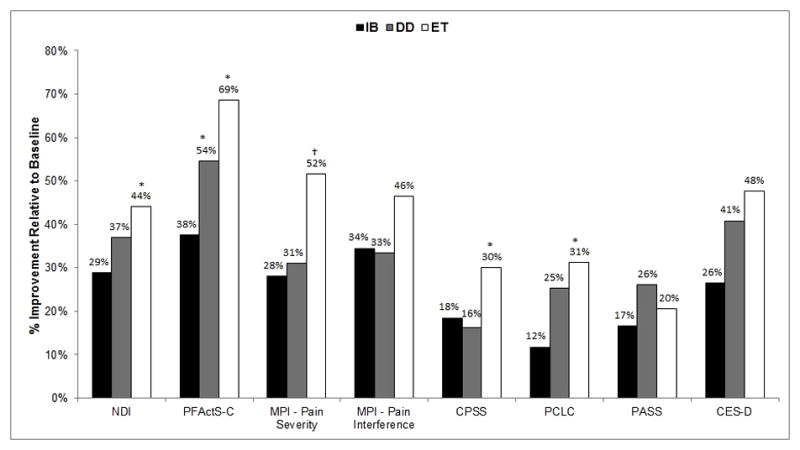
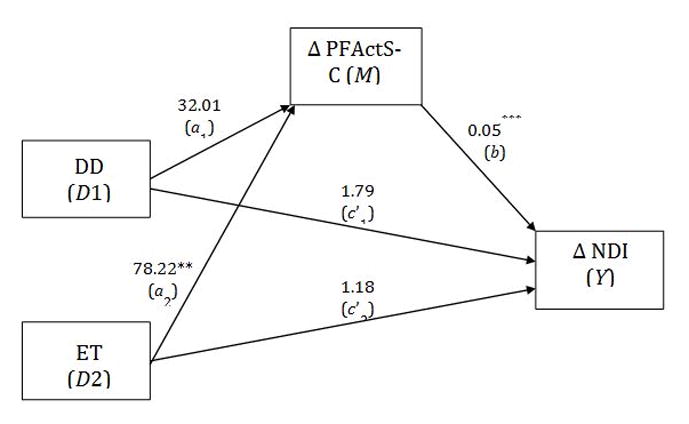
Fear and avoidance of activity may play a role in fostering disability in whiplash-associated disorders (WAD). This study examined the role of fear after WAD and assessed the effectiveness of 3 treatments targeting fear. People still symptomatic from WAD grade I-II injuries approximately 3months previously (n=191) completed questionnaires (eg, Neck Disability Index [NDI]) and were randomized to 1 of the treatments: (1) informational booklet (IB) describing WAD and the importance of resuming activities, (2) IB+didactic discussions (DD) with clinicians reinforcing the booklet, and (3) IB+imaginal and direct exposure desensitization (ET) to feared activities. DD and ET participants received three 2-hour treatment sessions. Absolute improvements in NDI were in predicted direction (ET=14.7, DD=11.9, IB=9.9). ETs reported significantly less posttreatment pain severity compared with the IB (Mean=1.5 vs 2.3, P<.001, d=0.6) and DD (M=1.5 vs 2.0, P=.039, d=0.6) groups. Reduction in fear was the most important predictor of improvement in NDI (β=0.30, P<.001), followed by reductions in pain (β=0.20, P=.003) and depression (β=0.18, P=.004). The mediational analysis confirmed that fear reduction significantly mediated the effect of treatment group on outcome. Results highlight the importance of fear in individuals with subacute WAD and suggest the importance of addressing fear via exposure therapy and/or educational interventions to improve function.
Trial registration: ClinicalTrials.gov NCT00021476.
Copyright © 2012 International Association for the Study of Pain. Published by Elsevier B.V. All rights reserved.
Conflict of interest statement
Conflict of Interest: There is no conflict of interest associated with any of the co-authors of this manuscript.
Figures
Comment in
-
Fear reduction in subacute whiplash-associated disorders: the royal road to recovery?Pain. 2013 Mar;154(3):330-331. doi: 10.1016/j.pain.2013.01.004. Epub 2013 Jan 11. Pain. 2013. PMID: 23391697 No abstract available.
-
Cure by fiat?Pain. 2013 Oct;154(10):2235-2237. doi: 10.1016/j.pain.2013.07.008. Epub 2013 Jul 16. Pain. 2013. PMID: 23872118 No abstract available.
-
Whiplash disorder--is it a valid disease definition?Pain. 2013 Oct;154(10):2235. doi: 10.1016/j.pain.2013.06.047. Epub 2013 Jul 17. Pain. 2013. PMID: 23872311 No abstract available.
References
-
- Anderson KO, Dowds BN, Pelletz RE, Edwards WT, Peeters-Asdourian C. Development and initial validation of a scale to measure self-efficacy beliefs in patients with chronic pain. Pain. 1995;63(1):77–84. - PubMed
-
- Barnsley L, Lord S, Bogduk N. Whiplash injury. Pain. 1994;58(3):283–307. - PubMed
-
- Buitenhuis J, de Jong PJ. Fear avoidance and illness beliefs in post-traumatic neck pain. Spine (Phila Pa 1976) 2011;36(25 Suppl):S238–243. - PubMed
-
- Buitenhuis J, de Jong PJ, Jaspers JPC, Groothoff JW. Relationship between posttraumatic stress disorder symptoms and the course of whiplash complaints. J Psychosom Res. 2006;61(5):681–689. - PubMed
-
- Buitenhuis J, Jaspers JPC, Fidler V. Can kinesiophobia predict the duration of neck symptoms in acute whiplash? Clin J Pain. 2006;22(3):272–277. - PubMed
Publication types
MeSH terms
Associated data
Grants and funding
LinkOut - more resources
Full Text Sources
Other Literature Sources
Medical
