Safety of withholding anticoagulation in pregnant women with suspected deep vein thrombosis following negative serial compression ultrasound and iliac vein imaging
- PMID: 23318405
- PMCID: PMC3589327
- DOI: 10.1503/cmaj.120895
Safety of withholding anticoagulation in pregnant women with suspected deep vein thrombosis following negative serial compression ultrasound and iliac vein imaging
Abstract
Background: Compression ultrasonography performed serially over a 7-day period is recommended for the diagnosis of deep vein thrombosis in symptomatic pregnant women, but whether this approach is safe is unknown. We evaluated the safety of withholding anticoagulation from pregnant women with suspected deep vein thrombosis following negative serial compression ultrasonography and iliac vein imaging.
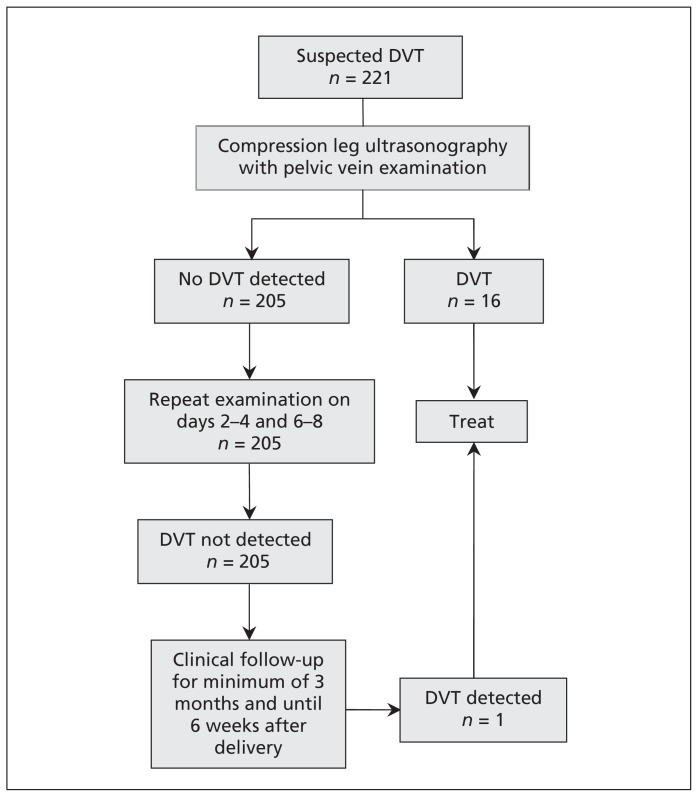
Methods: Consecutive pregnant women who presented with suspected deep vein thrombosis underwent compression ultrasonography and Doppler imaging of the iliac vein of the symptomatic leg(s). Women whose initial test results were negative underwent serial testing on 2 occasions over the next 7 days. Women not diagnosed with deep vein thrombosis were followed for a minimum of 3 months for the development of symptomatic deep vein thrombosis or pulmonary embolism.
Results: In total, 221 pregnant women presented with suspected deep vein thrombosis. Deep vein thrombosis was diagnosed in 16 (7.2%) women by initial compression ultrasonography and Doppler studies; none were identified as having deep vein thrombosis on serial testing. One patient with normal serial testing had a pulmonary embolism diagnosed 7 weeks later. The overall prevalence of deep vein thrombosis was 7.7% (17/221); of these, 65% (11/17) of cases were isolated to the iliofemoral veins and 12% (2/17) were isolated iliac deep vein thromboses. The incidence of venous thromboembolism during follow-up was 0.49% (95% confidence interval [CI] 0.09%-2.71%). The sensitivity of serial compression ultrasonography with Doppler imaging was 94.1% (95% CI 69.2%-99.7%), the negative predictive value was 99.5% (95% CI 96.9%-100%), and the negative likelihood ratio was 0.068 (95% CI 0.01-0.39).
Interpretation: Serial compression ultrasonography with Doppler imaging of the iliac vein performed over a 7-day period excludes deep-vein thrombosis in symptomatic pregnant women.
Figures
References
-
- Heijboer H, Buller HR, Lensing AWA, et al. A comparison of real-time compression ultrasonography with impedance plethysmography for the diagnosis of deep vein thrombosis in symptomatic outpatients. N Engl J Med 1993;19:1365–9 - PubMed
-
- Cogo A, Lensing AWA, Pradoni P, et al. Distribution of thrombosis in patients with symptomatic deep vein thrombosis. Arch Intern Med 1993;153:2777–80 - PubMed
-
- Bernardi E, Camporese G, Büller HR, et al. Erasmus Study Group Serial 2-point ultrasonography plus d-dimer vs whole-leg color-coded doppler ultrasonography for diagnosing suspected symptomatic deep vein thrombosis: a randomized controlled Trial. JAMA 2008;300:1653–9 - PubMed
-
- Kearon C, Julian JA, Ginsberg JS, et al. Noninvasive diagnosis of deep venous thrombosis. Ann Intern Med 1998;8:663–77 - PubMed
Publication types
MeSH terms
Substances
LinkOut - more resources
Full Text Sources
Other Literature Sources
Medical