Effects of FDA advisories on the pharmacologic treatment of ADHD, 2004-2008
- PMID: 23318985
- PMCID: PMC4023684
- DOI: 10.1176/appi.ps.201200147
Effects of FDA advisories on the pharmacologic treatment of ADHD, 2004-2008
Abstract
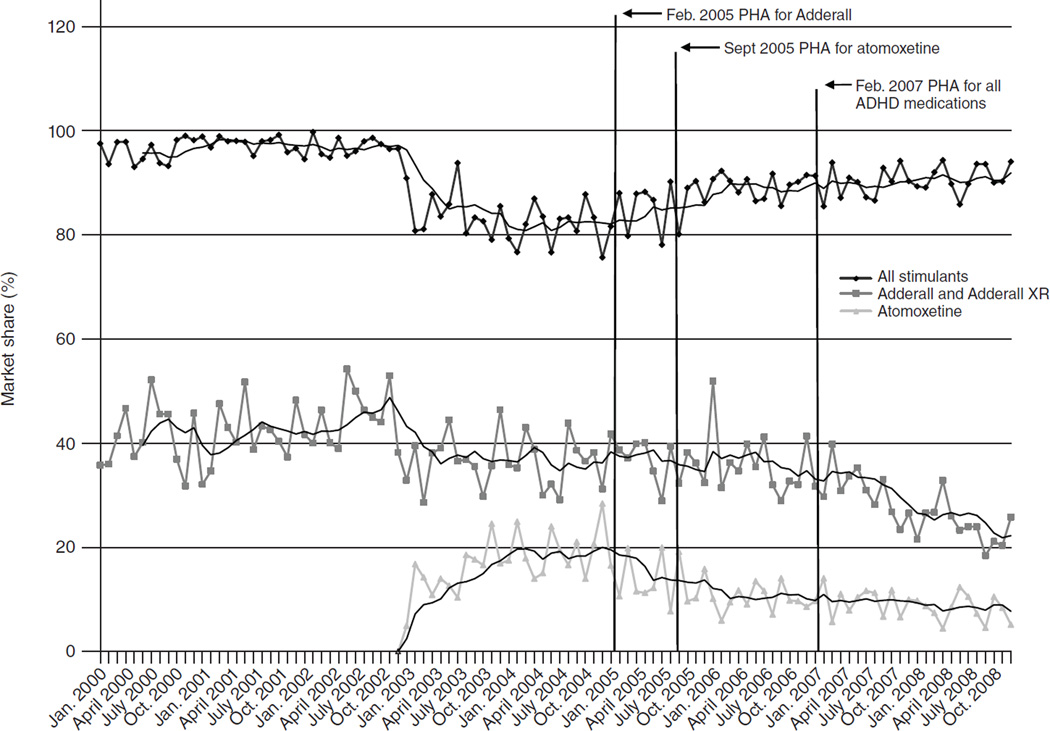
Objective: This study assessed the effect of public health advisories issued between 2005 and 2007 by the U.S. Food and Drug Administration (FDA) on treatments of attention-deficit hyperactivity disorder (ADHD) and physician prescribing practices.
Methods: Data obtained from the IMS Health National Disease and Therapeutic Index, a nationally representative audit of ambulatory physicians, were used to examine trends in office visits by children and adolescents (under age 18) during which ADHD was treated with Adderall, other psychostimulants, or atomoxetine. Segmented time series regressions were conducted to determine changes in use associated with three advisories issued between 2005 and 2007.
Results: In 2004, before the first FDA advisory, Adderall accounted for 36% of ADHD pharmacotherapy treatment visits. Other stimulants accounted for 46%, and atomoxetine accounted for 19%. Overall pharmacotherapy treatment rates were stable over the study period, but by 2008 the treatment visits accounted for by Adderall (that is, market share) declined to 24%, and the market share for atomoxetine declined to 8%. The market share for substitute therapies-clonidine, guanfacine, and bupropion-was stable over this period, ranging from 5% to 7%. Despite the declines in the use of Adderall and atomoxetine over the study period, results from the regression models suggest that the advisories did not have a statistically significant effect on ADHD medication prescribing.
Conclusions: FDA advisories regarding potential cardiovascular and other risks of ADHD medications had little discernible incremental effect on the use of these medicines in this nationally representative ambulatory audit.
Figures
References
-
- Leibson CL, Katusic SK, Barbaresi WJ, et al. Use and costs of medical care for children and adolescents with and without attention-deficit/hyperactivity disorder. JAMA. 2001;285:60–66. - PubMed
-
- Pelham WE, Foster EM, Robb JA. The economic impact of attention-deficit/hyperactivity disorder in children and adolescents. Ambulatory Pediatrics. 2007;7(suppl):121–131. - PubMed
-
- Froehlich TE, Lanphear BP, Epstein JN, et al. Prevalence, recognition, and treatment of attention-deficit/hyperactivity disorder in a national sample of US children. Archives of Pediatrics and Adolescent Medicine. 2007;161:857–864. - PubMed
-
- Increasing prevalence of parent-reported attention-deficit/hyperactivity disorder among children—United States, 2003 and 2007. Morbidity and Mortality Weekly Report. 2010;59:1439–1443. - PubMed
-
- Olfson M, Gameroff MJ, Marcus SC, et al. National trends in the treatment of attention deficit hyperactivity disorder. American Journal of Psychiatry. 2003;160:1071–1077. - PubMed
Publication types
MeSH terms
Substances
Grants and funding
LinkOut - more resources
Full Text Sources
Other Literature Sources
Medical