


Development of a new method for assessing global risk of Alzheimer's disease for use in population health approaches to prevention
- PMID: 23319292
- PMCID: PMC3696462
- DOI: 10.1007/s11121-012-0313-2
Development of a new method for assessing global risk of Alzheimer's disease for use in population health approaches to prevention
Abstract
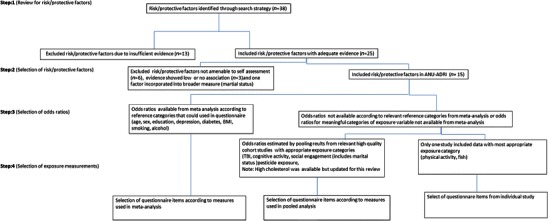
Alzheimer's disease (AD) affects approximately 35 million people worldwide. Increasing evidence suggests that many risk factors for AD are modifiable. AD pathology develops over decades. Hence risk reduction interventions require very long follow-ups to show effects on AD incidence. Focussing on AD risk, instead of diagnosis, provides a more realistic target for prevention strategies. We developed a novel methodology that yields a global approach to risk assessment for AD for use in population-based settings and interventions. The methodology was used to develop a risk assessment tool that can be updated as more evidence becomes available. First, a systematic search strategy identified risk and protective factors for AD. Eleven risk factors and four protective factors for AD were identified for which odds ratios were published or could be calculated (age, sex, education, body mass index, diabetes, depression, serum cholesterol, traumatic brain injury, smoking, alcohol intake, social engagement, physical activity, cognitive activity, fish intake, and pesticide exposure). An algorithm was developed to combine the odds ratios into an AD risk score. The approach allows for interactions among risk factors which provides for their varying impact over the life-course as current evidence suggests midlife is a critical period for some risk factors. Finally, a questionnaire was developed to assess the risk and protective factors by self-report. Compared with developing risk indices on single cohort studies, this approach allows for more risk factors to be included, greater generalizeability of results, and incorporation of interactions based on findings from different stages of the lifecourse.
Figures
References
-
- Access Economics (2009) Keeping Dementia Front of Mind: Incidence and Prevalence 2009. Report prepared for Alzheimer’s Australia. Canberra: Access Economics Pty Limited.
-
- Anstey KJ, Lipnicki DM, Low LF. Cholesterol as a risk factor for dementia and cognitive decline: A systematic review of prospective studies with meta-analysis. The American Journal of Geriatric Psychiatry. 2008;16:343–354. - PubMed
Publication types
MeSH terms
LinkOut - more resources
Full Text Sources
Other Literature Sources
Medical
