


Reproductive factors and menopausal hormone therapy and bladder cancer risk in the NIH-AARP Diet and Health Study
- PMID: 23319449
- PMCID: PMC3646919
- DOI: 10.1002/ijc.28022
Reproductive factors and menopausal hormone therapy and bladder cancer risk in the NIH-AARP Diet and Health Study
Abstract
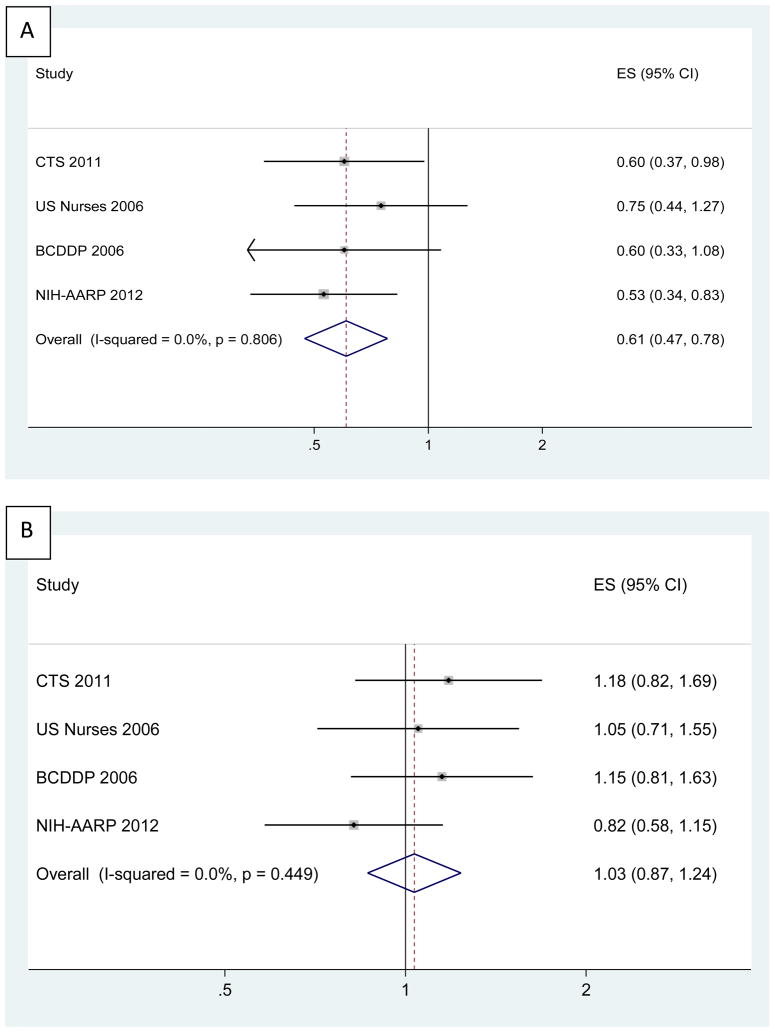
The incidence of bladder cancer among women is at least one-third to one-fourth that observed among men in many countries. Even after accounting for known risk factors, the reason for this gender disparity remains unexplained. We conducted a comprehensive evaluation of reproductive factors and exogenous hormone use with a primary focus on menopausal hormone therapy use and risk of bladder cancer in women in the NIH-AARP Diet and Health Study. Reproductive and hormonal factors were ascertained on the baseline questionnaire in 1995-1996 among 201,492 females who were followed until December 31, 2006. During follow-up, 651 cases of bladder cancer were diagnosed. A subset of women provided detailed information on use of MHT in a second questionnaire in 1996-1997. In this analysis, 127,361 females were followed through June 30, 2002 and 198 incident bladder cancer cases were identified. Cox proportional hazard models, adjusted for smoking status, cigarettes per day and body mass index using age as the time metric, were used to obtain hazard ratios (HRs). A reduced risk was observed among parous women (HR=0.76; 95% CI 0.62-0.93) and women who reported late age at menarche (≥15 years) (HR=0.57; 95% CI 0.39-0.84). Women who reported ever using estrogen and progestin therapy had a decreased risk (HR=0.53; 95% CI: 0.34-0.83) compared with women who did not report MHT use. No association was observed for estrogen only users (HR=0.82; 95% CI: 0.58-1.15). Our results suggest a putative role for sex hormones in the etiology of bladder cancer among women.
Copyright © 2013 UICC.
Figures
References
-
- Silverman DT, Devesa SS, Moore LE, Rothman N. Bladder Cancer. In: Schottenfeld D, Fraumeni JF Jr, editors. Cancer Epidemiology and Prevention. 3. New York: Oxford University Press; 2006. pp. 1101–1127.
-
- Hartge P, Harvey EB, Linehan WM, Silverman DT, Sullivan JW, Hoover RN, et al. Unexplained excess risk of bladder cancer in men. J Natl Cancer Inst. 1990;82(20):1636–1640. - PubMed
-
- Imada S, Akaza H, Ami Y, Koiso K, Ideyama Y, Takenaka T. Promoting effects and mechanisms of action of androgen in bladder carcinogenesis in male rats. Eur Urol. 1997;31(3):360–364. - PubMed
-
- Tanahashi NK, Suzawa N, Azuma C. Effects of sex hormones on oncogenesis in rat urinary bladder by N-butyl-N-(4-hydroxybutyl)-nitrosamine. Int J Clin Pharmacol Biopharm. 1977;15(3):101–105. - PubMed
-
- Miyamoto H, Yang Z, Chen YT, Ishiguro H, Uemura H, Kubota Y, Nagashima Y, Chang YJ, Hu YC, Tsai MY, Yeh S, Messing EM, et al. Promotion of bladder cancer development and progression by androgen receptor signals. J Natl Cancer Inst. 2007;99(7):558–568. - PubMed
Publication types
MeSH terms
Substances
Grants and funding
LinkOut - more resources
Full Text Sources
Other Literature Sources
Medical
