. 2013 Jan 21;200(2):141-9.
doi: 10.1083/jcb.201209002. Epub 2013 Jan 14.

FBH1 promotes DNA double-strand breakage and apoptosis in response to DNA replication stress

Affiliations

FBH1 promotes DNA double-strand breakage and apoptosis in response to DNA replication stress

Yeon-Tae Jeong et al. J Cell Biol. .

Erratum in

  • J Cell Biol. 2013 Jun 24;201(7):1087. Schildkraut, Carl [corrected to Schildkraut, Carl L]

Abstract

Proper resolution of stalled replication forks is essential for genome stability. Purification of FBH1, a UvrD DNA helicase, identified a physical interaction with replication protein A (RPA), the major cellular single-stranded DNA (ssDNA)-binding protein complex. Compared with control cells, FBH1-depleted cells responded to replication stress with considerably fewer double-strand breaks (DSBs), a dramatic reduction in the activation of ATM and DNA-PK and phosphorylation of RPA2 and p53, and a significantly increased rate of survival. A minor decrease in ssDNA levels was also observed. All these phenotypes were rescued by wild-type FBH1, but not a FBH1 mutant lacking helicase activity. FBH1 depletion had no effect on other forms of genotoxic stress in which DSBs form by means that do not require ssDNA intermediates. In response to catastrophic genotoxic stress, apoptosis prevents the persistence and propagation of DNA lesions. Our findings show that FBH1 helicase activity is required for the efficient induction of DSBs and apoptosis specifically in response to DNA replication stress.


Figures
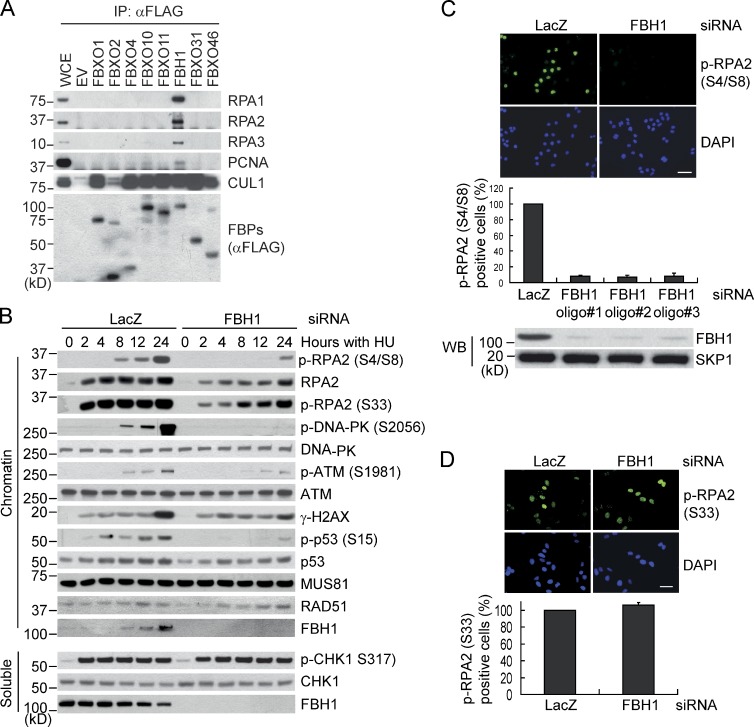
Figure 1.
Figure 1.
FBH1 is required for the efficient activation of ATM and DNA-PK after DNA replication stress. (A) HEK-293T cells were transfected with the indicated FLAG-tagged F-box proteins (FBPs) or an empty vector (EV). 24 h after transfection, cells were harvested and lysed. Whole-cell extracts (WCE) were subjected to immunoprecipitation (IP) with α-FLAG resin and immunoblotted as indicated. (B) U2OS cells were transfected with siRNAs against either LacZ or FBH1 mRNA. After 48 h, cells were treated with HU for the indicated times. After harvesting, cells were fractionated into soluble and chromatin fractions, and lysates were immunoblotted as indicated. (C) U2OS cells were transfected with siRNAs to either LacZ or FBH1 mRNA (in the latter case using three different oligos). 48 h after transfection, cells were treated with HU for 24 h and stained as indicated. Bar, 50 µm. The percentage of S-phase cells (i.e., RPA2-positive cells) that were also positive for p-RPA2(S4/S8) from three different experiments was plotted graphically (±SD). (D) U2OS cells were transfected with siRNAs to either LacZ or FBH1 mRNA. 48 h after transfection, cells were treated with HU for 24 h and stained as indicated. Bar, 50 µm. The number of p-RPA2(S33)–positive cells from three different experiments was plotted graphically (±SD).
Figure 2.
Figure 2.
The helicase domain of FBH1 is required for DSB formation and signaling. (A) U2OS cells stably infected with either an empty vector (EV), wild-type FBH1, or the indicated FBH1 mutants were transfected with siRNAs to either LacZ or FBH1 mRNA. After 48 h, cells were treated with HU for an additional 24 h and the number of p-RPA2(S4/S8)–positive cells from three different experiments was determined and plotted graphically (±SD). (B) U2OS cells were transfected with siRNAs to either LacZ or FBH1 mRNA (in the latter case using two different oligos). After 48 h, cells were treated with HU for an additional 24 h and analyzed for the presence of DSBs using a neutral comet assay. Representative images are shown. The means (±SD) of at least three independent experiments are shown in the graph below. (C) U2OS cell lysates from an experiment performed in A were immunoblotted for the indicated proteins, including both endogenous (Endo) and exogenous (Exo) FBH1. (D) U2OS cells stably infected with either an empty vector (EV), wild-type FBH1, or FBH1(D698N) were transfected with siRNAs to either LacZ or FBH1 mRNA. After 48 h, cells were treated with HU for 24 h and immunoblotted for SKP1 (loading normalization) and both endogenous (Endo) and exogenous (Exo) FBH1. The bottom graph shows the corresponding analysis of DSBs using a neutral comet assay performed as in B. (E) U2OS cells were treated with HU for the indicated hours and analyzed for the presence of DSBs using a neutral comet assay. The graph shows the percentage of cells with a comet tail moment >3.
Figure 3.
Figure 3.
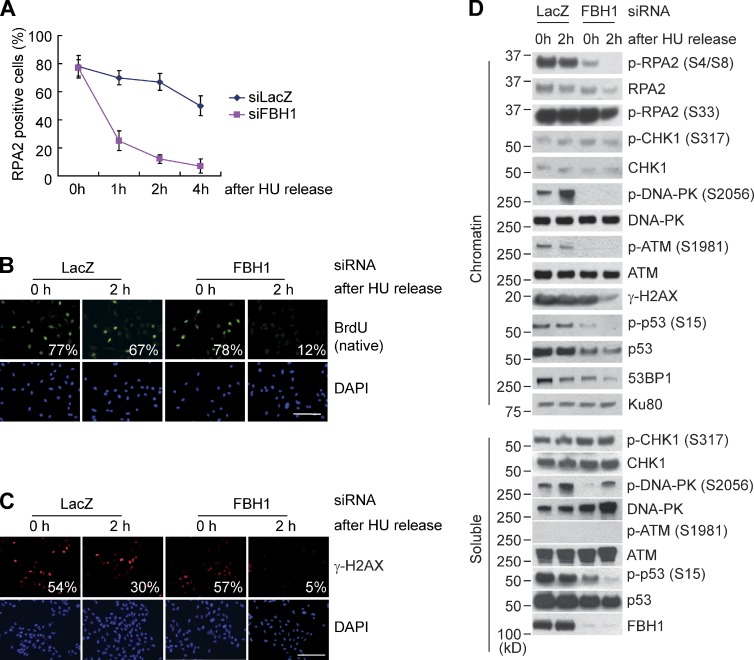
FBH1-depleted cells quickly recover from DNA replication stress. (A) U2OS cells were transfected with siRNAs to either LacZ or FBH1 mRNA. After 48 h, cells were treated with HU for an additional 24 h, immediately fixed (0 h), or released for the indicated times into fresh medium. The number of p-RPA2(S4/S8)–positive cells from three different experiments was determined and plotted graphically (±SD). (B) U2OS cells were treated as in A, except they were also incubated with BrdU for 24 h before HU incubation. Cells were stained under native conditions, as indicated. (C) U2OS cells were treated as in A and stained as indicated. (D) U2OS cells were transfected with siRNAs to either LacZ or FBH1 mRNA. After 48 h, cells were treated with HU for an additional 24 h (lanes 1 and 3) and released for 2 h into fresh medium (lanes 2 and 4). After harvesting, cells were fractionated into soluble and chromatin fractions, and lysates were immunoblotted as indicated.
Figure 4.
Figure 4.
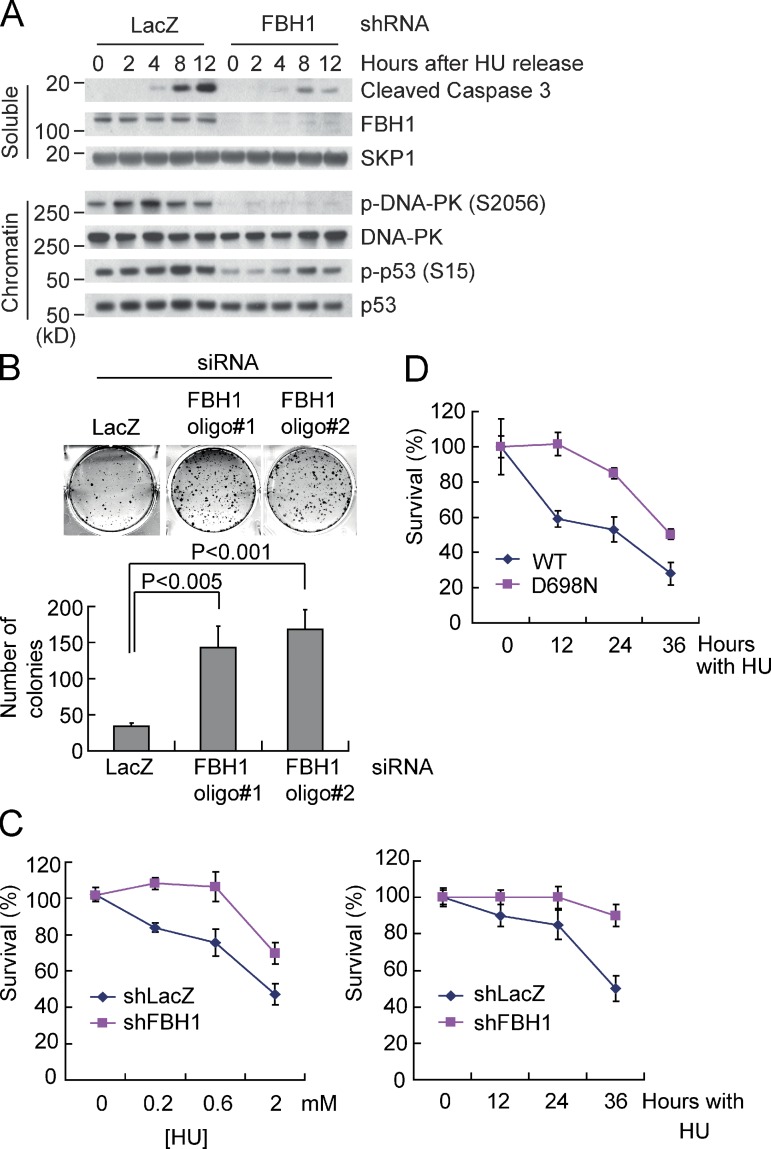
FBH1 promotes apoptosis in response to replication stress. (A) U2OS cells infected with lentiviruses encoding shRNAs to either LacZ or FBH1 mRNA were treated with HU for an additional 36 h and released for the indicated times. Cells were harvested, and their lysates were immunoblotted as indicated. (B) U2OS cells were transfected with siRNAs to either LacZ or FBH1 mRNA. After 48 h, cells were treated with HU for additional 72 h, released, cultured for an additional 10–15 d, and stained with crystal violet. The top images show representative examples. The bottom graph shows quantification of three independent experiments (±SD). P values were calculated by Student’s t test. (C) U2OS cells infected with lentiviruses encoding shRNAs targeting either LacZ or FBH1 mRNA were treated with the indicated concentrations of HU for 24 h (left) or with 0.2 mM HU for the indicated times, released, cultured for an additional 10–15 d, and stained with crystal violet. The graphs show quantification of three independent experiments (±SD). (D) U2OS cells stably infected with either an empty vector (EV), wild-type FBH1, or FBH1(D698N) were infected with lentiviruses encoding shRNAs to FBH1 and treated with HU for the indicated times.
Figure 5.
Figure 5.
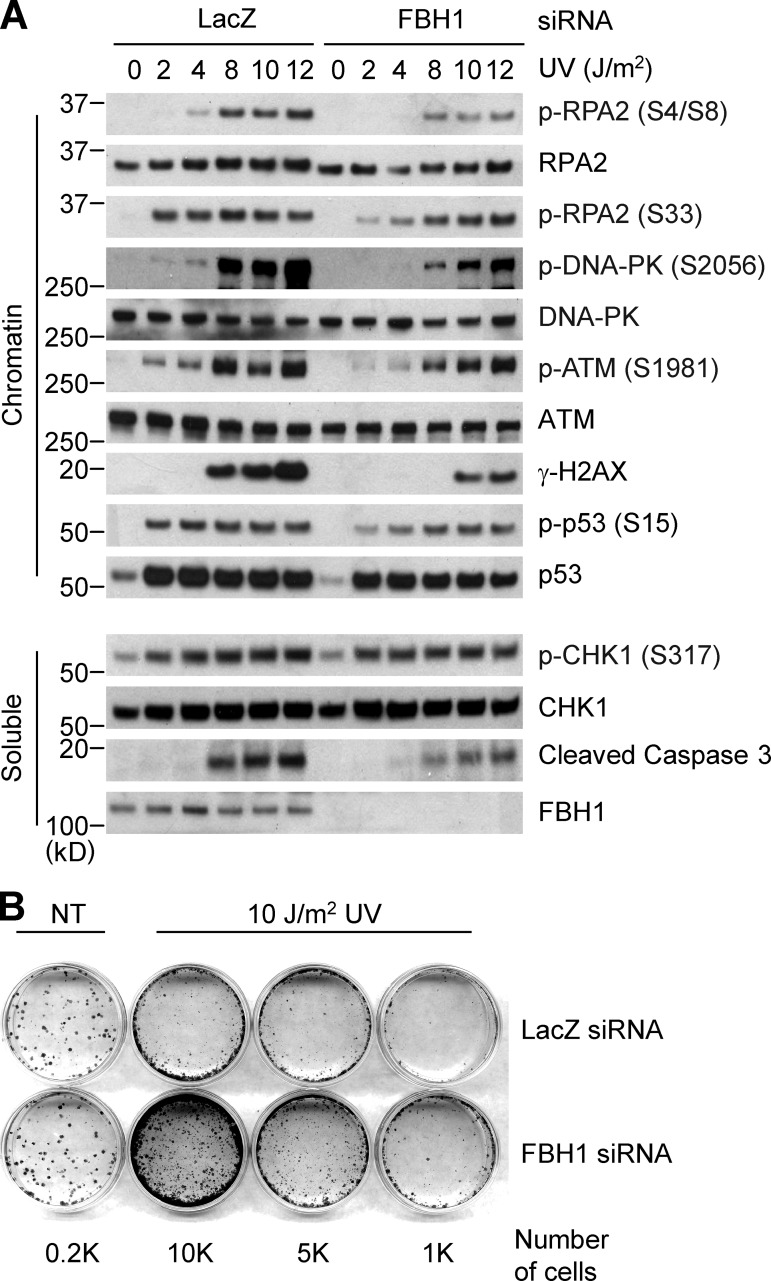
FBH1 is required for the efficient activation of ATM and DNA-PK after DNA replication stress induced by UV. (A) U2OS cells were transfected with siRNAs to either LacZ or FBH1 mRNA. After 48 h, cells were accumulated at G1/S by a 16-h thymidine treatment. Cells were then released for 2 h, treated with the indicated ultraviolet (UV) doses, and left in culture for an additional 4 h. After harvesting, cells were fractionated into soluble and chromatin fractions, and lysates were immunoblotted as indicated. (B) U2OS cells, plated at different dilutions (decreasing from left to right), were treated as in A, except that after UV treatment they were cultured for 7 d and stained with crystal blue. NT, non-treated cells. Images show representative examples.

References

    1. Barber L.J., Youds J.L., Ward J.D., McIlwraith M.J., O’Neil N.J., Petalcorin M.I., Martin J.S., Collis S.J., Cantor S.B., Auclair M., et al. 2008. RTEL1 maintains genomic stability by suppressing homologous recombination. Cell. 135:261–271 10.1016/j.cell.2008.08.016 - DOI - PMC - PubMed
    1. Binz S.K., Sheehan A.M., Wold M.S. 2004. Replication protein A phosphorylation and the cellular response to DNA damage. DNA Repair (Amst.). 3:1015–1024 10.1016/j.dnarep.2004.03.028 - DOI - PubMed
    1. Busino L., Bassermann F., Maiolica A., Lee C., Nolan P.M., Godinho S.I., Draetta G.F., Pagano M. 2007. SCFFbxl3 controls the oscillation of the circadian clock by directing the degradation of cryptochrome proteins. Science. 316:900–904 10.1126/science.1141194 - DOI - PubMed
    1. Chiolo I., Saponaro M., Baryshnikova A., Kim J.H., Seo Y.S., Liberi G. 2007. The human F-Box DNA helicase FBH1 faces Saccharomyces cerevisiae Srs2 and postreplication repair pathway roles. Mol. Cell. Biol. 27:7439–7450 10.1128/MCB.00963-07 - DOI - PMC - PubMed
    1. Chu W.K., Hickson I.D. 2009. RecQ helicases: multifunctional genome caretakers. Nat. Rev. Cancer. 9:644–654 10.1038/nrc2682 - DOI - PubMed

Publication types

MeSH terms