


Monkeys are perceptually tuned to facial expressions that exhibit a theta-like speech rhythm
- PMID: 23319616
- PMCID: PMC3562783
- DOI: 10.1073/pnas.1214956110
Monkeys are perceptually tuned to facial expressions that exhibit a theta-like speech rhythm
Abstract
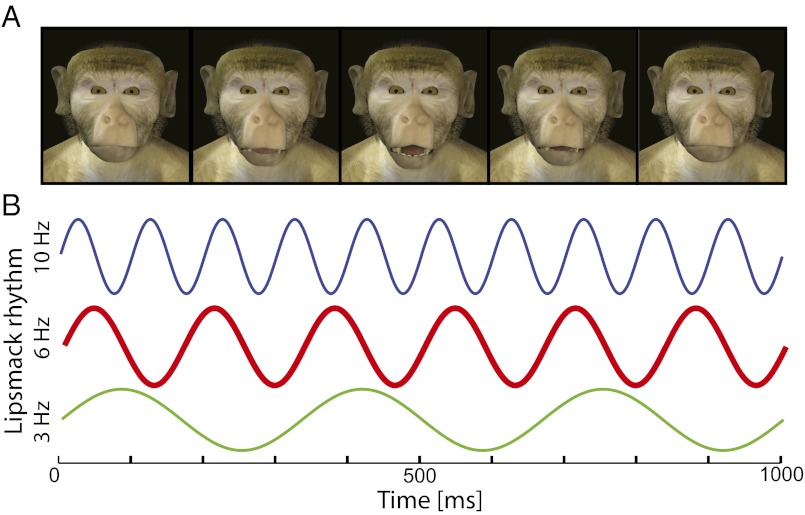
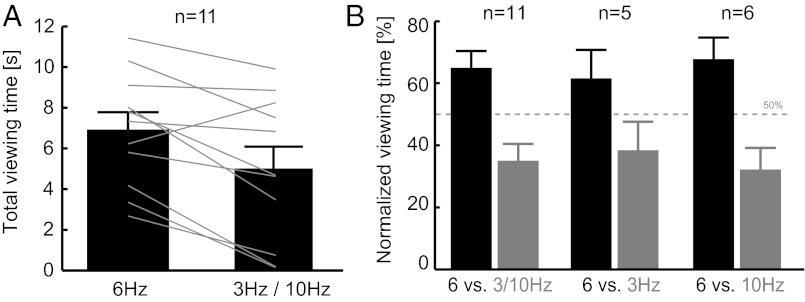
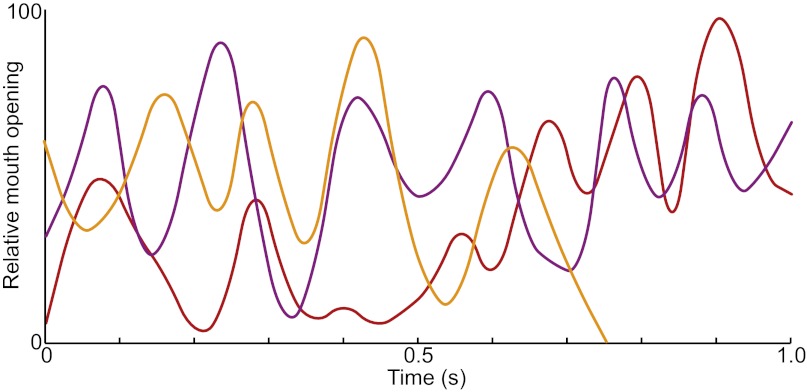
Human speech universally exhibits a 3- to 8-Hz rhythm, corresponding to the rate of syllable production, which is reflected in both the sound envelope and the visual mouth movements. Artificial perturbation of the speech rhythm outside the natural range reduces speech intelligibility, demonstrating a perceptual tuning to this frequency band. One theory posits that the mouth movements at the core of this speech rhythm evolved through modification of ancestral primate facial expressions. Recent evidence shows that one such communicative gesture in macaque monkeys, lip-smacking, has motor parallels with speech in its rhythmicity, its developmental trajectory, and the coordination of vocal tract structures. Whether monkeys also exhibit a perceptual tuning to the natural rhythms of lip-smacking is unknown. To investigate this, we tested rhesus monkeys in a preferential-looking procedure, measuring the time spent looking at each of two side-by-side computer-generated monkey avatars lip-smacking at natural versus sped-up or slowed-down rhythms. Monkeys showed an overall preference for the natural rhythm compared with the perturbed rhythms. This lends behavioral support for the hypothesis that perceptual processes in monkeys are similarly tuned to the natural frequencies of communication signals as they are in humans. Our data provide perceptual evidence for the theory that speech may have evolved from ancestral primate rhythmic facial expressions.
Conflict of interest statement
The authors declare no conflict of interest.
Figures
References
-
- Greenberg S, Carvey H, Hitchcock L, Chang S. Temporal properties of spontaneous speech: A syllable-centric perspective. J Phonetics. 2003;31(3–4):465–485.
-
- Crystal TH, House AS. Segmental durations in connected speech signals: Preliminary results. J Acoust Soc Am. 1982;72(3):705–716. - PubMed
-
- Malécot A, Johnston R, Kizziar P-A. Syllabic rate and utterance length in French. Phonetica. 1972;26(4):235–251. - PubMed
-
- Drullman R, Festen JM, Plomp R. Effect of reducing slow temporal modulations on speech reception. J Acoust Soc Am. 1994;95(5, Pt 1):2670–2680. - PubMed
Publication types
MeSH terms
Grants and funding
LinkOut - more resources
Full Text Sources
Other Literature Sources
