. 2013 Jan 22;110(4):1548-53.
doi: 10.1073/pnas.1213235110. Epub 2013 Jan 14.

Cytokinins can act as suppressors of nitric oxide in Arabidopsis

Affiliations

Cytokinins can act as suppressors of nitric oxide in Arabidopsis

Wei-Zhong Liu et al. Proc Natl Acad Sci U S A. .

Abstract

Maintaining nitric oxide (NO) homeostasis is essential for normal plant physiological processes. However, very little is known about the mechanisms of NO modulation in plants. Here, we report a unique mechanism for the catabolism of NO based on the reaction with the plant hormone cytokinin. We screened for NO-insensitive mutants in Arabidopsis and isolated two allelic lines, cnu1-1 and 1-2 (continuous NO-unstressed 1), that were identified as the previously reported altered meristem program 1 (amp1) and as having elevated levels of cytokinins. A double mutant of cnu1-2 and nitric oxide overexpression 1 (nox1) reduced the severity of the phenotypes ascribed to excess NO levels as did treating the nox1 line with trans-zeatin, the predominant form of cytokinin in Arabidopsis. We further showed that peroxinitrite, an active NO derivative, can react with zeatin in vitro, which together with the results in vivo suggests that cytokinins suppress the action of NO most likely through direct interaction between them, leading to the reduction of endogenous NO levels. These results provide insights into NO signaling and regulation of its bioactivity in plants.


Conflict of interest statement

The authors declare no conflict of interest.

Figures
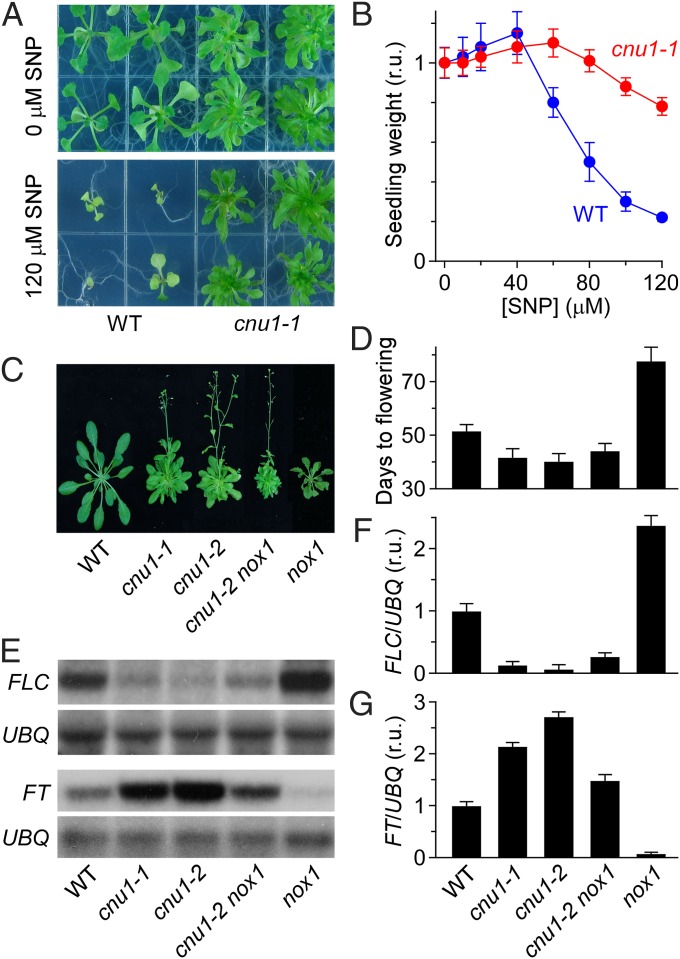
Fig. 1.
Fig. 1.
The cnu1 mutant is insensitive to NO and flowers early. (A) Effects of an NO donor SNP on plant growth and development. Arabidopsis seedlings were grown on petri dishes containing several concentrations of SNP during long days (16-h light/8-h dark) for 3 wk. It can be seen that cnu1 mutants have started flowering, and WT plants are still in the vegetative stage at 120 μM SNP. (B) The effect of SNP concentration on shoot growth. Fresh weight per seedling was from experiments as in A (mean ± SD; n = 150 seedlings). (C and D) The variation of endogenous NO and cytokinin levels affect the onset of flowering in Arabidopsis. The cnu1 mutant and cnu1-2 nox1 double mutant flowers early. Plants were grown on soil under 12-h light/12-h dark cycles and were photographed (C) after 50 d of growth. The days to flowering (D) from experiments as in C were scored (mean ± SD; n ≥ 30 plants). (E–G) The variation of endogenous NO and cytokinin levels affect the expression of genes that control the floral transition in Arabidopsis. The expression levels of FLC and FT, respectively, in WT, cnu1-1, cnu1-2, cnu1-2 nox1, and nox1 plants (E). Seedlings were grown on MS media under 16-h light/8-h dark cycles for 10–12 d. Leaves were collected 8 h after dawn for total RNA extraction. The FLC mRNA abundance was analyzed by using Northern blot and FT mRNA by RT-PCR. Ubiquitin mRNA (UBQ10) was used as a loading control. Quantification of the effects of endogenous NO and cytokinin on flowering repressor FLC (F) and flowering promoter FT (G) expression, respectively, showed that endogenous NO and cytokinins on flowering control gene expression have the opposite effect. The relative mRNA abundance was normalized to the UBQ levels. The relative mRNA abundance of WT was arbitrarily set to 1 (mean ± SEM; n = 3).
Fig. 2.
Fig. 2.
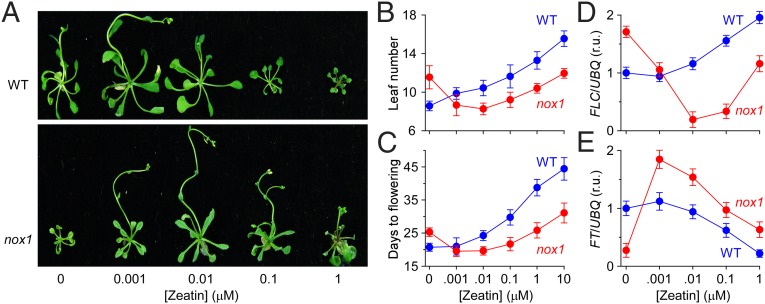
Exogenous zeatin rescues the late-flowering phenotype in nox1 resulting from elevated NO. (A) The cytokinin zeatin rescues the late-flowering phenotype in nox1. WT and nox1 seedlings were grown on MS media containing several concentrations of trans-zeatin under 16-h light/8-h dark cycles and were photographed after 25 d of growth. (B and C) Quantification of flowering time measured as the days to flowering (C) and the number of rosette leaves (B) (mean ± SD; n = 180 seedlings) from plants grown as in A. (D and E) Quantification of the FLC (D) and the FT (E) expression in response to zeatin treatments, respectively, using the methods as described in Fig. 1. Seedlings were grown on media containing several concentrations of trans-zeatin under long days for 10–12 d. The relative mRNA abundance was normalized to the UBQ levels. The relative mRNA abundance of WT at 0 μM zeatin was arbitrarily set to 1 (mean ± SEM; n = 3).
Fig. 3.
Fig. 3.
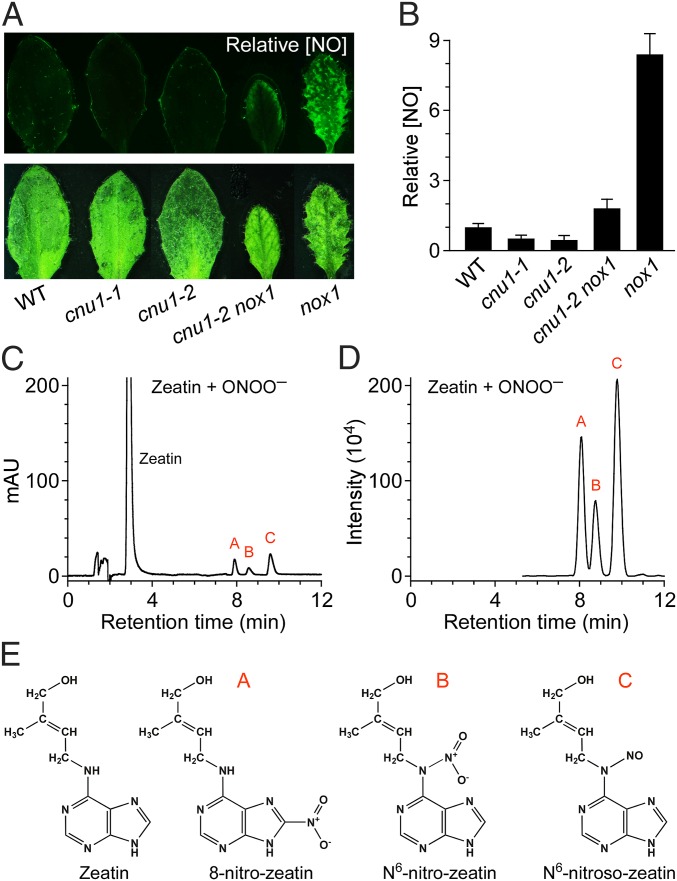
Excessive NO nitrates the adenine group of cytokinins and leads to the reduction of endogenous NO levels. (A) The endogenous NO levels in WT, cnu1-1, cnu1-2, cnu1-2 nox1, and nox1. Leaves were stained with DAF-2DA (Upper). (Lower) White-light images are shown. A total of 50 leaves were analyzed for each genotype in three independent experiments, and similar results were obtained. (B) Quantification of the relative NO levels for various genotypes grown in A. The relative NO level of WT was arbitrarily set to 1 (mean ± SD; n = 50). (C and D) HPLC-UV and HPLC-MS/MS profile of the reaction products of peroxynitrite with trans-zeatin in test tube at pH 9.5. The reaction solution of trans-zeatin and peroxynitrite (Zeatin + ONOO) was run through HPLC and monitored by UV absorption (C) or MS/MS detection (D). Similar results were seen from more than 10 independent experiments. (E) The chemical structures of zeatin and the identified reaction products. Peaks A, B, and C in HPLC-UV (C) and HPLC-MS/MS (D) profile correspond to 8-nitro-trans-zeatin, N6-nitro-trans-zeatin, and N6-nitroso-trans-zeatin, respectively.
Fig. 4.
Fig. 4.
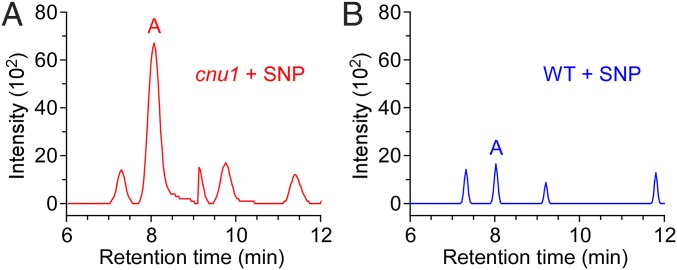
Peroxynitrite and cytokinin can interact directly in vivo. HPLC-MS/MS profile of the extract from the cnu1 (A) and WT (B) seedlings treated with 100 μM SNP. Arabidopsis seedlings were grown on petri dishes containing 100 μM SNP for 2 wk. Peak A corresponds to the main product A (8-nitro-trans-zeatin). The intensity of peak A from SNP-treated WT (WT + SNP) was much lower than that from SNP-treated cnu1 (cnu1 + SNP).
Fig. 5.
Fig. 5.
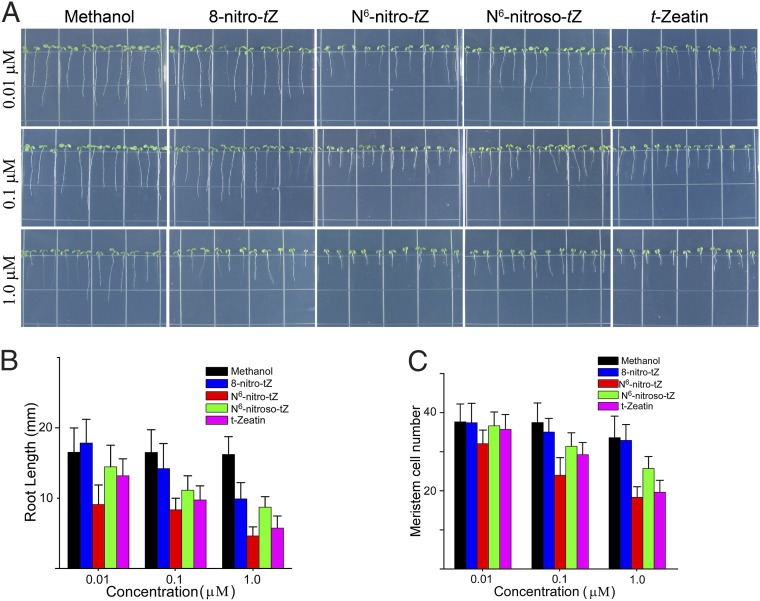
Cytokinin-like activity of products A, B, and C. (A) Root phenotypes of seedlings grown under long days for 1 wk on the indicated treatments. WT seeds were grown on MS media each containing several concentrations of 8-nitro-trans-zeatin, N6-nitro-trans-zeatin, N6-nitroso-trans-zeatin, trans-zeatin, and methanol, respectively. All compounds were dissolved in methanol, which is shown at the same concentration as a control. (B) The root length from experiments as in A was analyzed with Image J software (mean ± SD; n = 160 seedlings). (C) Effects of these three products on the root-meristem cell number. Root-meristem size was expressed as the number of cortex cells in a file extending from the quiescent center (QC) to the first elongated cell. The meristem sizes of roots treated with these three products were analyzed using the number of cortex cells (mean ± SD; n = 160 seedlings).

References

    1. Schmidt HH, Walter U. NO at work. Cell. 1994;78(6):919–925. - PubMed
    1. Lamattina L, García-Mata C, Graziano M, Pagnussat G. Nitric oxide: the versatility of an extensive signal molecule. Annu Rev Plant Biol. 2003;54:109–136. - PubMed
    1. Besson-Bard A, Pugin A, Wendehenne D. New insights into nitric oxide signaling in plants. Annu Rev Plant Biol. 2008;59:21–39. - PubMed
    1. He Y, et al. Nitric oxide represses the Arabidopsis floral transition. Science. 2004;305(5692):1968–1971. - PubMed
    1. Asai S, Ohta K, Yoshioka H. MAPK signaling regulates nitric oxide and NADPH oxidase-dependent oxidative bursts in Nicotiana benthamiana. Plant Cell. 2008;20(5):1390–1406. - PMC - PubMed

Publication types

MeSH terms