Comment
doi: 10.1084/jem.20122739.
Clonal expansion in B-CLL: fungal drivers or self-service?
Affiliations
- PMID: 23319726
- PMCID: PMC3549708
- DOI: 10.1084/jem.20122739
Item in Clipboard
Comment
Clonal expansion in B-CLL: fungal drivers or self-service?
J Exp Med.
.
Abstract
Relatively few cancers arise in mature, differentiated cells. The propensity of mature B cells to transform has been linked to their longevity and proliferative potential, and stimulation of the B cell receptor (BCR) by cognate antigen may promote the transformation process. A study in this issue (Hoogeboom et al.) lends support to this notion, showing that cancer cells from a subset of patients with chronic lymphocytic leukemia (CLL) express a BCR specific for a sugar expressed by commensal yeast species. Another study, in contrast, suggests that B-CLL cells uniquely acquire the ability to signal in the complete absence of ligand.
Figures
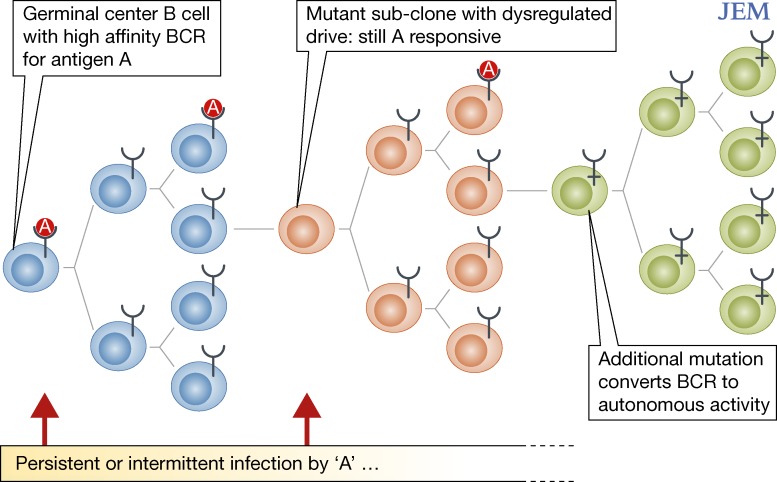
Putative pattern of clonal evolution and antigen dependence in CLL. Three potential mechanisms may underlie microbial drive in the transformation of B cells in CLL. Germinal center B cells with high-affinity BCRs (blue) may be chronically stimulated by microbial antigens, increasing the probability that the cell acquires transforming mutations. After transformation, subclones of antigen-specific B cells may acquire mutations that confer a selective proliferative advantage in the presence of antigen (orange). Finally, antigen-specific B cells may acquire mutations that render BCR signaling completely independent of antigenic ligation (green). The “Y”-shaped symbols indicate BCRs, and “A” indicates nominal antigens derived from microbial infection.
Comment on
-
A mutated B cell chronic lymphocytic leukemia subset that recognizes and responds to fungi.J Exp Med. 2013 Jan 14;210(1):59-70. doi: 10.1084/jem.20121801. Epub 2013 Jan 7. J Exp Med. 2013. PMID: 23296468 Free PMC article.
References
-
- Crowther-Swanepoel D., Broderick P., Di Bernardo M.C., Dobbins S.E., Torres M., Mansouri M., Ruiz-Ponte C., Enjuanes A., Rosenquist R., Carracedo A., et al. 2010. Common variants at 2q37.3, 8q24.21, 15q21.3 and 16q24.1 influence chronic lymphocytic leukemia risk. Nat. Genet. 42:132–136 10.1038/ng.510 - DOI - PMC - PubMed
Publication types
MeSH terms
Substances
LinkOut - more resources
Full Text Sources
Other Literature Sources