


Molecular targeted therapies in advanced gastric cancer: does tumor histology matter?
- PMID: 23320047
- PMCID: PMC3539290
- DOI: 10.1177/1756283X12453636
Molecular targeted therapies in advanced gastric cancer: does tumor histology matter?
Abstract
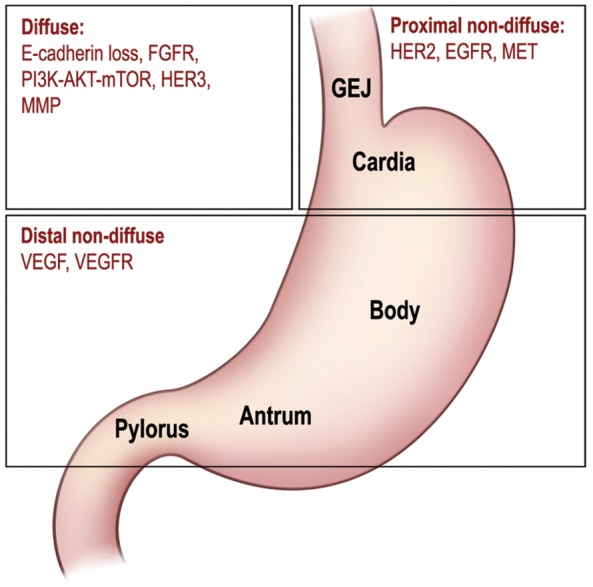
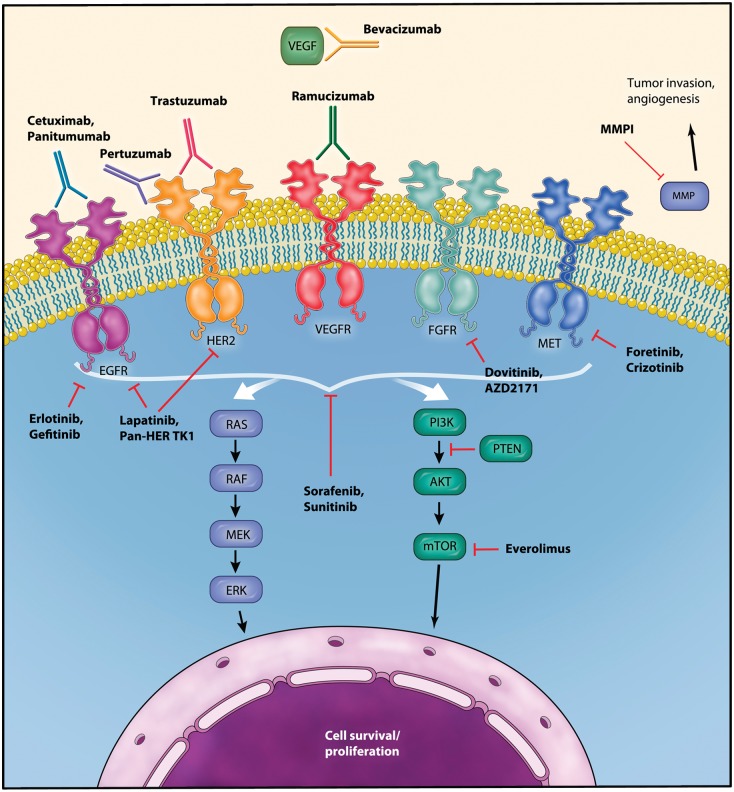
It is increasingly recognized that gastric cancer is a heterogeneous disease which may be divided into subgroups based on histological, anatomical, epidemiological and molecular classifications. Distinct molecular drivers and tumor biology, and thus different treatment targets and predictive biomarkers, may be implicated in each subtype. However, there is little evidence in the literature regarding the correlation among these different classifications, and particularly the molecular aberrations present in each subtype. In this review, we approach advanced gastric cancer (AGC) by presenting aberrant molecular pathways and their potential therapeutic targets in gastric cancer according to histological and anatomical classification, dividing gastric cancer into proximal nondiffuse, distal nondiffuse and diffuse disease. Several pathways are involved predominantly, although not exclusively, in different subtypes. This may help to explain the disappointing results of many published AGC trials in which study populations were heterogeneous regardless of clinicopathological characteristics of the primary tumor. Histological and anatomical classification may provide insights into tumor biology and facilitate selection of an enriched patient population for targeted agents in future studies and in the clinic. However, some molecular pathways implicated in gastric cancer have not been studied in correlation with histological or anatomical subtypes. Further studies are necessary to confirm the suggestion that such classification may predict tumor biology and facilitate selection of an enriched patient population for targeted agents in future studies and in the clinic.
Keywords: Advanced gastric cancer; angiogenic pathway; biomarker; epidermal growth factor pathway; targeted therapy.
Conflict of interest statement
Figures
References
-
- Al-Kasspooles M., Moore J., Orringer M., Beer D. (1993) Amplification and over-expression of the EGFR and erbB-2 genes in human esophageal adenocarcinomas. Int J Cancer 54: 213–219 - PubMed
-
- Alsina M., Ko A., Garcia De Paredes M., Rivera F., Schwartzberg L., Fattaey A., et al. (2011) Clinical and pharmacodynamic (PD) results of TEL0805 trial: a phase II study of telatinib (TEL) in combination with capecitabine (X) and cisplatin (P) as first-line treatment in patients (pts) with advanced gastric or gastroesophageal junction (GEJ) cancer. J Clin Oncol 29(Suppl.): abstract 4122
-
- An J., Kim K., Choi M., Noh J., Sohn T., Bae J., et al. (2010) Prognostic role of p-mTOR expression in cancer tissues and metastatic lymph nodes in pT2b gastric cancer. Int J Cancer 126: 2904–2913 - PubMed
-
- Asaka M., Kimura T., Kato M., Kudo M., Miki K., Ogoshi K., et al. (1994) Possible role of Helicobacter pylori infection in early gastric cancer development. Cancer 73: 2691–2694 - PubMed
-
- Bang Y., Chung H., Xu J., Lordick F., Sawaki A., Lipatov O., et al. (2009) Pathological features of advanced gastric cancer (GC): relationship to human epidermal growth factor receptor 2 (HER2) positivity in the global screening programme of the ToGA trial. J Clin Oncol 27(15 Suppl.): abstract 4556
LinkOut - more resources
Full Text Sources
