


Similar decline in mortality rate of older persons with and without type 2 diabetes between 1993 and 2004 the Icelandic population-based Reykjavik and AGES-Reykjavik cohort studies
- PMID: 23320535
- PMCID: PMC3626863
- DOI: 10.1186/1471-2458-13-36
Similar decline in mortality rate of older persons with and without type 2 diabetes between 1993 and 2004 the Icelandic population-based Reykjavik and AGES-Reykjavik cohort studies
Abstract
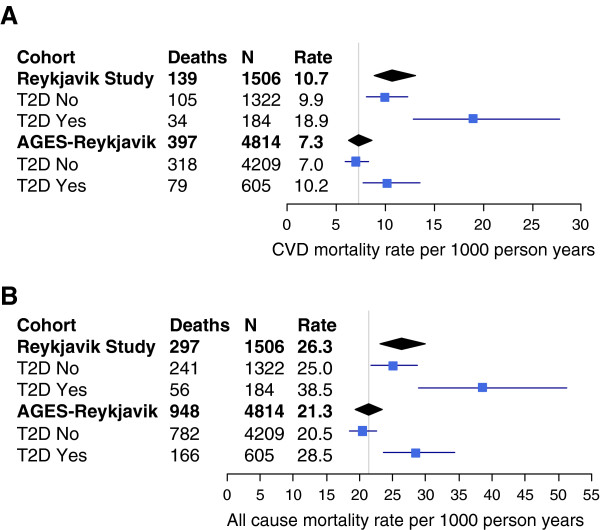
Background: A decline in mortality rates due to cardiovascular diseases and all-cause mortality has led to increased life expectancy in the Western world in recent decades. At the same time, the prevalence of type 2 diabetes, a disease associated with a twofold excess risk of cardiovascular disease and mortality, has been increasing. The objective of this study was to estimate the secular trend of cardiovascular and all-cause mortality rates in two population-based cohorts of older persons, with and without type 2 diabetes, examined 11 years apart.
Methods: 1506 participants (42% men) from the population-based Reykjavik Study, examined during 1991-1996 (median 1993), mean age 75.0 years, and 4814 participants (43% men) from the AGES-Reykjavik Study, examined during 2002-2006 (median 2004), mean age 77.2 years, age range in both cohorts 70-87 years. The main outcome measures were age-specific mortality rates due to cardiovascular disease and all causes, over two consecutive 5.7- and 5.3-year follow-up periods.
Results: A 32% decline in cardiovascular mortality rate and a 19% decline in all-cause mortality rate were observed between 1993 and 2004. The decline was greater in those with type 2 diabetes, as illustrated by the decline in the adjusted hazard ratio of cardiovascular mortality in individuals with diabetes compared to those without diabetes, from 1.88 (95% CI 1.24-2.85) in 1993 to 1.46 (95% CI 1.11-1.91) in 2004. We also observed a concurrent decrease in major cardiovascular risk factors in both those with and without diabetes. A higher proportion of persons with diabetes received glucose-lowering, hypertensive and lipid-lowering medication in 2004.
Conclusions: A decline in cardiovascular and all-cause mortality rates was observed in older persons during the period 1993-2004, in both those with and without type 2 diabetes. This decline may be partly explained by improvements in cardiovascular risk factors and medical treatment over the period studied. However, type 2 diabetes still persists as an independent risk factor for cardiovascular mortality.
Figures
References
-
- Kesteloot H, Sans S, Kromhout D. Dynamics of cardiovascular and all-cause mortality in Western and Eastern Europe between 1970 and 2000. Eur Heart J. 2006;27(1):107–13. - PubMed
-
- Lam DW, Leroith D. The worldwide diabetes epidemic. Curr Opin Endocrinol Diabetes Obes. 2012;19(2):93–6. - PubMed
-
- Sarwar N, Gao P, Seshasai SR, Gobin R, Kaptoge S, Di Angelantonio E. et al. Diabetes mellitus, fasting blood glucose concentration, and risk of vascular disease: a collaborative meta-analysis of 102 prospective studies. Lancet. 2010;375(9733):2215–22. doi: 10.1016/S0140-6736(10)60484-9. - DOI - PMC - PubMed
-
- Dale AC, Vatten LJ, Nilsen TI, Midthjell K, Wiseth R. Secular decline in mortality from coronary heart disease in adults with diabetes mellitus: cohort study. BMJ. 2008;337:a236. doi: 10.1136/bmj.39582.447998.BE. - DOI - PMC - PubMed
Publication types
MeSH terms
Grants and funding
LinkOut - more resources
Full Text Sources
Other Literature Sources
Medical
