Review
. 2013 Mar:297:42-51.
doi: 10.1016/j.heares.2012.12.014. Epub 2013 Jan 12.

A brief history of hair cell regeneration research and speculations on the future

Affiliations
Review

A brief history of hair cell regeneration research and speculations on the future

Edwin W Rubel et al. Hear Res. 2013 Mar.

Abstract

Millions of people worldwide suffer from hearing and balance disorders caused by loss of the sensory hair cells that convert sound vibrations and head movements into electrical signals that are conveyed to the brain. In mammals, the great majority of hair cells are produced during embryogenesis. Hair cells that are lost after birth are virtually irreplaceable, leading to permanent disability. Other vertebrates, such as fish and amphibians, produce hair cells throughout life. However, hair cell replacement after damage to the mature inner ear was either not investigated or assumed to be impossible until studies in the late 1980s proved this to be false. Adult birds were shown to regenerate lost hair cells in the auditory sensory epithelium after noise- and ototoxic drug-induced damage. Since then, the field of hair cell regeneration has continued to investigate the capacity of the auditory and vestibular epithelia in vertebrates (fishes, birds, reptiles, and mammals) to regenerate hair cells and to recover function, the molecular mechanisms governing these regenerative capabilities, and the prospect of designing biologically-based treatments for hearing loss and balance disorders. Here, we review the major findings of the field during the past 25 years and speculate how future inner ear repair may one day be achieved.


Figures

Figure 1
Figure 1
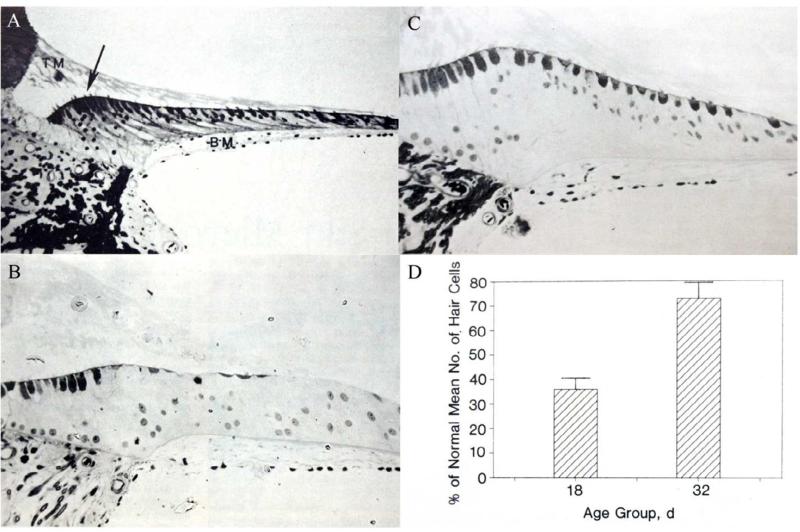
Hair cell regeneration occurs in post-hatch (mature) chicken basilar papilla after aminoglycoside-induced hair cell loss. A, Transverse section of mid-portion of normal basilar papilla. Tall and short hair cells are located medially (arrow) and laterally, respectively. TM indicates tectorial membrane, and BM indicates basilar membrane. B, Transverse section of mid-portion of basilar papilla 8 days (age 18 days) after 10 consecutive days of gentamicin injections. C, Transverse section of mid-portion of basilar papilla 22 days (age 32 days) after gentamicin injections. D, Mean hair cell number in gentamicin-treated chickens as a percentage of hair cells counted in undamaged control animals. In the mid-portion of the basilar papilla, hair cell regeneration occurs to restore approximately 70% of lost hair cells by 3 weeks after damage. Bars represent 1 SEM. (From: Cruz RM, Lambert PR, Rubel EW. 1987. Light microscopic evidence of hair cell regeneration after gentamicin toxicity in chick cochlea. Arch Otolaryngol Head Neck Surg 113: 1058-1062.)
Figure 2
Figure 2
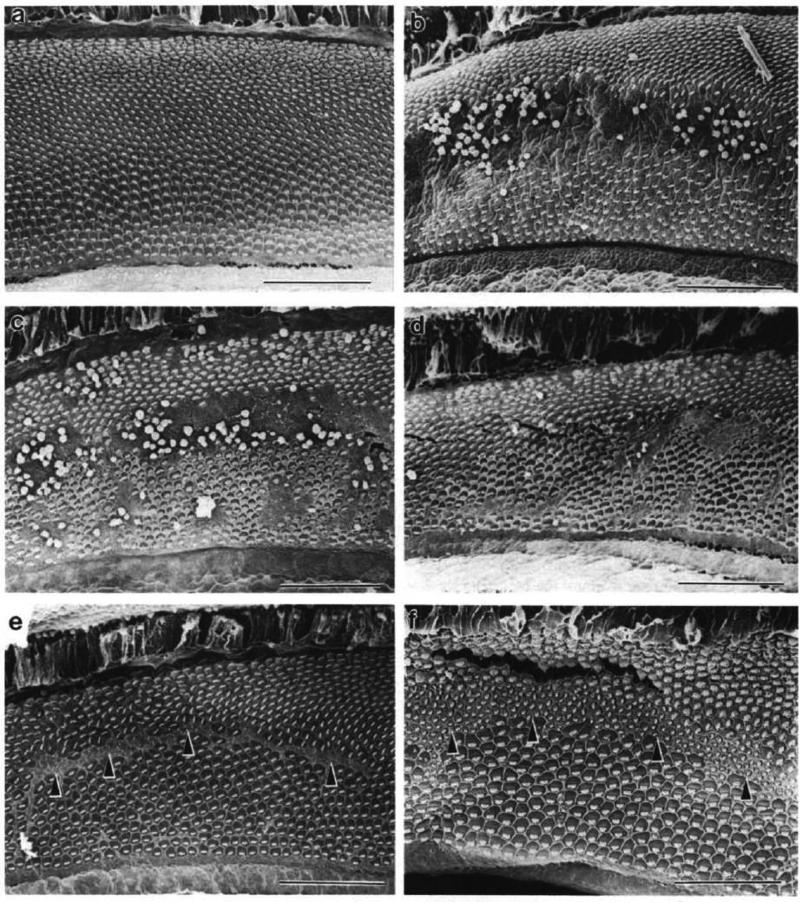
Hair cell regeneration occurs in adult chicken basilar papilla after noise-induced hair cell loss. a-f, Scanning electron microscopy analysis conducted on the 1500 Hz region of chicken basilar papillae. a, Control basilar papilla. b-f, Basilar papillae from chickens exposed to 1500 Hz pure tone for 48 hours at 120 dB SPL at 0 hours (b), 24 hours (c), 48 hours (d), 6 days (e), and 10 days (f) after noise exposure. Arrowheads, new stereociliary bundles. Bars represent 100 μm. (From: Cotanche, DA. 1987a. Regeneration of hair cell stereociliary bundles in the chick cochlea following severe acoustic trauma. Hearing Research 30: 181-196.)
Figure 3
Figure 3
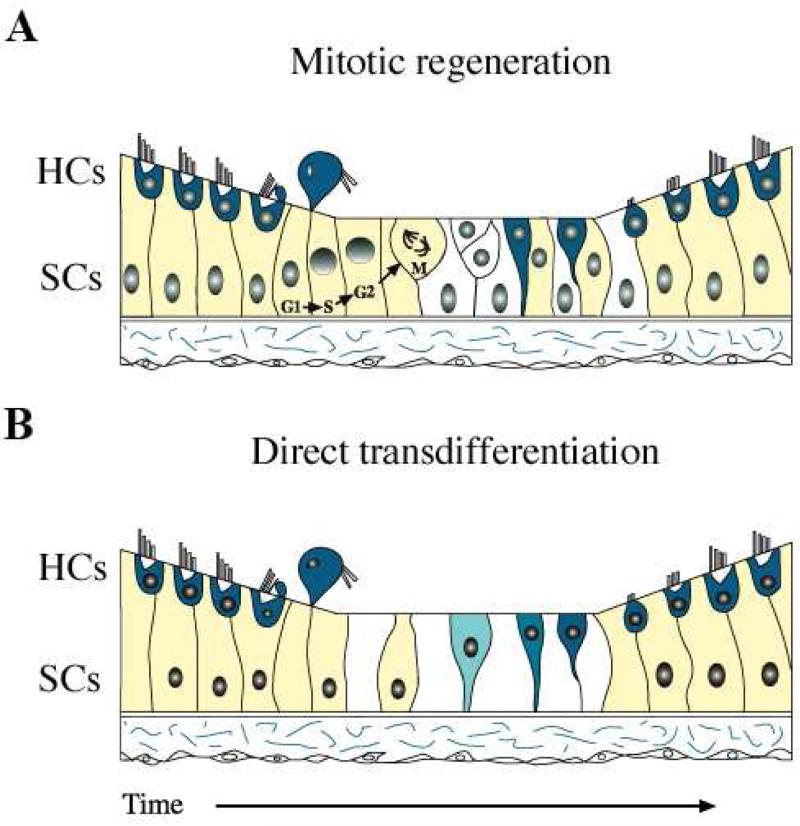
Schematic representation of hair cell regeneration from supporting cells after damage. After damage, hair cells are extruded from the epithelium which signals nearby supporting cells to re-enter the cell cycle and produce mitotically-derived daughter cells (A), or convert directly into hair cells (B). Dividing supporting cells can give rise to both hair cells and supporting cells (A). Blue designates hair cells (HCs) and white designates supporting cells (SCs). (From: Oesterle EC and Stone JS. 2008. Hair cell regeneration: mechanisms guiding cellular proliferation and differentiation. Springer Handbook of Auditory Research Chapter 5: 141-196.)

References

    1. Adler HJ, Raphael Y. New hair cells arise from supporting cell conversion in the acoustically damaged chick inner ear. Neurosci Lett. 1996;205:17–20. - PubMed
    1. Adler HJ, Komeda M, Raphael Y. Further evidence for supporting cell conversion in the damaged avian basilar papilla. Int J Dev Neurosci. 1997;15:375–85. - PubMed
    1. Alvarado DM, Hawkins RD, Bashiardes S, Veile RA, Ku YC, Powder KE, Spriggs MK, Speck JD, Warchol ME, Lovett M. An RNA interference-based screen of transcription factor genes identifies pathways necessary for sensory regeneration in the avian inner ear. J Neurosci. 2011;31:4535–43. - PMC - PubMed
    1. Baird RA, Torres MA, Schuff NR. Hair cell regeneration in the bullfrog vestibular otolith organs following aminoglycoside toxicity. Hear Res. 1993;65:164–74. - PubMed
    1. Baird RA, Steyger PS, Schuff NR. Mitotic and nonmitotic hair cell regeneration in the bullfrog vestibular otolith organs. Ann N Y Acad Sci. 1996;781:59–70. - PubMed