


Influence of donor-recipient gender mismatch on graft function and survival following lung transplantation
- PMID: 23322094
- PMCID: PMC3598053
- DOI: 10.1093/icvts/ivs570
Influence of donor-recipient gender mismatch on graft function and survival following lung transplantation
Abstract
Objectives: In current practice, donors and recipients are not matched for gender in lung transplantation. However, some data have suggested a possible effect of gender combinations on lung transplant outcomes. We examined whether donor-recipient (D/R) gender mismatch is related to adverse outcomes after lung transplantation in terms of early and long-term graft function and survival.
Methods: We reviewed 256 donors and lung transplant recipients over a 14-year period. Patients were distributed into four groups: Group A (D/R: female/female), Group B (D/R: male/male), Group C (D/R: female/male), Group D (D/R: male/female). Donor and recipient variables were compared among groups, including early graft function, 30-day mortality, freedom from bronchiolitis obliterans syndrome (BOS), and long-term survival.
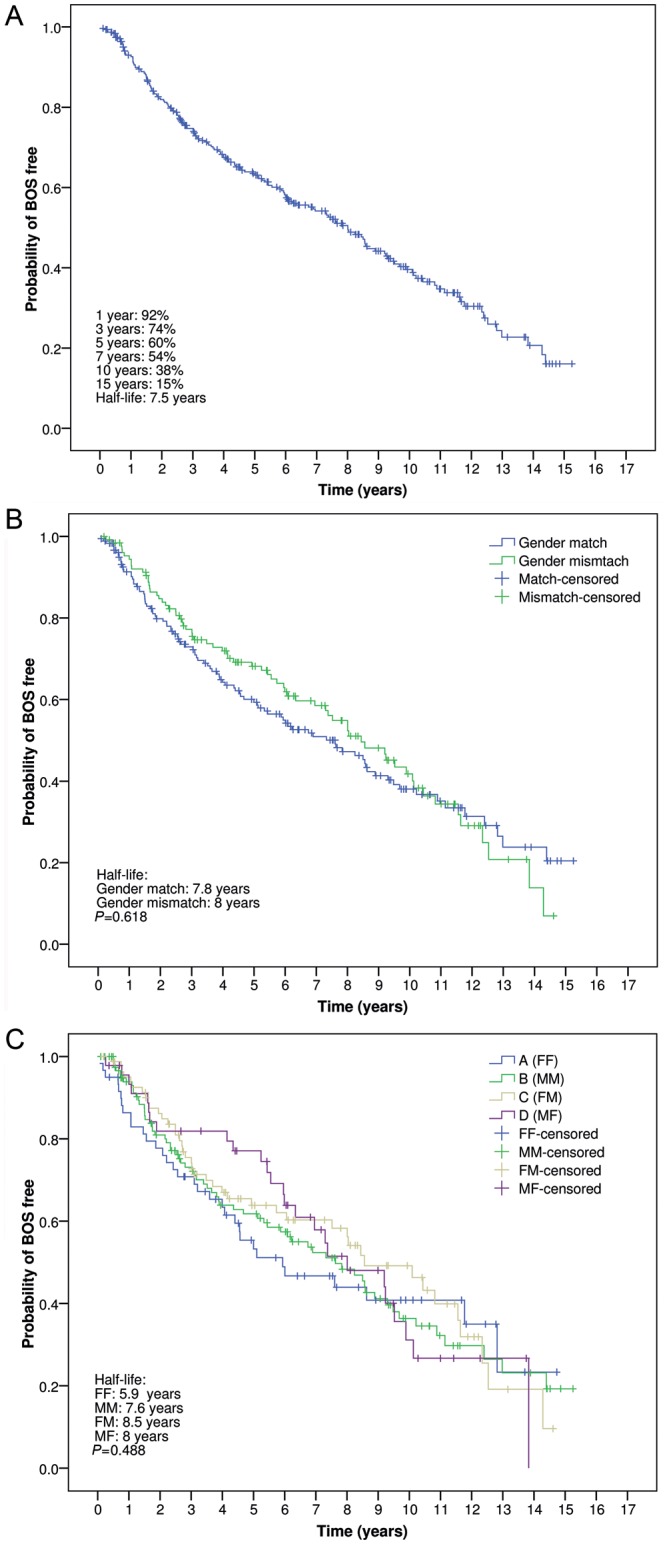
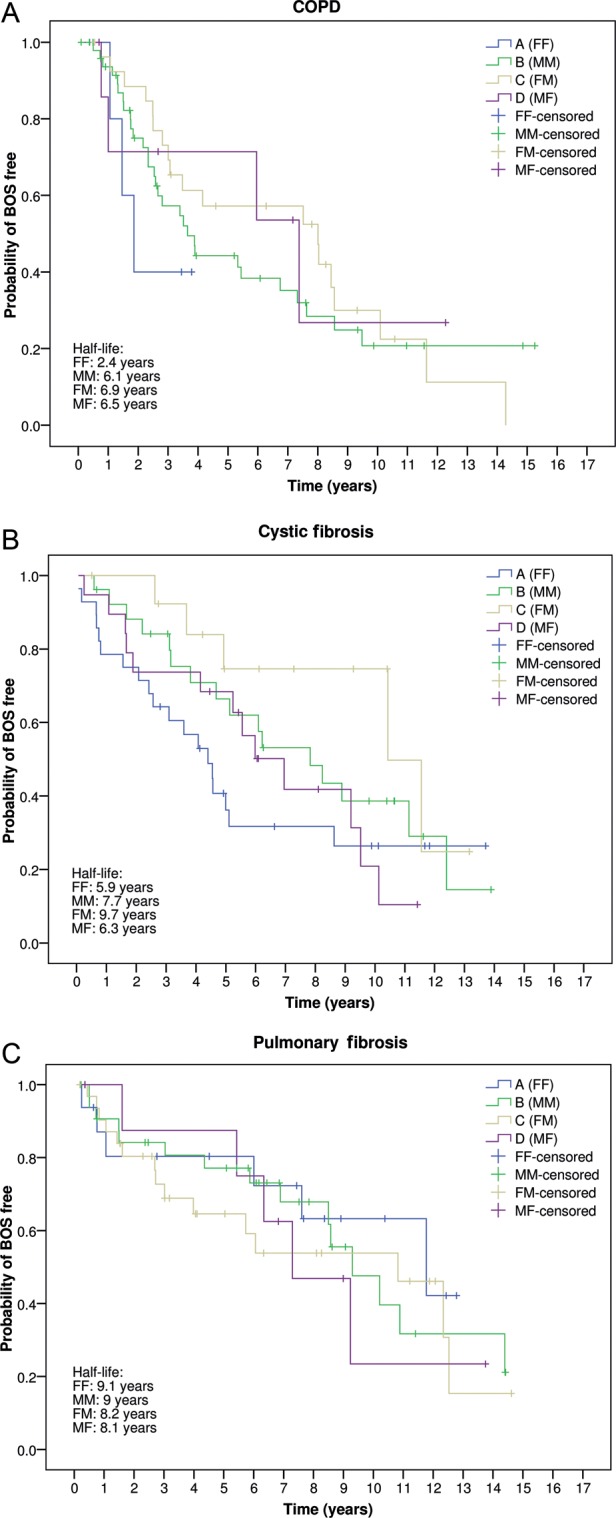
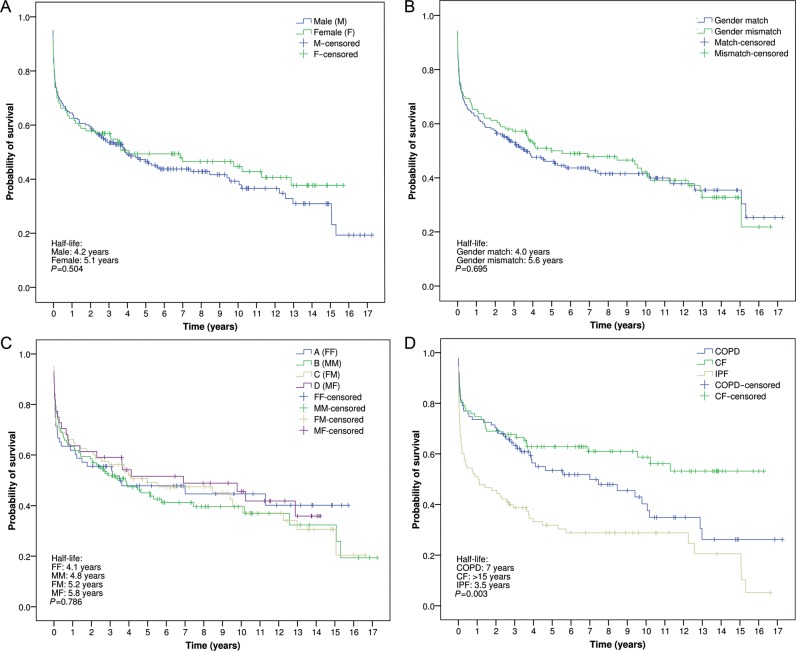
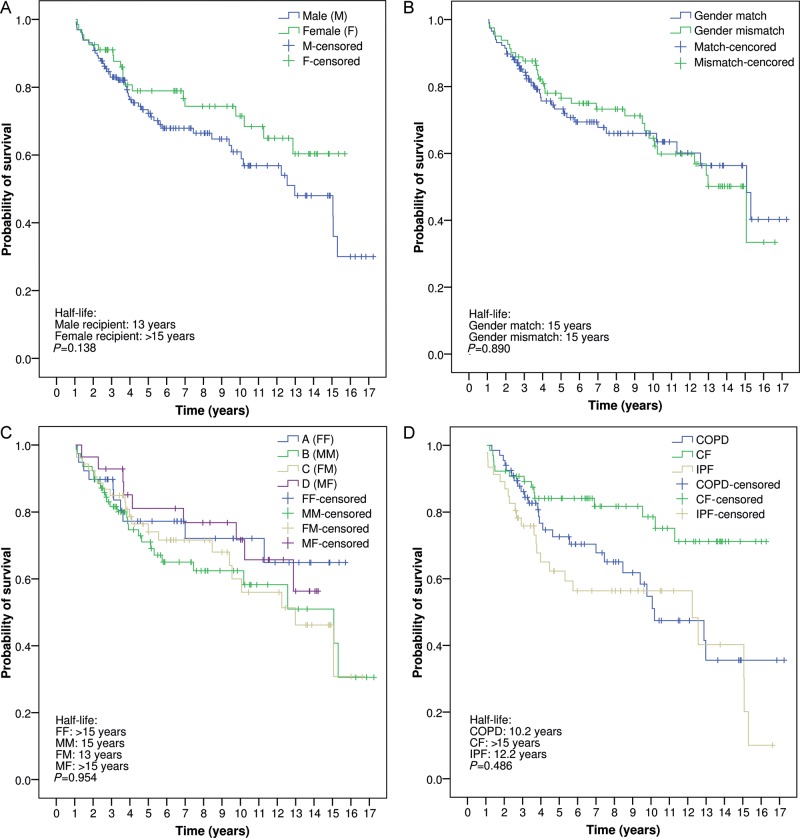
Results: Group A: 57 (22%), Group B: 99 (39%), Group C: 62 (24%), Group D: 38 (15%) transplants (P = 0.001). Donor age was 29 ± 14, 27 ± 12, 33 ± 13 and 23 ± 12 years for Groups A, B, C and D, respectively (P = 0.004). Recipient age was 31 ± 15, 44 ± 17, 42 ± 16 and 30 ± 16 years for Groups A, B, C and D, respectively (P = 0.000). PaO2/FiO2 (mmHg) 24 h post-transplant was: Group A: 276 ± 144, Group B: 297 ± 131, Group C: 344 ± 133 and Group D: 238 ± 138 (P = 0.015). Primary graft dysfunction developed in 23, 14, 17 and 21% of recipients from Groups A, B, C and D, respectively (P = 0.45). Operative mortality was 4.4, 6.5, 5.2 and 2%, for recipients from Groups A, B, C and D, respectively (P = 0.66). Freedom from BOS was 73, 59 and 36% for gender-matched transplants vs 76, 67 and 40% for gender-mismatched transplants at 3, 5 and 10 years, respectively (P = 0.618), without differences among groups. A non-significant survival benefit was observed for female recipients, irrespective of the donor gender.
Conclusions: Donor-recipient gender mismatch does not have a negative impact on early graft function and mortality following lung transplantation. There is a trend towards a survival benefit for female recipients, irrespective of the donor gender.
Figures
Comment in
-
eComment. Gender mismatching in lung transplantation: lung size mismatch is the issue!Interact Cardiovasc Thorac Surg. 2013 Apr;16(4):435-6. doi: 10.1093/icvts/ivt053. Interact Cardiovasc Thorac Surg. 2013. PMID: 23504748 Free PMC article. No abstract available.
References
-
- Lynch JP, Saggar R, Weigt SS, Ross DJ, Belperio JA. Overview of lung transplantation and criteria for selection of candidates. Semin Respir Crit Care Med. 2006;27:441–69. - PubMed
-
- Rustgi VK, Marino G, Halpern MT, Johnson LB, Umana WO, Tolleris C. Role of gender and race mismatch and graft failure in patients undergoing liver transplantation. Liver Transpl. 2002;8:514–8. - PubMed
-
- Stehlik J, Edwards LB, Kucheryavaya AY, Benden C, Christie JD, Dipchand AI, et al. The registry of the International Society for Heart and Lung Transplantation: 29th official adult heart transplant report—2012. J Heart Lung Transplant. 2012;31:1052–64. - PubMed
-
- Roberts DH, Wain JC, Chang Y, Ginns LC. Donor-recipient gender mismatch in lung transplantation: impact on obliterative bronchiolitis and survival. J Heart Lung Transplant. 2004;23:1252–59. - PubMed
Publication types
MeSH terms
LinkOut - more resources
Full Text Sources
Other Literature Sources
Medical
