


Treatment, prognostic factors, and outcomes in spinal cord astrocytomas
- PMID: 23322747
- PMCID: PMC3607259
- DOI: 10.1093/neuonc/nos309
Treatment, prognostic factors, and outcomes in spinal cord astrocytomas
Abstract
Background: Spinal astrocytomas are rare intramedullary CNS tumors for which there is limited consensus on treatment; the importance of the extent of resection (EOR), postoperative radiotherapy, and chemotherapy remains poorly understood. We report on outcomes associated with surgery, postoperative radiotherapy, and chemotherapy in a series of patients treated at M. D. Anderson Cancer Center (MDACC) with the aim of elucidating the role of these treatments in spinal astrocytomas.
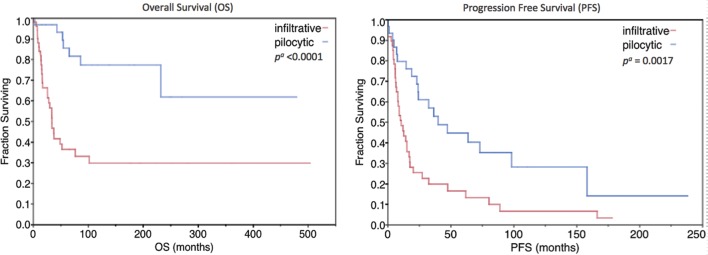
Methods: We retrospectively reviewed charts from a series of 83 patients with histologically confirmed spinal astrocytoma treated at MDACC during 1990-2011. Data collected included patient demographic characteristics, prognostic indicators, and treatment modality at diagnosis. We analyzed overall survival (OS) and progression-free survival (PFS) for pilocytic (World Health Organization [WHO] grade I) and infiltrative (WHO grades II, III, and IV) astrocytomas, separately. Multivariate analysis was performed for the infiltrative patients but not the pilocytic patients because of a limited number of cases.
Results: Higher WHO grade among all patients was associated with worse OS (P < .0001) and PFS (P = .0003). Among patients with infiltrative tumors, neither EOR nor radiotherapy was associated with a difference in outcomes in multivariate analysis; however, among patients with infiltrative astrocytomas, chemotherapy was significantly associated with improved PFS (hazard ratio = .22, P = .0075) but not OS (hazard ratio = .89, P = .83) in multivariate analysis.
Conclusion: WHO grade was the strongest prognostic indicator in patients with spinal cord astrocytomas. Our results also show that chemotherapy improved PFS in infiltrative astrocytomas in multivariate analysis, but neither EOR nor radiation therapy influenced outcomes in this group.
Figures
References
-
- Raco A, Piccirilli M, Landi A, et al. High-grade intramedullary astrocytomas: 30 years’ experience at the Neurosurgery Department of the University of Rome “Sapienza”. J Neurosurg Spine. 2010;12(2):144–153. - PubMed
-
- Minehan KJ, Brown PD, Scheithauer BW, et al. Prognosis and treatment of spinal cord astrocytoma. Int J Radiat Oncol Biol Phys. 2009;73(3):727–733. - PubMed
-
- Minehan KJ, Shaw EG, Scheithauer BW, et al. Spinal cord astrocytoma: pathological and treatment considerations. J Neurosurg. 1995;83(4):590–595. - PubMed
-
- Constantini S, Miller DC, Allen JC, et al. Radical excision of intramedullary spinal cord tumors: surgical morbidity and long-term follow-up evaluation in 164 children and young adults. J Neurosurg. 2000;93(2 Suppl):83–193. - PubMed
-
- Nakamura M, Chiba K, Ishii K, et al. Surgical outcomes of spinal cord astrocytomas. Spinal Cord. 2006;44(12):740–745. - PubMed
MeSH terms
Grants and funding
LinkOut - more resources
Full Text Sources
Other Literature Sources
Medical
