Systems-level analysis of proteolytic events in increased vascular permeability and complement activation in skin inflammation
- PMID: 23322905
- PMCID: PMC3872078
- DOI: 10.1126/scisignal.2003512
Systems-level analysis of proteolytic events in increased vascular permeability and complement activation in skin inflammation
Abstract
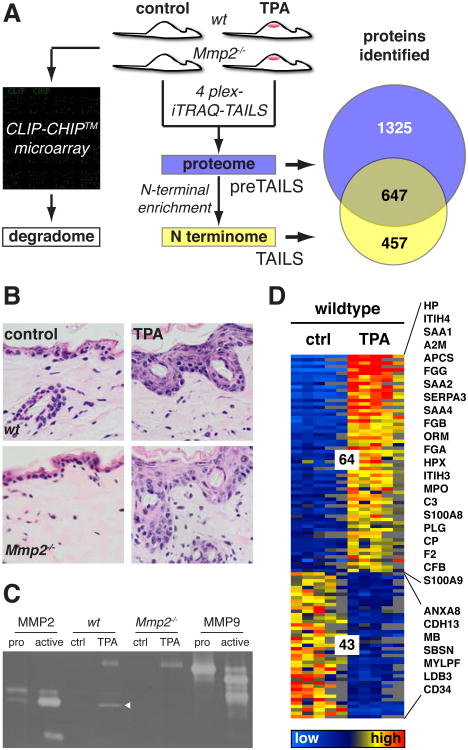
During inflammation, vascular permeability is increased by various proteolytic events, such as the generation of bradykinin, that augment local tissue responses by enabling tissue penetration of serum proteins, including complement and acute-phase proteins. Proteases also govern inflammatory responses by processing extracellular matrix proteins and soluble bioactive mediators. We quantified changes in the proteome and the nature of protein amino termini (the N-terminome) and the altered abundance of murine proteases and inhibitors during skin inflammation. Through analysis of the N-terminome by iTRAQ-TAILS, we identified cotranslational and posttranslational αN-acetylation motifs, quantitative increases in protein abundance, and qualitative changes in the proteolytic signature during inflammation. Of the proteins identified in normal skin, about half were cleaved, and phorbol ester-induced inflammation increased the proportion of cleaved proteins, including chemokines and complement proteins, that were processed at previously uncharacterized sites. In response to phorbol ester-induced inflammation, mice deficient in matrix metalloproteinase 2 (MMP2) showed reduced accumulation of serum proteins in the skin and exhibited different proteolytic networks from those of wild-type mice. We found that the complement 1 (C1) inhibitor attenuated the increase in serum protein accumulation in inflamed skin. Cleavage and inactivation of the C1 inhibitor by MMP2 increased complement activation and bradykinin generation in wild-type mice, leading to increased vessel permeability during inflammation, which was diminished in Mmp2(-/-) mice. Thus, our systems-level analysis of proteolysis dissected cleavage events associated with skin inflammation and demonstrated that loss of a single protease could perturb the proteolytic signaling network and enhance inflammation.
Conflict of interest statement
Figures


References
-
- Parks WC, Wilson CL, Lopez-Boado YS. Matrix metalloproteinases as modulators of inflammation and innate immunity. Nat Rev Immunol. 2004;4:617–629. - PubMed
-
- Doucet A, Butler GS, Rodriguez D, Prudova A, Overall CM. Metadegradomics: toward in vivo quantitative degradomics of proteolytic post-translational modifications of the cancer proteome. Mol Cell Proteomics. 2008;7:1925–1951. - PubMed
-
- Lange PF, Overall CM. Protein TAILS: when termini tell tales of proteolysis and function. Curr Opin Chem Biol. 2012 http://dx.doi.org/10.1016/j.cbpa.2012.1011.1025. - DOI - PubMed
-
- Riddel JP, Jr, Aouizerat BE, Miaskowski C, Lillicrap DP. Theories of blood coagulation. J Pediatr Oncol Nurs. 2007;24:123–131. - PubMed
Publication types
MeSH terms
Substances
Grants and funding
LinkOut - more resources
Full Text Sources
Other Literature Sources
Molecular Biology Databases
Miscellaneous