Serum bilirubin levels are inversely associated with nonalcoholic fatty liver disease
- PMID: 23323254
- PMCID: PMC3540375
- DOI: 10.3350/cmh.2012.18.4.383
Serum bilirubin levels are inversely associated with nonalcoholic fatty liver disease
Abstract
Background/aims: Serum bilirubin exerts antioxidant and cytoprotective effects. In addition, elevated serum bilirubin levels are associated with a decreased risk of metabolic and cardiovascular diseases. However, few studies have evaluated whether serum bilirubin is associated with non-alcoholic fatty liver disease (NAFLD), which is closely associated with other metabolic diseases. The aim of this study was thus to elucidate the association between serum total bilirubin levels and NAFLD.
Methods: A cross-sectional study of 17,348 subjects undergoing a routine health check-up was conducted. Subjects positive for hepatitis B or hepatitis C virus, or with other hepatitis history were excluded. NAFLD was diagnosed on the basis of typical ultrasonographic findings and an alcohol consumption of less than 20 g/day.
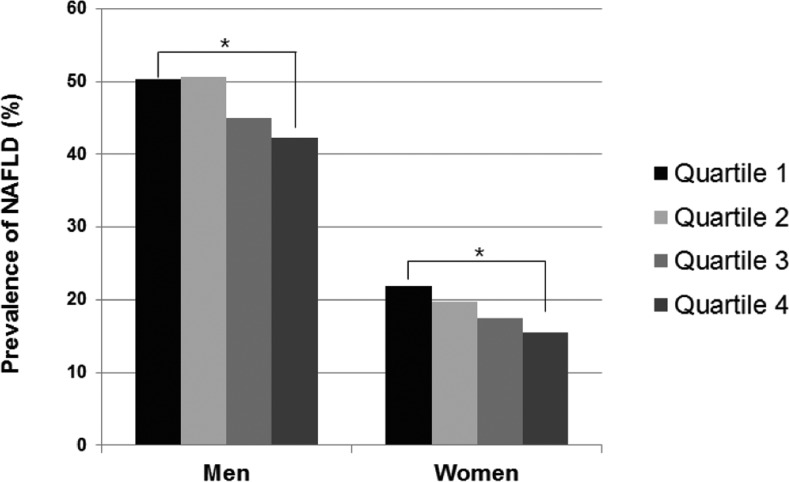
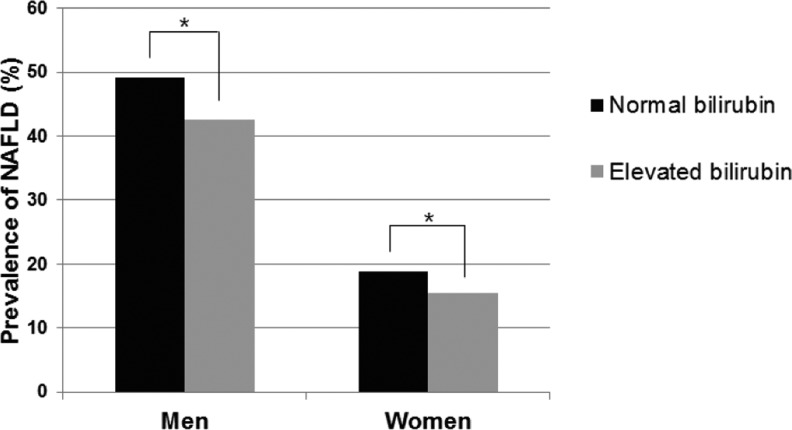
Results: The mean age of the subjects was 49 years and 9,076 (52.3%) were men. The prevalence of NAFLD decreased steadily as the serum bilirubin level increased in both men and women (P<0.001 for both). Multivariate regression analysis adjusted for other metabolic risk factors showed that serum bilirubin level was inversely associated with the prevalence of NAFLD [odds ratio (OR)=0.88, 95% confidence interval (CI)=0.80-0.97]. Furthermore, there was an inverse, dose-dependent association between NAFLD and serum total bilirubin levels (OR=0.83, 95% CI=0.75-0.93 in the third quartile; OR=0.80, 95% CI=0.71-0.90 in the fourth quartile vs. lowest quartile, P for trend <0.001).
Conclusions: Serum bilirubin levels were found to be inversely associated with the prevalence of NAFLD independent of known metabolic risk factors. Serum bilirubin might be a protective marker for NAFLD.
Keywords: Bilirubin; Nonalcoholic fatty liver disease (NAFLD).
Conflict of interest statement
The authors have no conflicts to disclose.
Figures
Comment in
-
Elevated serum bilirubin levels are inversely associated with nonalcoholic fatty liver disease.Clin Mol Hepatol. 2012 Dec;18(4):357-9. doi: 10.3350/cmh.2012.18.4.357. Epub 2012 Dec 21. Clin Mol Hepatol. 2012. PMID: 23323250 Free PMC article. No abstract available.
References
-
- Browning JD, Szczepaniak LS, Dobbins R, Nuremberg P, Horton JD, Cohen JC, et al. Prevalence of hepatic steatosis in an urban population in the United States: impact of ethnicity. Hepatology. 2004;40:1387–1395. - PubMed
-
- Neuschwander-Tetri BA, Caldwell SH. Nonalcoholic steatohepatitis: summary of an AASLD Single Topic Conference. Hepatology. 2003;37:1202–1219. - PubMed
-
- Salamone F, Bugianesi E. Nonalcoholic fatty liver disease: the hepatic trigger of the metabolic syndrome. J Hepatol. 2010;53:1146–1147. - PubMed
-
- Choi SY, Kim D, Kim HJ, Kang JH, Chung SJ, Park MJ, et al. The relation between non-alcoholic fatty liver disease and the risk of coronary heart disease in Koreans. Am J Gastroenterol. 2009;104:1953–1960. - PubMed
Publication types
MeSH terms
Substances
LinkOut - more resources
Full Text Sources
Medical