


Risk factors for antepartum stillbirth and the influence of maternal age in New South Wales Australia: a population based study
- PMID: 23324309
- PMCID: PMC3552834
- DOI: 10.1186/1471-2393-13-12
Risk factors for antepartum stillbirth and the influence of maternal age in New South Wales Australia: a population based study
Abstract
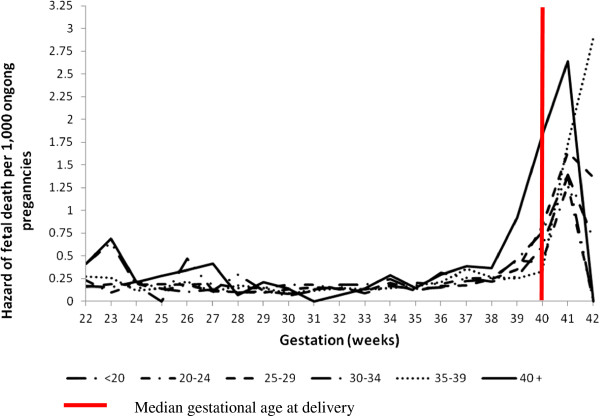
Background: Maternal age is a known risk factor for stillbirth and delayed childbearing is a societal norm in developed country settings. The timing and reasons for age being a risk factor are less clear. This study aimed to document the gestational specific risk of maternal age throughout pregnancy and whether the underlying causes of stillbirth differ for older women.
Methods: Using linkage of state maternity and perinatal death data collections the authors assessed risk factors for antepartum stillbirth in New South Wales Australia for births between 2002 - 2006 (n = 327,690) using a Cox proportional hazards model. Gestational age specific risk was calculated for different maternal age groups. Deaths were classified according to the Perinatal Mortality Classifications of the Perinatal Society of Australia and New Zealand.
Results: Maternal age was a significant independent risk factor for antepartum stillbirth (35 - 39 years HR 1.4 95% CI 1.12 - 1.75; ≥ 40 years HR 2.41 95% CI 1.8 - 3.23). Other significant risk factors were smoking HR 1.82 (95% CI 1.56 -2.12) nulliparity HR 1.23 (95% CI 1.08 - 1.40), pre-existing hypertension HR 2.77 (95% CI 1.94 - 3.97) and pre-existing diabetes HR 2.65 (95% CI 1.63 - 4.32). For women aged 40 or over the risk of antepartum stillbirth beyond 40 weeks was 1 in 455 ongoing pregnancies compared with 1 in 1177 ongoing pregnancies for those under 40. This risk was increased in nulliparous women to 1 in 247 ongoing pregnancies. Unexplained stillbirths were the most common classification for all women, stillbirths classified as perinatal infection were more common in the women aged 40 or above.
Conclusions: Women aged 35 or older in a first pregnancy should be counselled regarding stillbirth risk at the end of pregnancy to assist with informed decision making regarding delivery. For women aged 40 or older in their first pregnancy it would be reasonable to offer induction of labour by 40 weeks gestation.
Figures
References
-
- Cousens S, Blencowe H, Stanton C, Chou D, Ahmed S, Steinhardt L, Creanga AA, Tuncalp O, Balsara ZP, Gupta S. et al. National, regional, and worldwide estimates of stillbirth rates in 2009 with trends since 1995: a systematic analysis. Lancet. 2011;377(9774):1319–1330. doi: 10.1016/S0140-6736(10)62310-0. - DOI - PubMed
-
- Laws PJ, Sullivan EA. Australia’s mothers and babies 2007. Sydney: AIHW National Perinatal Statistics Unit (Perinatal Statistics Series no. 23); 2009. (AIHW Cat No PER 48).
-
- Flenady V, Koopmans L, Middleton P, Froen JF, Smith GC, Gibbons K, Coory M, Gordon A, Ellwood D, McIntyre HD. et al. Major risk factors for stillbirth in high-income countries: a systematic review and meta-analysis. Lancet. 2011;377(9774):1331–1340. doi: 10.1016/S0140-6736(10)62233-7. - DOI - PubMed
MeSH terms
LinkOut - more resources
Full Text Sources
Other Literature Sources
Medical
Molecular Biology Databases
