. 2013 Jan 16:8:13.
doi: 10.1186/1750-1172-8-13.

Partial protoporphyrinogen oxidase (PPOX) gene deletions, due to different Alu-mediated mechanisms, identified by MLPA analysis in patients with variegate porphyria

Affiliations

Partial protoporphyrinogen oxidase (PPOX) gene deletions, due to different Alu-mediated mechanisms, identified by MLPA analysis in patients with variegate porphyria

Michela Barbaro et al. Orphanet J Rare Dis. .

Abstract

Variegate porphyria (VP) is an autosomal dominantly inherited hepatic porphyria. The genetic defect in the PPOX gene leads to a partial defect of protoporphyrinogen oxidase, the penultimate enzyme of heme biosynthesis. Affected individuals can develop cutaneous symptoms in sun-exposed areas of the skin and/or neuropsychiatric acute attacks. The identification of the genetic defect in VP families is of crucial importance to detect the carrier status which allows counseling to prevent potentially life threatening neurovisceral attacks, usually triggered by factors such as certain drugs, alcohol or fasting.In a total of 31 Swedish VP families sequence analysis had identified a genetic defect in 26. In the remaining five families an extended genetic investigation was necessary. After the development of a synthetic probe set, MLPA analysis to screen for single exon deletions/duplications was performed.We describe here, for the first time, two partial deletions within the PPOX gene detected by MLPA analysis. One deletion affects exon 5 and 6 (c.339-197_616+320del1099) and has been identified in four families, most probably after a founder effect. The other extends from exon 5 to exon 9 (c.339-350_987+229del2609) and was found in one family. We show that both deletions are mediated by Alu repeats.Our findings emphasize the usefulness of MLPA analysis as a complement to PPOX gene sequencing analysis for comprehensive genetic diagnostics in patients with VP.


Figures
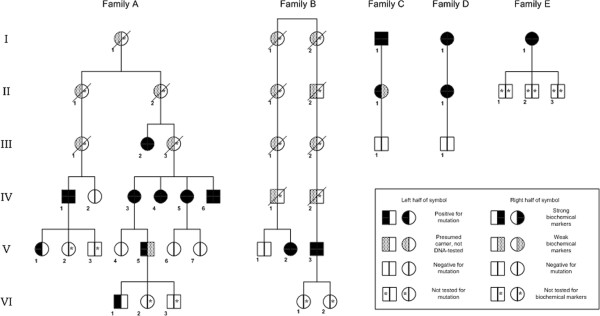
Figure 1
Figure 1
Pedigrees of VP families carrying partial PPOX deletion. Pedigrees of the five families carrying partial PPOX deletion with DNA results and markers for biochemical symptoms. In families A-D affected members carry an exon 5–6 deletion. In family E the patient carries an exon 5–9 deletion. Members in family A-D for whom neither biochemical nor genetic investigation were performed are omitted for simplification.
Figure 2
Figure 2
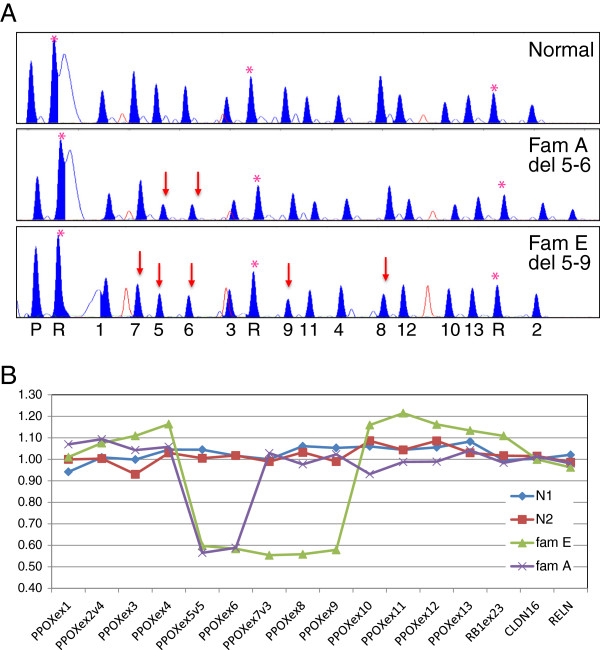
PPOX probe set MLPA results. (A). MLPA trace results for the PPOX probe set in patients belonging to VP families A and E, and two normal controls (N1 and N2) used as reference. Peaks corresponding to control probes are labeled (*). On the X-axis at the bottom of the figure the numbers indicate the PPOX exon to which the peak corresponds; P the pilot probe; R the reference probes. Red arrows indicate the deleted probes. (B). Graph showing the analysis results from Excel. Probes on the PPOX gene are ordered according to their location along the gene. Internal reference probes are included and show a ratio value near 1. The ratio values near 0.5 indicate a heterozygous deletion for the corresponding probes.
Figure 3
Figure 3
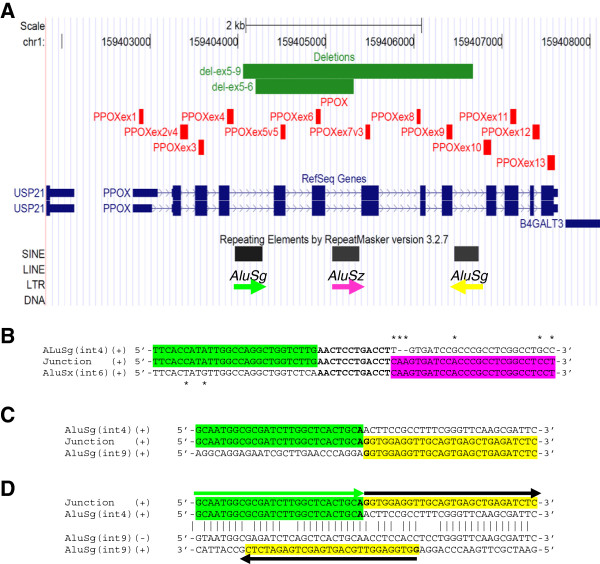
PPOX MLPA probe set and deletion characterizations. (A). Representation from the UCSC genome browser (Mar2006. NCBI36, hg18) of the protoporphyrinogen (PPOX) gene locus on 1q22-23. Probes included in the 'PPOX MLPA probe set' are represented as vertical red lines. Deletions are represented by horizontal green lines. Repeats identified by Repeat Masker are represented by black boxes, arrows underneath indicate the respective genomic orientation. The colour of the arrow is used to highlight the sequence of the corresponding Alu in the sequence analysis showed below. (B). Sequence analysis of the exon 5–6 deletion junction. Partial alignment of the AluSg within intron 4, the deletion junction sequence and the AluSx within intron 6. Single nucleotide differences between the two Alu repeats are denoted by an asterisk (*). Nucleotides in the region of complete homology are bolded. (C). Sequence analysis of the exon 5–9 deletion junction. Partial alignment of the deletion junction with the AluSg within intron 4 and within intron 9, respectively. The two nucleotides at the junction site are bolded. (D). Partial alignment between the AluSg within intron 4 and the AluSg within intron 9, showing the homology between the two AluSg and their inverted orientation. Vertical lines denote identical nucleotides; (+) and (−) indicate the positive and negative filament, respectively. The junction sequence and the positive filament of intron 9 AluSg are shown together with arrows to facilitate the understanding of the rearrangement.

References

    1. Puy H, Gouya L, Deybach JC. Porphyrias. Lancet. 2010;375:924–937. doi: 10.1016/S0140-6736(09)61925-5. - DOI - PubMed
    1. Hift RJ, Meissner D, Meissner PN. A systematic study of the clinical and biochemical expression of variegate porphyria in a large South African family. Br J Dermatol. 2004;151:465–471. doi: 10.1111/j.1365-2133.2004.06120.x. - DOI - PubMed
    1. Von Und Zu Fraunberg M, Timonen K, Mustajoki P, Kauppinen R. Clinical and biochemical characteristics and genotype-phenotype correlation in Finnish variegate porphyria patients. Eur J Hum Genet. 2002;10:649–657. doi: 10.1038/sj.ejhg.5200860. - DOI - PubMed
    1. Meissner P, Adams P, Kirsch R. Allosteric inhibition of human lymphoblast and purified porphobilinogen deaminase by protoporphyrinogen and coproporphyrinogen. A possible mechanism for the acute attack of variegate porphyria. J Clin Invest. 1993;91:1436–1444. doi: 10.1172/JCI116348. - DOI - PMC - PubMed
    1. Wiman Å, Harper P, Floderus Y. Nine novel mutations in the protoporphyrinogen oxidase gene in Swedish families with variegate porphyria. Clin Genet. 2003;64:122–130. doi: 10.1034/j.1399-0004.2003.00116.x. - DOI - PubMed

LinkOut - more resources