Long-term follow-up and survival of patients following a recurrence of melanoma after a negative sentinel lymph node biopsy result
- PMID: 23325294
- PMCID: PMC3856253
- DOI: 10.1001/jamasurg.2013.1335
Long-term follow-up and survival of patients following a recurrence of melanoma after a negative sentinel lymph node biopsy result
Abstract
Objective: To analyze the predictors and patterns of recurrence of melanoma in patients with a negative sentinel lymph node biopsy result.
Design: Retrospective chart review of a prospectively created database of patients with cutaneous melanoma. SETTING Tertiary university hospital.
Patients: A total of 515 patients with melanoma underwent a sentinel lymph node biopsy without evidence of metastatic disease between 1996 and 2008.
Main outcome measures: Time to recurrence and overall survival.
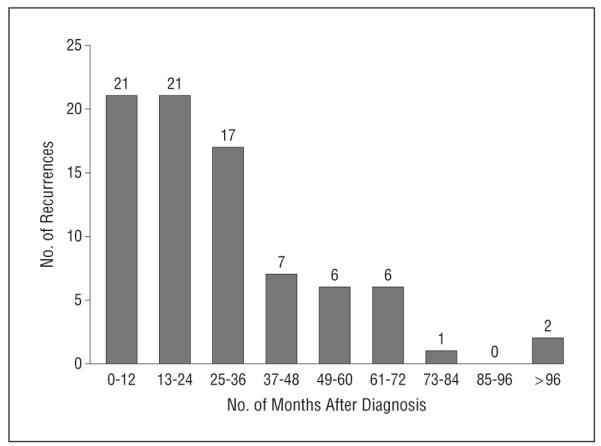
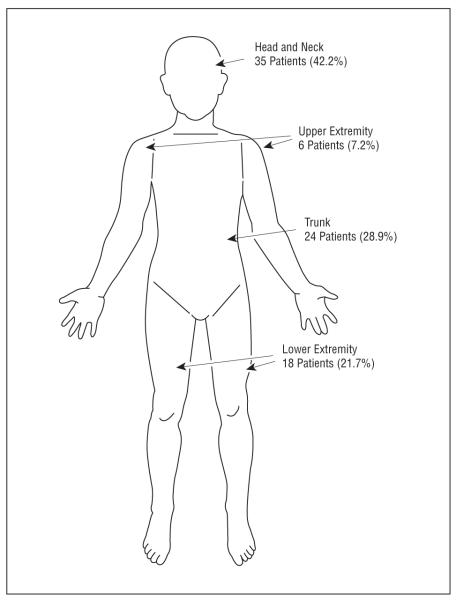
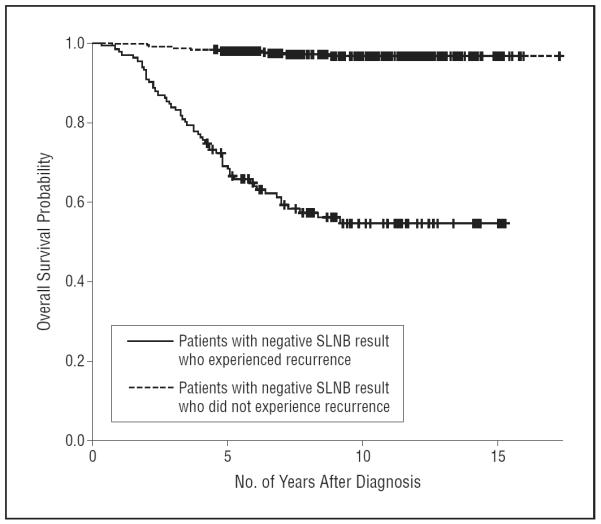
Results: Of 515 patients, 83 (16%) had a recurrence of melanoma at a median of 23 months during a median follow-up of 61 months (range, 1-154 months). Of these 83 patients, 21 had melanoma that metastasized in the studied nodal basin for an in-basin false-negative rate of 4.0%. Patients with recurrence had deeper primary lesions (mean thickness, 2.7 vs 1.8 mm; P < .01) that were more likely to be ulcerated (32.5% vs 13.5%; P < .001) than those without recurrence. The primary melanoma of patients with recurrence was more likely to be located in the head and neck region compared with all other locations combined (31.8% vs 11.7%; P < .001). Median survival following a recurrence was 21 months (range, 1-106 months). Favorable characteristics associated with lower risk of recurrence included younger age at diagnosis (mean, 49 vs 57 years) and female sex (9% vs 21% for males; P < .001).
Conclusion: Overall, recurrence of melanoma (16%) after a negative sentinel lymph node biopsy result was similar to that in previously reported studies with an in-basin false-negative rate of 4.0%. Lesions of the head and neck, the presence of ulceration, increasing Breslow thickness, older age, and male sex are associated with increased risk of recurrence, despite a negative sentinel lymph node biopsy result.
Figures
Comment in
-
Early diagnosis of metastatic disease in melanoma: does it make a difference?: Comment on "Long-term follow-up and survival of patients following a recurrence of melanoma after a negative sentinel lymph node biopsy result".JAMA Surg. 2013 May;148(5):462. doi: 10.1001/jamasurg.2013.1345. JAMA Surg. 2013. PMID: 23325337 No abstract available.
References
-
- Cancer facts and figures 2005. American Cancer Society; [Accessed April 27, 2012]. website. http://www.cancer.org/research/cancerfactsfigures/cancerfactsfigures/can....
-
- Siegel R, Naishadham D, Jemal A. Cancer statistics, 2012. CA Cancer J Clin. 2012;62(1):10–29. - PubMed
-
- Kretschmer L, Starz H, Thoms KM, et al. Age as a key factor influencing metastasizing patterns and disease-specific survival after sentinel lymph node biopsy for cutaneous melanoma. Int J Cancer. 2011;129(6):1435–1442. - PubMed
-
- Balch CM, Soong SJ, Murad TM, Ingalls AL, Maddox WA. A multifactorial analysis of melanoma: II, prognostic factors in patients with stage I (localized) melanoma. Surgery. 1979;86(2):343–351. - PubMed
MeSH terms
Grants and funding
LinkOut - more resources
Full Text Sources
Other Literature Sources
Medical