


Perception of silent and motionless prey on vegetation by echolocation in the gleaning bat Micronycteris microtis
- PMID: 23325775
- PMCID: PMC3574334
- DOI: 10.1098/rspb.2012.2830
Perception of silent and motionless prey on vegetation by echolocation in the gleaning bat Micronycteris microtis
Abstract
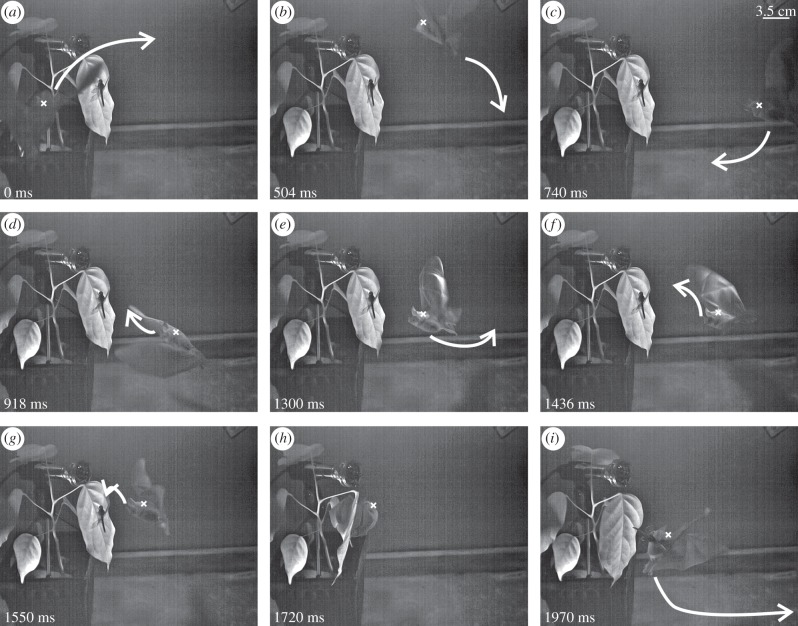
Gleaning insectivorous bats that forage by using echolocation within dense forest vegetation face the sensorial challenge of acoustic masking effects. Active perception of silent and motionless prey in acoustically cluttered environments by echolocation alone has thus been regarded impossible. The gleaning insectivorous bat Micronycteris microtis however, forages in dense understory vegetation and preys on insects, including dragonflies, which rest silent and motionless on vegetation. From behavioural experiments, we show that M. microtis uses echolocation as the sole sensorial modality for successful prey perception within a complex acoustic environment. All individuals performed a stereotypical three-dimensional hovering flight in front of prey items, while continuously emitting short, multi-harmonic, broadband echolocation calls. We observed a high precision in target localization which suggests that M. microtis perceives a detailed acoustic image of the prey based on shape, surface structure and material. Our experiments provide, to our knowledge, the first evidence that a gleaning bat uses echolocation alone for successful detection, classification and precise localization of silent and motionless prey in acoustic clutter. Overall, we conclude that the three-dimensional hovering flight of M. microtis in combination with a frequent emission of short, high-frequency echolocation calls is the key for active prey perception in acoustically highly cluttered environments.
Figures


Comment in
-
Sensory biology: listening in the dark for echoes from silent and stationary prey.Curr Biol. 2013 Mar 18;23(6):R249-51. doi: 10.1016/j.cub.2013.02.016. Curr Biol. 2013. PMID: 23518059
References
-
- Griffin DR. 1986. Listening in the dark, 2nd edn Ithaca, NY: Cornell University Press
-
- Johnson M, Madsen PT, Zimmer WMX, de Soto NA, Tyack PL. 2004. Beaked whales echolocate on prey. Proc. R. Soc. Lond. B 271, S383–S386 10.1098/rsbl.2004.0208 (doi:10.1098/rsbl.2004.0208) - DOI - PMC - PubMed
-
- Au WWL. 1993. The sonar of dolphins. New York, NY: Springer
-
- Novick A. 1959. Acoustic orientation in the cave swiftlet. Biol. Bull. 117, 497–503 10.1103/PhysRevE.66.035103 (doi:10.1103/PhysRevE.66.035103) - DOI
-
- Konishi M, Knudsen EI. 1979. The oilbird: hearing and echolocation. Science 204, 425–427 10.1126/science.441731 (doi:10.1126/science.441731) - DOI - PubMed
Publication types
MeSH terms
LinkOut - more resources
Full Text Sources
Other Literature Sources
