Effect of intravenous infusion of dexmedetomidine on perioperative haemodynamic changes and postoperative recovery: A study with entropy analysis
- PMID: 23325938
- PMCID: PMC3546240
- DOI: 10.4103/0019-5049.104571
Effect of intravenous infusion of dexmedetomidine on perioperative haemodynamic changes and postoperative recovery: A study with entropy analysis
Abstract
Background: Dexmedetomidine, an α2 agonist, when used as an adjuvant in general anaesthesia attenuates stress response to various noxious stimuli, maintains perioperative haemodynamic stability and provides sedation without significant respiratory depression postoperatively.
Methods: Sixty patients were randomly divided into two groups of 30 each. In group A, fentanyl 2 μg/kg and in group B dexmedetomidine were given intravenously as loading dose of 1 μg/kg over 10 min prior to induction. After induction with thiopentone, in group B, dexmedetomidine was given as infusion at a dose of 0.2-0.8 μg/kg. Sevoflurane was used as inhalation agent in both groups. Haemodynamic variables and entropy (response entropy and state entropy) were recorded continuously. Postoperative sedation and recovery were assessed by sedation score and modified Aldrete's score, respectively.
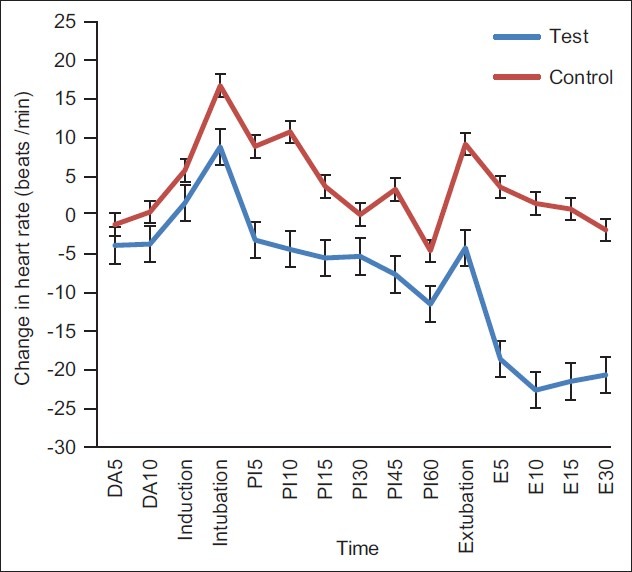
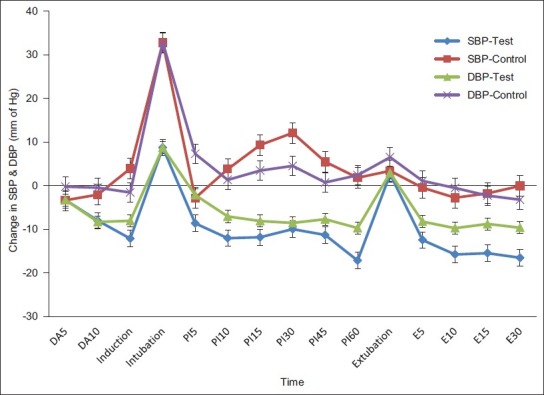
Results: Dexmedetomidine significantly attenuates stress response at intubation with lesser increase in heart rate (10% vs. 17%), systolic blood pressure (6% vs. 23%) and diastolic blood pressure (7% vs. 20%) as compared to the control group (P<0.05). Intraoperatively, an average of 8% fall in systolic blood pressure and 8.16% fall in diastolic pressure in the test group as compared to 3.6% rise in systolic and 3.3% in diastolic pressure of the control group was observed. Postoperatively, the test group showed significant sedation at 2 h as compared to the control group (P=0.00) and recovery was better in the control group for the first 2 h post extubation.
Conclusion: Dexmedetomidine attenuates various stress responses during surgery and maintains the haemodynamic stability when used as an adjuvant in general anaesthesia. Also, the sedative action of dexmedetomidine delays recovery for the first few hours post extubation.
Keywords: Dexmedetomidine; entropy; perioperative haemodynamics; recovery.
Conflict of interest statement
Figures
References
-
- Savola JM, Ruskoaho H, Puurunen J, Salonen JS, Kärki NT. Evidence for medetomidine as a selective and potent agonist at alpha 2-adrenoreceptors. J Auton Pharmacol. 1986;6:275–84. - PubMed
-
- Gurbet A, Basagan-Mogol E, Turker G, Ugun F, Kaya FN, Ozcan B. Intraoperative infusion of dexmedetomidine reduces perioperative analgesic requirements. Can J Anaesth. 2006;53:646–52. - PubMed
-
- Ebert TJ, Hall JE, Barney JA, Uhrich TD, Colinco MD. The effects of increasing plasma concentrations of dexmedetomidine in humans. Anesthesiology. 2000;93:382–94. - PubMed
-
- Hall JE, Uhrich TD, Barney JA, Arain SR, Ebert TJ. Sedative, amnestic, and analgesic properties of small-dose dexmedetomidine infusions. Anesth Analg. 2000;90:699–705. - PubMed
-
- White PF, Song D. New criteria for fast-tracking after outpatient anesthesia: A comparison with the modified Aldrete's scoring system. Anesth Analg. 1999;88:1069–72. - PubMed