


Predictive value of auricular diagnosis on coronary heart disease
- PMID: 23326290
- PMCID: PMC3544543
- DOI: 10.1155/2012/706249
Predictive value of auricular diagnosis on coronary heart disease
Abstract
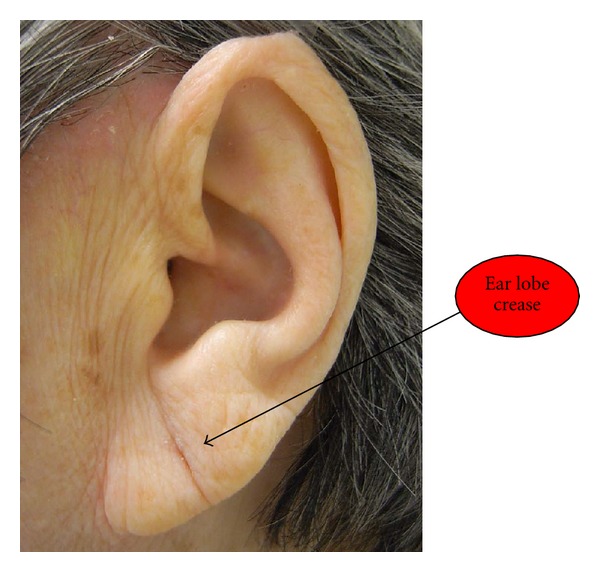
The ear has a reflexive property; therefore, various physical attributes may appear on the auricle when disorders of the internal organs or other parts of the body exist. Auricular diagnostics is an objective, painless, and noninvasive method that provides rapid access to information. Thus, the association between auricular signals and coronary heart disease (CHD) should be further investigated. A case control study was conducted to determine the predictive value of auricular signals on 100 cases of CHD (CHD+ve = 50; CHD-ve = 50) via visual inspection, electrical skin resistance measurement, and tenderness testing. The results showed that the presence of an ear lobe crease (ELC) was significantly associated with coronary heart disease. The "heart" zone of the CHD+ve group significantly exhibited higher conductivity on both ears than that of the controls. The CHD+ve group experienced significant tenderness in the "heart" region compared with those in the CHD-ve group in both acute and chronic conditions. Further studies that take into consideration the impact of age, race, and earlobe shape on ELC prevalence in a larger sample should be done.
Figures
References
-
- Feng CX, Bai XH, Du Y. Chinese Auricular Therapy. Chinese-English edition. Beijing, China: Scientific and Technical Documents Publishing House; 1994.
-
- Abbate S. Chinese Auricular Acupuncture. Boca Raton, Fla, USA: CRC Press; 2004.
-
- Oleson T. Auriculotherapy Manual. 3rd edition. New York, NY, USA: Churchill Livingstone; 2003.
-
- Frank ST. Aural sign of coronary-artery disease. New England Journal of Medicine. 1973;289(6):327–328. - PubMed
-
- Elliott WJ, Karrison T. Increased all-cause and cardiac morbidity and mortality associated with the diagonal earlobe crease: a prospective cohort study. American Journal of Medicine. 1991;91(3):247–254. - PubMed
LinkOut - more resources
Full Text Sources
