


Non-alcoholic fatty liver disease is closely associated with sub-clinical inflammation: a case-control study on Asian Indians in North India
- PMID: 23326306
- PMCID: PMC3543427
- DOI: 10.1371/journal.pone.0049286
Non-alcoholic fatty liver disease is closely associated with sub-clinical inflammation: a case-control study on Asian Indians in North India
Abstract
Objectives: Association between sub-clinical inflammation and non-alcoholic fatty liver disease (NAFLD) has not been studied in Asian Indians. In this case-control study, we aimed to analyse association of NAFLD with the sub-clinical inflammation and metabolic profile in Asian Indians in north India.
Methods: Ultrasound diagnosed 120 cases of NAFLD were compared to 152 healthy controls without NAFLD. Anthropometric profile [body mass index (BMI), waist circumference (WC), hip circumference (HC)], high-sensitivity C-reactive protein (hs-CRP), metabolic profile [fasting blood glucose (FBG), lipid profile] and hepatic function tests [alanine aminotransferase (ALT) and aspartate aminotransferase (AST)] were recorded.
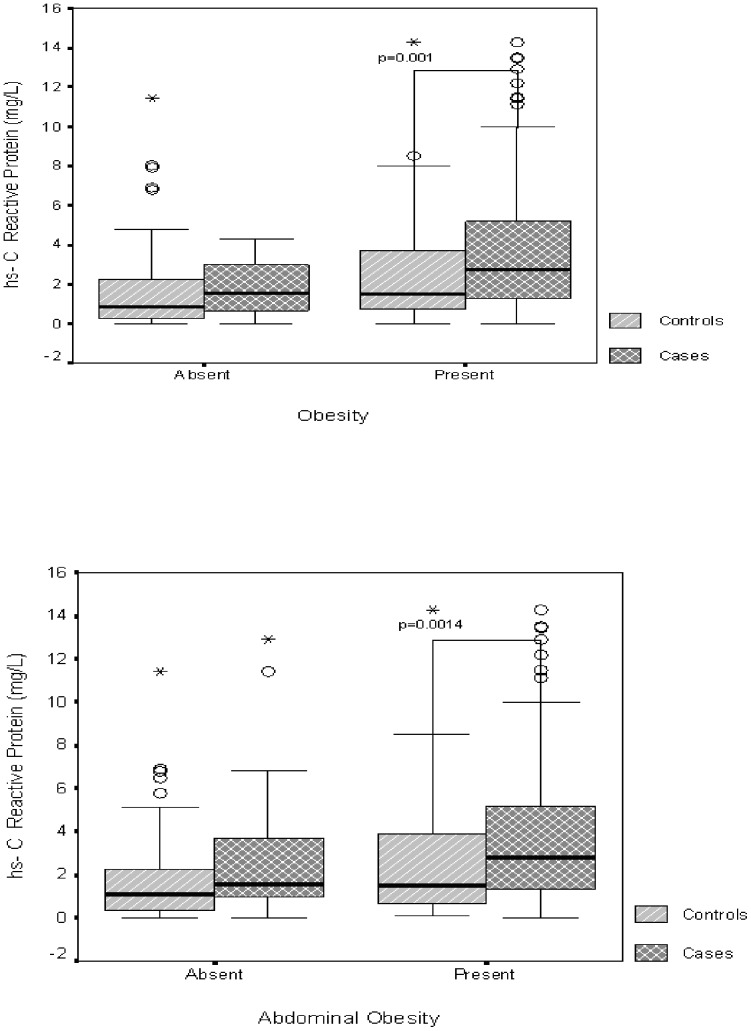
Results: Metabolic parameters [FBG, total cholesterol (TC), serum triglycerides (TG),low-density lipoprotein (LDL-c)], hs-CRP and prevalence of the metabolic syndrome were higher in cases as compared to controls (p-value<0.05 for all). The median (range) of hs-CRP (mg/L) for cases [2.6(0.2-13.4)] were significantly higher than in controls [1.4(0.03-11.4), p = 0.01]. Similarly, higher values of hs-CRP were obtained when subgroups of cases with obesity, abdominal obesity and the metabolic syndrome were compared to controls [2.75 (0.03-14.3) vs. 1.52 (0.04-14.3), p = 0.0010; 2.8 (0.03-14.3) vs. 1.5 (0.06-14.3), p = 0.0014 and 2.7 (0.5-14.3) vs. 1.6 (0.06-8.5), p = 0.0013, respectively. On multivariate logistic regression analysis BMI (p = 0.001), WC (p = 0.001), FBG (p = 0.002), TC (p = 0.008), TG (p = 0.002), blood pressure (p = 0.005), metabolic syndrome (p = 0.001) and hs-CRP (p = 0.003) were significantly and independently associated with NAFLD. After adjusting for significant variables, the association between high hs-CRP and NAFLD remained large and statistically significant [adjusted OR = 1.17, 95% confidence interval (CI) = 1.05-1.29]. An increase in 1 mg/dl of hs-CRP level calculated to increase the risk of developing NAFLD by 1.7 times as compared to controls after adjusting for significant variables associated with NAFLD.
Conclusions: In this cohort of Asian Indians in North India, presence of NAFLD showed independent relationships with sub-clinical inflammation.
Conflict of interest statement
Figures
References
-
- Ridker PM, Buring JE, Cook NR, Rifai N (2003) C-reactive protein, the metabolic syndrome, and risk of incident cardiovascular events: an 8-year follow-up of 14 719 initially healthy American women. Circulation 107: 391–7. - PubMed
-
- Barzilay JI, Abraham L, Heckbert SR, Cushman M, Kuller LH, et al. (2001) The relation of markers of inflammation to the development of glucose disorders in the elderly: the Cardiovascular Health Study. Diabetes 50: 2384–9. - PubMed
-
- Ridker PM, Rifai N, Cook NR, Bradwin G, Buring JE (2005) Non-HDL cholesterol, apolipoproteins A-I and B100, standard lipid measures, lipid ratios, and CRP as risk factors for cardiovascular disease in women. Jama 294: 326–33. - PubMed
-
- Vikram NK, Misra A, Dwivedi M, Sharma R, Pandey RM, et al. (2003) Correlations of C-reactive protein levels with anthropometric profile, percentage of body fat and lipids in healthy adolescents and young adults in urban North India. Atherosclerosis 168: 305–13. - PubMed
-
- Socha P, Wierzbicka A, Neuhoff-Murawska J, Wlodarek D, Podlesny J, et al. (2007) Nonalcoholic fatty liver disease as a feature of the metabolic syndrome. Rocz Panstw Zakl Hig 58: 129–37. - PubMed
Publication types
MeSH terms
Substances
LinkOut - more resources
Full Text Sources
Other Literature Sources
Medical
Research Materials
Miscellaneous
