


VEGF, HIF-1α expression and MVD as an angiogenic network in familial breast cancer
- PMID: 23326384
- PMCID: PMC3543407
- DOI: 10.1371/journal.pone.0053070
VEGF, HIF-1α expression and MVD as an angiogenic network in familial breast cancer
Abstract
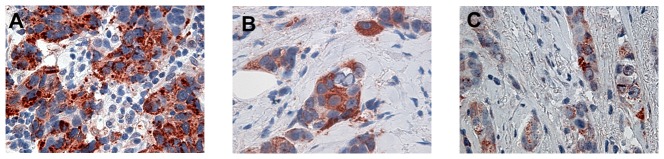
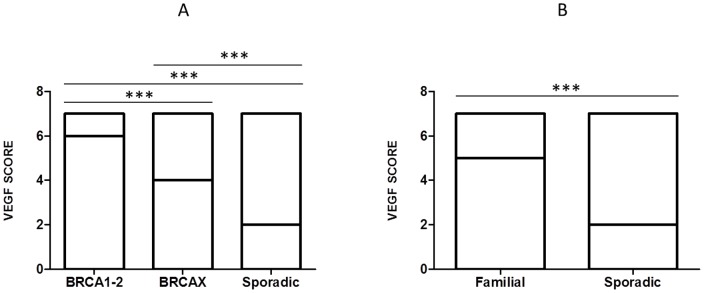
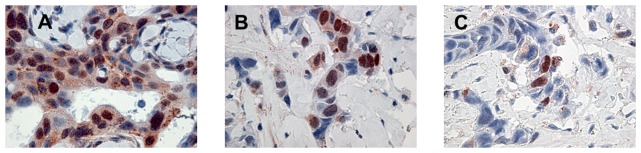
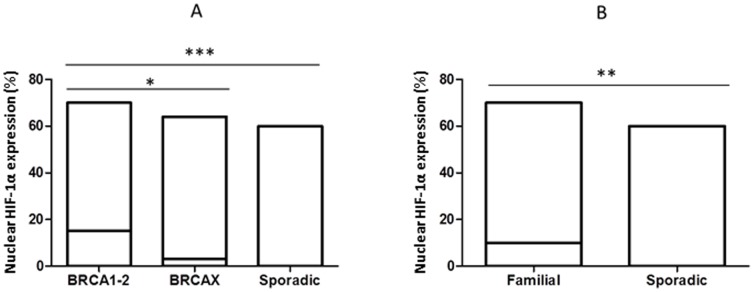
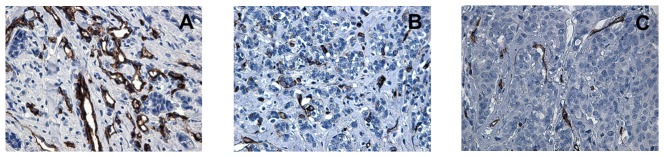
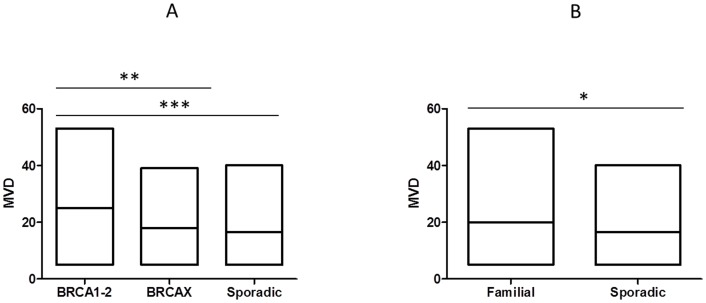
Angiogenesis, which plays an important role in tumor growth and progression of breast cancer, is regulated by a balance between pro- and anti-angiogenic factors. Expression of vascular endothelial growth factor (VEGF) is up-regulated during hypoxia by hypoxia-inducible factor-1α (HIF-1α). It is known that there is an interaction between HIF-1α and BRCA1 carrier cancers, but little has been reported about angiogenesis in BRCA1-2 carrier and BRCAX breast cancers. In this study, we investigated the expression of VEGF and HIF-1α and microvessel density (MVD) in 26 BRCA1-2 carriers and 58 BRCAX compared to 77 sporadic breast cancers, by immunohistochemistry. VEGF expression in BRCA1-2 carriers was higher than in BRCAX cancer tissues (p = 0.0001). Furthermore, VEGF expression was higher in both BRCA1-2 carriers and BRCAX than the sporadic group (p<0.0001). VEGF immunoreactivity was correlated with poor tumor grade (p = 0.0074), hormone receptors negativity (p = 0.0206, p = 0.0002 respectively), and MIB-1-labeling index (p = 0.0044) in familial cancers (BRCA1-2 and BRCAX). The percentage of nuclear HIF-1α expression was higher in the BRCA1-2 carriers than in BRCAX cancers (p<0.05), and in all familial than in sporadic tumor tissues (p = 0.0045). A higher MVD was observed in BRCA1-2 carrier than in BRCAX and sporadic cancer tissues (p = 0.002, p = 0.0001 respectively), and in all familial tumors than in sporadic tumors (p = 0.01). MVD was positively related to HIF-1α expression in BRCA1-2 carriers (r = 0.521, p = 0.006), and, in particular, we observed a highly significant correlation in the familial group (r = 0.421, p<0.0001). Our findings suggest that angiogenesis plays a crucial role in BRCA1-2 carrier breast cancers. Prospective studies in larger BRCA1-2 carrier series are needed to improve the best therapeutic strategies for this subgroup of breast cancer patients.
Conflict of interest statement
Figures
References
-
- Ferlay J, Autier P, Boniol M, Heanue M, Colombet M, et al. (2007) Estimates of the cancer incidence and mortality in Europe in 2006. Ann Oncol 18 3: 581–592 doi: mdl498 [pii] 10.1093/annonc/mdl498. - DOI - PubMed
-
- Fernandez-Ramires R, Gomez G, Munoz-Repeto I, de Cecco L, Llort G, et al. (2011) Transcriptional characteristics of familial non-BRCA1/BRCA2 breast tumors. Int J Cancer 128 11: 2635–2644 doi:10.1002/ijc.25603. - DOI - PubMed
-
- Vargas AC, Reis-Filho JS, Lakhani SR (2011) Phenotype-genotype correlation in familial breast cancer. J Mammary Gland Biol Neoplasia 16 1: 27–40 doi:10.1007/s10911-011-9204-6. - DOI - PubMed
-
- van der Groep P, van der Wall E, van Diest PJ (2011) Pathology of hereditary breast cancer. Cell Oncol (Dordr) 34 2: 71–88 doi:10.1007/s13402-011-0010-3. - DOI - PMC - PubMed
Publication types
MeSH terms
Substances
LinkOut - more resources
Full Text Sources
Other Literature Sources
Medical
Miscellaneous
