


Copeptin as a marker for severity and prognosis of aneurysmal subarachnoid hemorrhage
- PMID: 23326397
- PMCID: PMC3543451
- DOI: 10.1371/journal.pone.0053191
Copeptin as a marker for severity and prognosis of aneurysmal subarachnoid hemorrhage
Abstract
Background: Grading of patients with aneurysmal subarachnoid hemorrhage (aSAH) is often confounded by seizure, hydrocephalus or sedation and the prediction of prognosis remains difficult. Recently, copeptin has been identified as a serum marker for outcomes in acute ischemic stroke and intracerebral hemorrhage (ICH). We investigated whether copeptin might serve as a marker for severity and prognosis in aSAH.
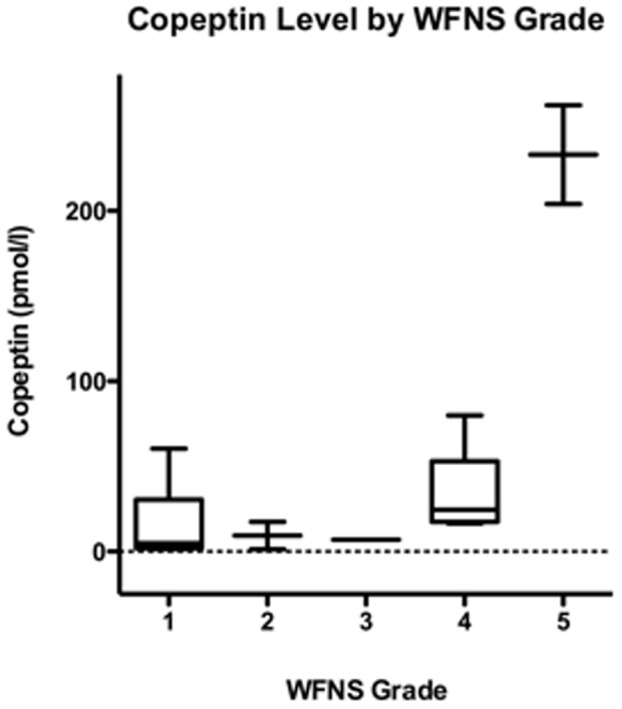
Methods: Eighteen consecutive patients with aSAH had plasma copeptin levels measured with a validated chemiluminescence sandwich immunoassay. The primary endpoint was the association of copeptin levels at admission with the World Federation of Neurological Surgeons (WFNS) grade score after resuscitation. Levels of copeptin were compared across clinical and radiological scores as well as between patients with ICH, intraventricular hemorrhage, hydrocephalus, vasospasm and ischemia.
Results: Copeptin levels were significantly associated with the severity of aSAH measured by WFNS grade (P = 0.006), the amount of subarachnoid blood (P = 0.03) and the occurrence of ICH (P = 0.02). There was also a trend between copeptin levels and functional clinical outcome at 6-months (P = 0.054). No other clinical outcomes showed any statistically significant association.
Conclusions: Copeptin may indicate clinical severity of the initial bleeding and may therefore help in guiding treatment decisions in the setting of aSAH. These initial results show that copeptin might also have prognostic value for clinical outcome in aSAH.
Conflict of interest statement
Figures
References
-
- Report of World Federation of Neurological Surgeons Committee on a Universal Subarachnoid Hemorrhage Grading Scale (1988) J Neurosurg 68: 985–986. - PubMed
-
- Bederson JB, Connolly ES Jr, Batjer HH, Dacey RG, Dion JE, et al. (2009) Guidelines for the management of aneurysmal subarachnoid hemorrhage: a statement for healthcare professionals from a Special Writing Group of the Stroke Council. Stroke 40: 994–1025. - PubMed
-
- Le Roux PD, Elliott JP, Newell DW, Grady MS, Winn HR (1996) Predicting outcome in poor-grade patients with subarachnoid hemorrhage: a retrospective review of 159 aggressively managed cases. J Neurosurg 85: 39–49. - PubMed
-
- Katan M, Fluri F, Morgenthaler NG, Schuetz P, Zweifel C, et al. (2009) Copeptin: a novel, independent prognostic marker in patients with ischemic stroke. Ann Neurol 66: 799–808. - PubMed
-
- Morgenthaler NG, Muller B, Struck J, Bergmann A, Redl H, et al. (2007) Copeptin, a stable peptide of the arginine vasopressin precursor, is elevated in hemorrhagic and septic shock. Shock 28: 219–226. - PubMed
Publication types
MeSH terms
Substances
LinkOut - more resources
Full Text Sources
Other Literature Sources
