


A comprehensive census of microbial diversity in hot springs of Tengchong, Yunnan Province China using 16S rRNA gene pyrosequencing
- PMID: 23326417
- PMCID: PMC3541193
- DOI: 10.1371/journal.pone.0053350
A comprehensive census of microbial diversity in hot springs of Tengchong, Yunnan Province China using 16S rRNA gene pyrosequencing
Abstract
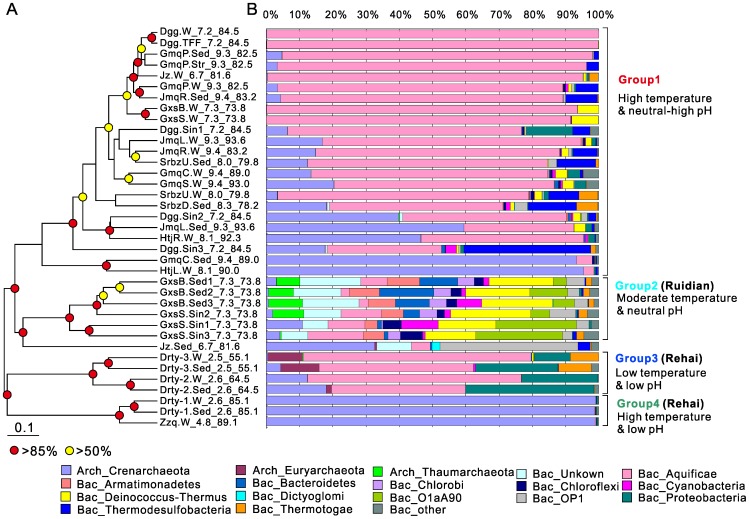
The Rehai and Ruidian geothermal fields, located in Tengchong County, Yunnan Province, China, host a variety of geochemically distinct hot springs. In this study, we report a comprehensive, cultivation-independent census of microbial communities in 37 samples collected from these geothermal fields, encompassing sites ranging in temperature from 55.1 to 93.6°C, in pH from 2.5 to 9.4, and in mineralogy from silicates in Rehai to carbonates in Ruidian. Richness was low in all samples, with 21-123 species-level OTUs detected. The bacterial phylum Aquificae or archaeal phylum Crenarchaeota were dominant in Rehai samples, yet the dominant taxa within those phyla depended on temperature, pH, and geochemistry. Rehai springs with low pH (2.5-2.6), high temperature (85.1-89.1°C), and high sulfur contents favored the crenarchaeal order Sulfolobales, whereas those with low pH (2.6-4.8) and cooler temperature (55.1-64.5°C) favored the Aquificae genus Hydrogenobaculum. Rehai springs with neutral-alkaline pH (7.2-9.4) and high temperature (>80°C) with high concentrations of silica and salt ions (Na, K, and Cl) favored the Aquificae genus Hydrogenobacter and crenarchaeal orders Desulfurococcales and Thermoproteales. Desulfurococcales and Thermoproteales became predominant in springs with pH much higher than the optimum and even the maximum pH known for these orders. Ruidian water samples harbored a single Aquificae genus Hydrogenobacter, whereas microbial communities in Ruidian sediment samples were more diverse at the phylum level and distinctly different from those in Rehai and Ruidian water samples, with a higher abundance of uncultivated lineages, close relatives of the ammonia-oxidizing archaeon "Candidatus Nitrosocaldus yellowstonii", and candidate division O1aA90 and OP1. These differences between Ruidian sediments and Rehai samples were likely caused by temperature, pH, and sediment mineralogy. The results of this study significantly expand the current understanding of the microbiology in Tengchong hot springs and provide a basis for comparison with other geothermal systems around the world.
Conflict of interest statement
Figures


References
-
- Liao Z, Guo G (1986) Geology of the Tengchong geothermal field and surrounding area, west Yunnan, China. Geothermics 15: 339–345.
-
- Tong W, Zhang M (1989) Tengchong geothermics. Beijing: Science Press (in Chinese). 282 p.
-
- Wang F, Peng Z, Chen W, Wang Z, Yang J, et al. (2000) High-precision thermal ionization mass spectrometry dating of young volcanic rocks by using U-series method. Chinese Sci Bull 45: 83–87.
-
- Du J, Liu C, Fu B, Ninomiya Y, Zhang Y, et al. (2005) Variations of geothermometry and chemical-isotopic compositions of hot spring fluids in the Rehai geothermal field, southwestern China. J Volcanol Geoth Res 142: 243–261.
-
- Fournier RO (1989) Geochemistry and dynamics of the Yellowstone National Park hydrothermal system. Annu Rev Earth Planet Sci 17: 13–53.
Publication types
MeSH terms
Substances
LinkOut - more resources
Full Text Sources
Other Literature Sources
