. 2013 Feb;7(1):73-83.
doi: 10.1007/s12170-012-0280-y. Epub 2012 Oct 18.

Systems Biology Approaches and Applications in Obesity, Diabetes, and Cardiovascular Diseases

Affiliations

Systems Biology Approaches and Applications in Obesity, Diabetes, and Cardiovascular Diseases

Qingying Meng et al. Curr Cardiovasc Risk Rep. 2013 Feb.

Abstract

The metabolically connected triad of obesity, diabetes, and cardiovascular diseases is a major public health threat, and is expected to worsen due to the global shift toward energy-rich and sedentary living. Despite decades of intense research, a large part of the molecular pathogenesis behind complex metabolic diseases remains unknown. Recent advances in genetics, epigenomics, transcriptomics, proteomics and metabolomics enable us to obtain large-scale snapshots of the etiological processes in multiple disease-related cells, tissues and organs. These datasets provide us with an opportunity to go beyond conventional reductionist approaches and to pinpoint the specific perturbations in critical biological processes. In this review, we summarize systems biology methodologies such as functional genomics, causality inference, data-driven biological network construction, and higher-level integrative analyses that can produce novel mechanistic insights, identify disease biomarkers, and uncover potential therapeutic targets from a combination of omics datasets. Importantly, we also demonstrate the power of these approaches by application examples in obesity, diabetes, and cardiovascular diseases.


Figures
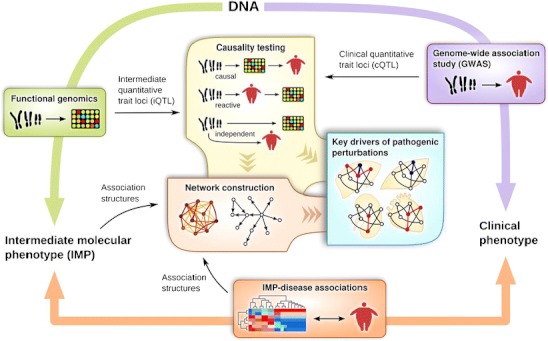
Fig. 1
Fig. 1
Systems biology strategies that integrate large-scale genetic, intermediate molecular phenotypes (IMPs, primarily gene expression), and disease phenotypes. Traditional genetic association studies such as GWAS identify genetic loci associated with clinical disease phenotypes (cQTLs, right lavender edge), which provides causal information but lacks mechanistic insights. Molecular profiling experiments help identify IMPs associated or correlated with disease status (bottom orange edge) but the results are purely correlative with no causal information. More recent functional genomics efforts offer mechanistic insights on how DNA variations affect IMPs (primarily gene expression) via the identification of intermediate QTLs (iQTLs; left lime edge). By leveraging both iQTL and cQTL and performing statistical testing to differentiate causal, reactive, and independent relationships between IMPs and disease, one can detect putative disease causal genes (center yellow box). IMPs, iQTLs, cQTLs, disease phenotypes, and genetic causality can all be fed into various network construction algorithms to reconstruct regulatory networks that inform on mechanisms of IMP and disease regulation (center orange box). Higher level integrative approaches that take advantage of multiple methodologies are used to derive key regulatory genes and subnetworks underlying disease development in a tissue-specific fashion (center blue box)

References

    1. Lusis AJ, Attie AD, Reue K. Metabolic syndrome: from epidemiology to systems biology. Nat Rev Genet. 2008;9(11):819–30. doi: 10.1038/nrg2468. - DOI - PMC - PubMed
    1. Hindorff LA, Sethupathy P, Junkins HA, Ramos EM, Mehta JP, Collins FS, et al. Potential etiologic and functional implications of genome-wide association loci for human diseases and traits. Proc Natl Acad Sci U S A. 2009;106(23):9362–7. doi: 10.1073/pnas.0903103106. - DOI - PMC - PubMed
    1. Schunkert H, Konig IR, Kathiresan S, Reilly MP, Assimes TL, Holm H, et al. Large-scale association analysis identifies 13 new susceptibility loci for coronary artery disease. Nat Genet. 2011;43(4):333–8. doi: 10.1038/ng.784. - DOI - PMC - PubMed
    1. Ordovas JM, Smith CE. Epigenetics and cardiovascular disease. Nat Rev Cardiol. 2010;7(9):510–9. doi: 10.1038/nrcardio.2010.104. - DOI - PMC - PubMed
    1. Ala-Korpela M, Kangas AJ, Inouye M. Genome-wide association studies and systems biology: together at last. Trends Genet: TIG. 2011;27(12):493–8. doi: 10.1016/j.tig.2011.09.002. - DOI - PubMed