


Review
doi: 10.5732/cjc.012.10218.
Epub 2013 Jan 18.
Skeletal metastasis: treatments, mouse models, and the Wnt signaling
Affiliations
- PMID: 23327798
- PMCID: PMC3845601
- DOI: 10.5732/cjc.012.10218
Item in Clipboard
Review
Skeletal metastasis: treatments, mouse models, and the Wnt signaling
Chin J Cancer.
2013 Jul.
Abstract
Skeletal metastases result in significant morbidity and mortality. This is particularly true of cancers with a strong predilection for the bone, such as breast, prostate, and lung cancers. There is currently no reliable cure for skeletal metastasis, and palliative therapy options are limited. The Wnt signaling pathway has been found to play an integral role in the process of skeletal metastasis and may be an important clinical target. Several experimental models of skeletal metastasis have been used to find new biomarkers and test new treatments. In this review, we discuss pathologic process of bone metastasis, the roles of the Wnt signaling, and the available experimental models and treatments.
Figures
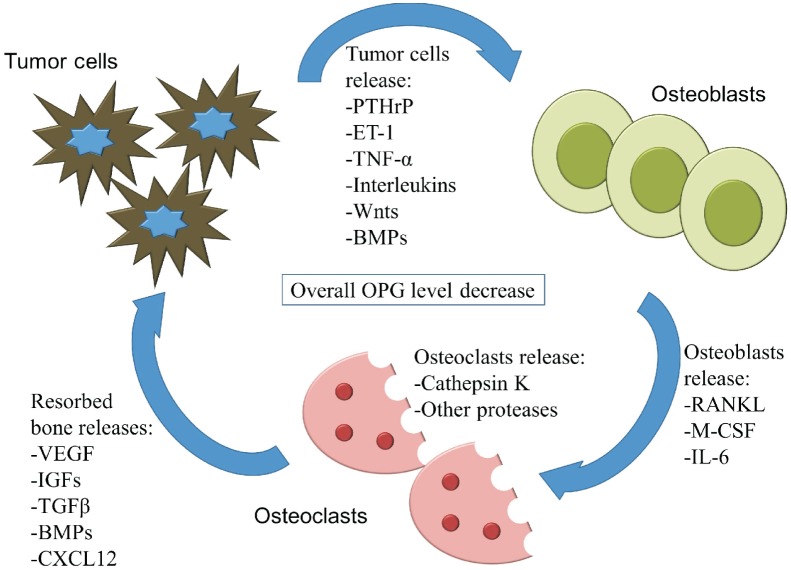
Tumor cells secrete factors that stimulate osteoblast activation and bone formation. Osteoblasts release RANK ligand and other factors that stimulate osteoclast activation and resorption of the bones. This allows for the release of growth factors that stimulate tumor growth and maintenance. These factors and their concentrations can change throughout the process of metastasis and can differ from cancer to cancer, which results in a variable balance of bone formation and resorption. PTHrP, parathyroid hormone-related protein; ET-1, endothelin-1; TNF-α, tumor necrosis factor alpha; BMP, bone morphogenetic protein; RANKL, receptor activator of nuclear kappa-B ligand; M-CSF, macrophage colony-stimulating factor; IL-6, interleukin-6; VEGF, vascular endothelial growth factor; IGF, insulin-like growth factor; TGFβ, transforming growth factor beta; CXCL12, chemokine C-X-C motif ligand 12; OPG, osteoprotegerin.
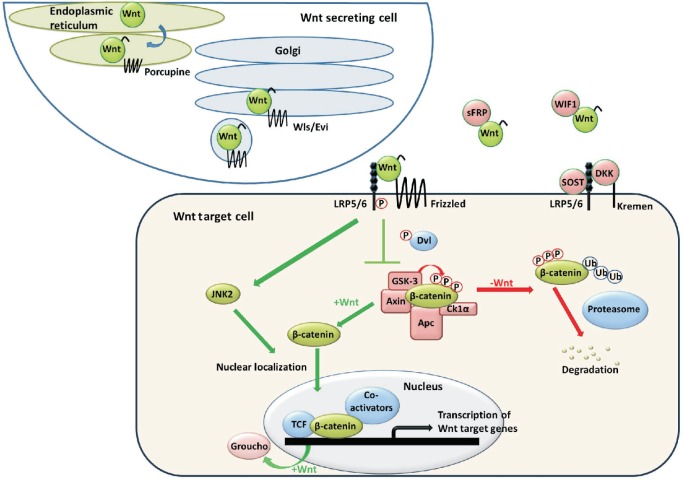
Wnt is secreted, binds to receptors, and causes β-catenin to accumulate in the cytosol and subsequently migrate to the nucleus to activate transcription of Wnt target genes. Wls/Evi, Wntless/evenness interrupted; sFRP, secreted frizzled-related protein; WIF1, Wnt inhibitory factor 1; SOST, sclerostin; DKK1, Dickkopf 1; LRP5/6, low-density lipoprotein receptor-related protein 5/6; Dvl, disheveled; GSK3, glycogen synthase kinase 3; Apc, adenomatous polyposis coli; CK1α, casein kinase 1 alpha; JNK2, c-Jun N-terminal kinase 2; TCF, T-cell factor. The authors have published this figure previously in "Wnt/β-catenin signaling in normal and cancer stem cells" [Cancer, 2011,3:2050-2079] and have got the permission to republish this figure.
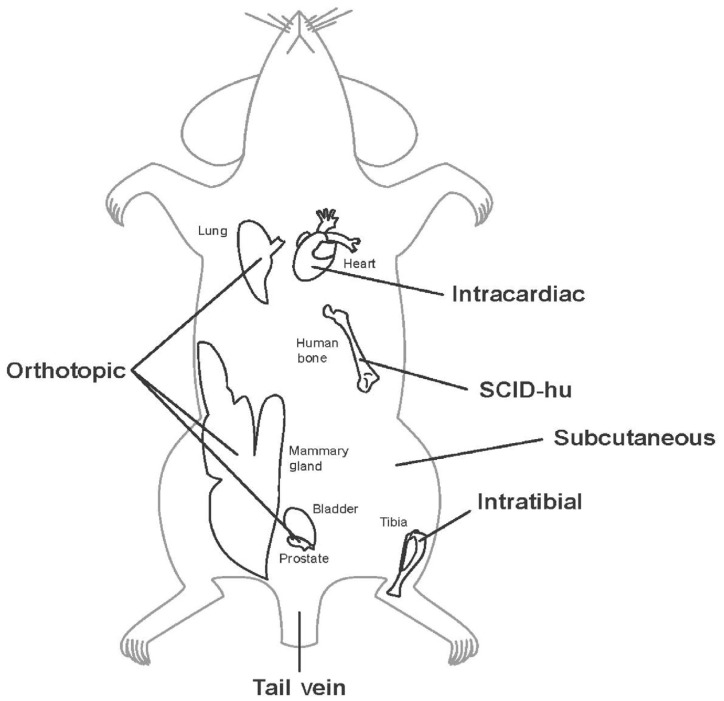
Tumor cells can be injected at any of the sites shown to generate a metastasis model. Note that the intracardiac, intravenous, and intratibial models can only establish models of experimental metastasis that do not reflect the entire process of metastasis (see the description of the process of metastasis in the “Skeletal Metastasis” section of this review). However, spontaneous metastasis can be achieved by the orthotopic and subcutaneous models, which generate primary tumors prior to metastasizing.
References
-
- Atlanta: American Cancer Society, Inc; 2011. Cancer facts & figures.
-
- Hess KR, Varadhachary GR, Taylor SH, et al. Metastatic patterns in adenocarcinoma. Cancer. 2006;106:1624–1633. - PubMed
-
- Nguyen DX, Bos PD, Massague J. Metastasis: from dissemination to organ-specific colonization. Nat Rev Cancer. 2009;9:274–284. - PubMed
Publication types
MeSH terms
Substances
LinkOut - more resources
Full Text Sources
Other Literature Sources
Medical