


Magnetic resonance measurement of turbulent kinetic energy for the estimation of irreversible pressure loss in aortic stenosis
- PMID: 23328563
- PMCID: PMC3624082
- DOI: 10.1016/j.jcmg.2012.07.017
Magnetic resonance measurement of turbulent kinetic energy for the estimation of irreversible pressure loss in aortic stenosis
Abstract
Objectives: The authors sought to measure the turbulent kinetic energy (TKE) in the ascending aorta of patients with aortic stenosis and to assess its relationship to irreversible pressure loss.
Background: Irreversible pressure loss caused by energy dissipation in post-stenotic flow is an important determinant of the hemodynamic significance of aortic stenosis. The simplified Bernoulli equation used to estimate pressure gradients often misclassifies the ventricular overload caused by aortic stenosis. The current gold standard for estimation of irreversible pressure loss is catheterization, but this method is rarely used due to its invasiveness. Post-stenotic pressure loss is largely caused by dissipation of turbulent kinetic energy into heat. Recent developments in magnetic resonance flow imaging permit noninvasive estimation of TKE.
Methods: The study was approved by the local ethics review board and all subjects gave written informed consent. Three-dimensional cine magnetic resonance flow imaging was used to measure TKE in 18 subjects (4 normal volunteers, 14 patients with aortic stenosis with and without dilation). For each subject, the peak total TKE in the ascending aorta was compared with a pressure loss index. The pressure loss index was based on a previously validated theory relating pressure loss to measures obtainable by echocardiography.
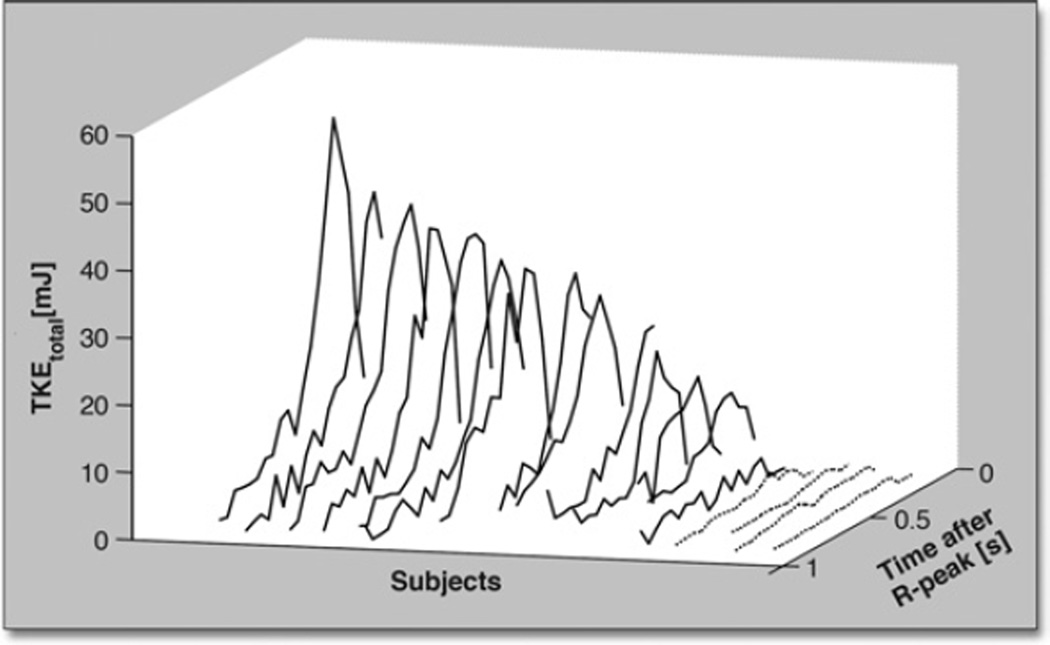
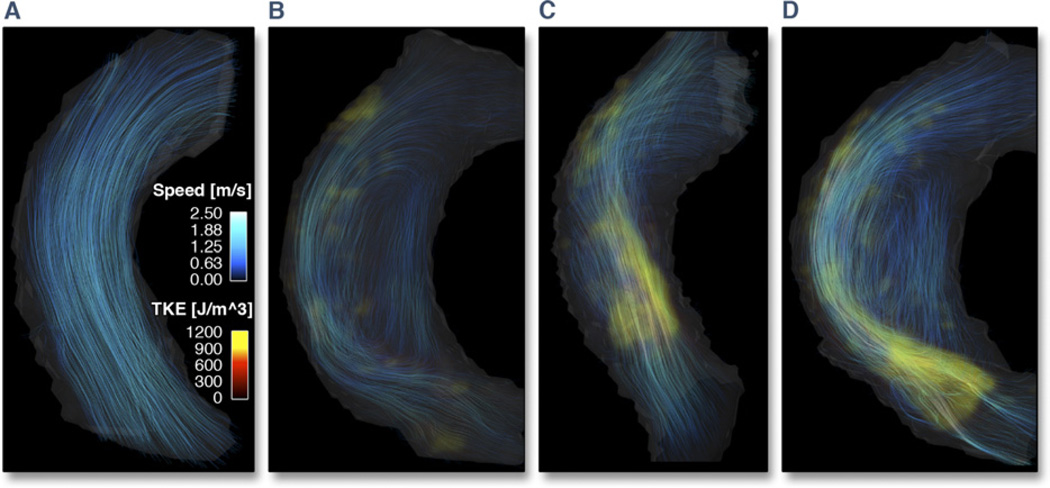
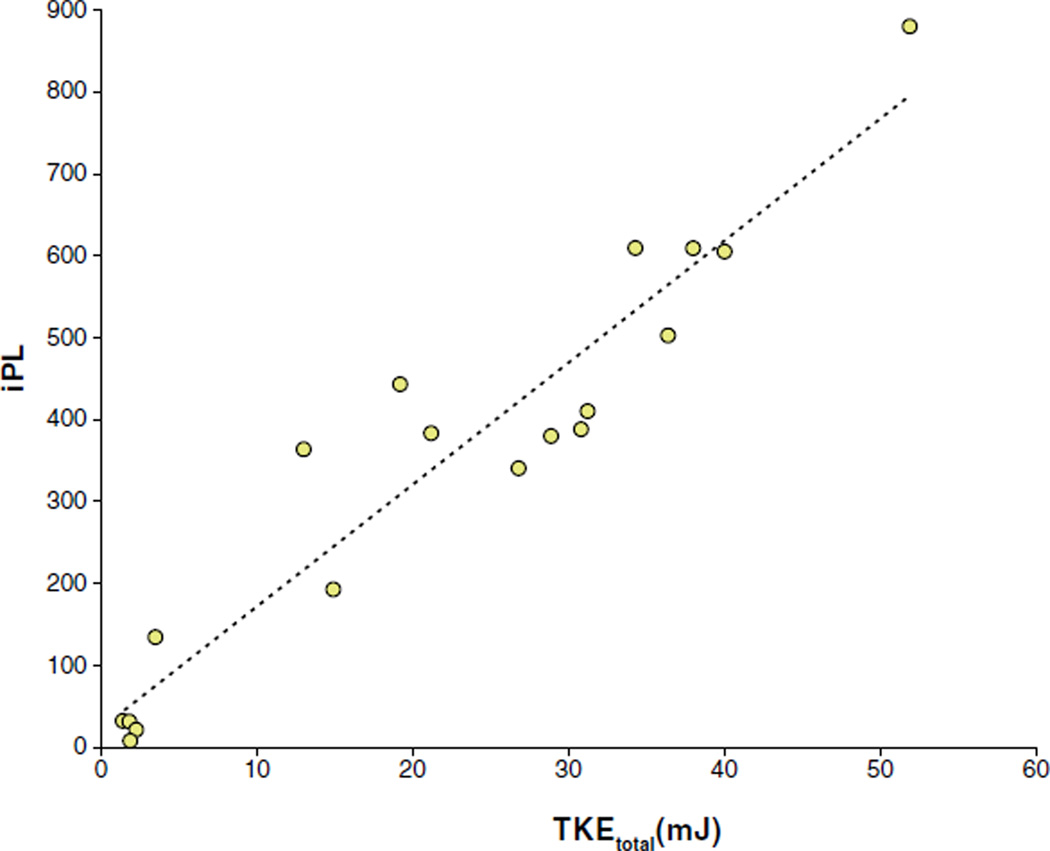
Results: The total TKE did not appear to be related to global flow patterns visualized based on magnetic resonance-measured velocity fields. The TKE was significantly higher in patients with aortic stenosis than in normal volunteers (p < 0.001). The peak total TKE in the ascending aorta was strongly correlated to index pressure loss (R(2) = 0.91).
Conclusions: Peak total TKE in the ascending aorta correlated strongly with irreversible pressure loss estimated by a well-established method. Direct measurement of TKE by magnetic resonance flow imaging may, with further validation, be used to estimate irreversible pressure loss in aortic stenosis.
Copyright © 2013 American College of Cardiology Foundation. Published by Elsevier Inc. All rights reserved.
Figures
References
-
- Ohlsson J, Wranne B. Noninvasive assessment of valve area in patients with aortic stenosis. J Am Coll Cardiol. 1986;7:501–508. - PubMed
-
- Laskey WK, Kussmaul WG. Pressure recovery in aortic valve stenosis. Circulation. 1994;89:116–121. - PubMed
-
- Schobel WA, Voelker W, Haase KK, Karsch KR. Extent, determiants and clinical importance of pressure recovery in patients with aortic valve stenosis. Eur Heart J. 1999;20:1355–1363. - PubMed
-
- Gjertsson P, Caidahl K, Svensson G, Wallentin I, Bech-Hanssen O. Important pressure recovery in patients with aortic stenosis and high Doppler gradients. Am J Cardiol. 2001;88:139–144. - PubMed
Publication types
MeSH terms
Grants and funding
LinkOut - more resources
Full Text Sources
Other Literature Sources
