


Steep, cheap and deep: an ideotype to optimize water and N acquisition by maize root systems
- PMID: 23328767
- PMCID: PMC3698384
- DOI: 10.1093/aob/mcs293
Steep, cheap and deep: an ideotype to optimize water and N acquisition by maize root systems
Abstract
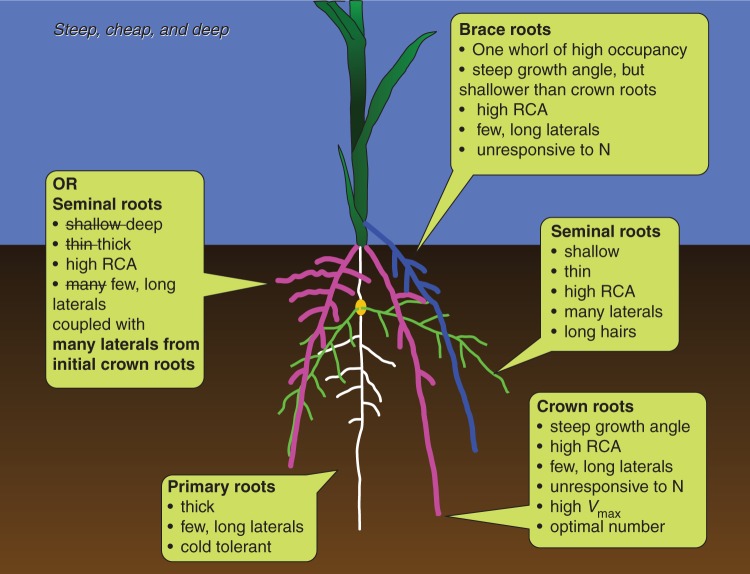
A hypothetical ideotype is presented to optimize water and N acquisition by maize root systems. The overall premise is that soil resource acquisition is optimized by the coincidence of root foraging and resource availability in time and space. Since water and nitrate enter deeper soil strata over time and are initially depleted in surface soil strata, root systems with rapid exploitation of deep soil would optimize water and N capture in most maize production environments. • THE IDEOTYPE: Specific phenes that may contribute to rooting depth in maize include (a) a large diameter primary root with few but long laterals and tolerance of cold soil temperatures, (b) many seminal roots with shallow growth angles, small diameter, many laterals, and long root hairs, or as an alternative, an intermediate number of seminal roots with steep growth angles, large diameter, and few laterals coupled with abundant lateral branching of the initial crown roots, (c) an intermediate number of crown roots with steep growth angles, and few but long laterals, (d) one whorl of brace roots of high occupancy, having a growth angle that is slightly shallower than the growth angle for crown roots, with few but long laterals, (e) low cortical respiratory burden created by abundant cortical aerenchyma, large cortical cell size, an optimal number of cells per cortical file, and accelerated cortical senescence, (f) unresponsiveness of lateral branching to localized resource availability, and (g) low K(m) and high Vmax for nitrate uptake. Some elements of this ideotype have experimental support, others are hypothetical. Despite differences in N distribution between low-input and commercial maize production, this ideotype is applicable to low-input systems because of the importance of deep rooting for water acquisition. Many features of this ideotype are relevant to other cereal root systems and more generally to root systems of dicotyledonous crops.
Keywords: Root phenes; anatomy; architecture; ideotype; nitrogen; water.
Figures
References
-
- Barber SA. Soil nutrient bioavailability: a mechanistic approach. New York, NY: John Wiley & Sons; 1995.
-
- Bayuelo-Jimenez JS, Gallardo-Valdez M, Perez-Decelis VA, Magdaleno-Armas L, Ochoa I, Lynch JP. Genotypic variation for root traits of maize (Zea mays L.) from the Purhepecha Plateau under contrasting phosphorus availability. Field Crops Research. 2011;121:350–362.
-
- Bengough AG, McKenzie BM, Hallett PD, Valentine TA. Root elongation, water stress, and mechanical impedance: a review of limiting stresses and beneficial root tip traits. Journal of Experimental Botany. 2011;62:59–68. - PubMed
-
- Bernier J, Serraj R, Kumar A, et al. The large-effect drought-resistance QTL qtl12·1 increases water uptake in upland rice. Field Crops Research. 2009;110:139–146.
-
- Bonser AM, Lynch JP, Snapp S. Effect of phosphorus deficiency on growth angle of basal roots in Phaseolus vulgaris. New Phytologist. 1996;132:281–288. - PubMed
Publication types
MeSH terms
Substances
LinkOut - more resources
Full Text Sources
Other Literature Sources
