


Low hemoglobin levels and recurrent falls in U.S. men and women: prospective findings from the REasons for Geographic And Racial Differences in Stroke (REGARDS) cohort
- PMID: 23328832
- PMCID: PMC3640699
- DOI: 10.1097/MAJ.0b013e3182638364
Low hemoglobin levels and recurrent falls in U.S. men and women: prospective findings from the REasons for Geographic And Racial Differences in Stroke (REGARDS) cohort
Abstract
Background: There are few data available on low hemoglobin and incident falls in the general U.S. population.
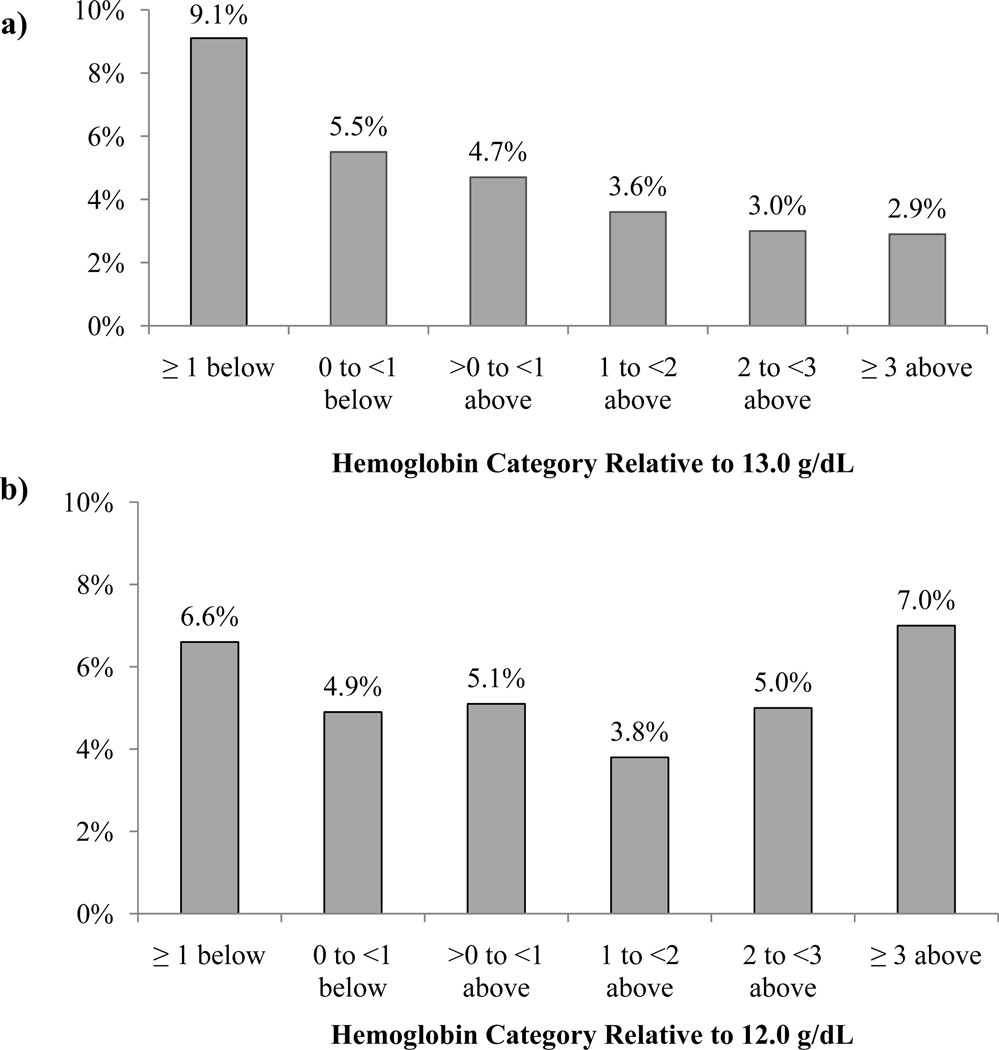
Methods: Of 30,239 black and white U.S. adults ≥45 years in the population-based REasons for Geographic And Racial Differences in Stroke study, 16,782 had hemoglobin measured at baseline and follow-up data on falls. Hemoglobin was categorized by 1.0 g/dL increments relative to the World Health Organization anemia threshold (<13.0 g/dL for men, <12.0 g/dL for women). Recurrent falls (≥2 falls in the 6 months after baseline) were assessed during a telephone interview.
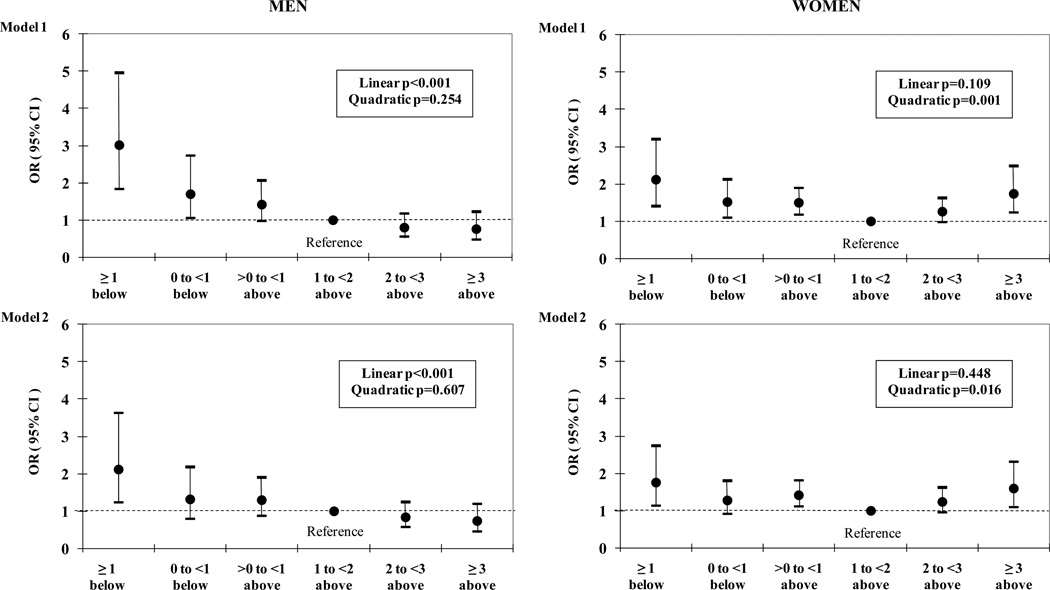
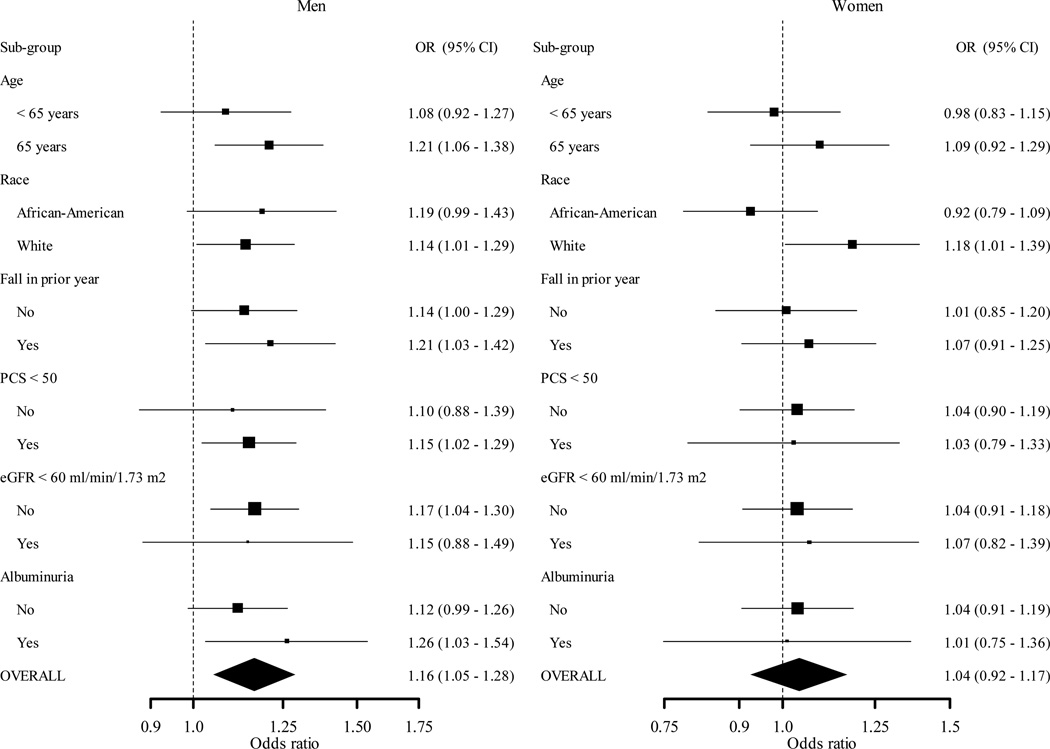
Results: Recurrent falls occurred in 3.9% of men and 4.8% of women. Compared with those with a hemoglobin level 1 to 2 g/dL above the anemia cut-off, multivariable adjusted odds ratios (95% confidence intervals) for recurrent falls associated with hemoglobin levels ≥3, 2 to <3 and 0 to 1 g/dL above the cut-off point, and 0 to <1 and ≥1 g/dL below the cut-off point were 0.73 (0.45-1.19), 0.84 (0.57-1.24), 1.29 (0.88-1.90), 1.32 (0.0.80-1.2.18) and 2.12 (1.23-3.63), respectively, among men (linear trend P < 0.001), and 1.59 (1.10-2.3), 1.24 (0.95-1.62), 1.42(1.11-1.81), 1.28 (0.91-1.80) and 1.76 (1.13-2.74), respectively, among women (linear trend P = 0.45; quadratic trend P = 0.016).
Conclusions: Among men, lower hemoglobin levels were associated with an increased risk for recurrent falls. Although our findings suggest an increased risk for recurrent falls at both lower and higher hemoglobin levels among women, these findings should be confirmed in subsequent studies.
Conflict of interest statement
Figures
References
-
- Nevitt MC, Cummings SR, Hudes ES. Risk factors for injurious falls: a prospective study. J Gerontol. 1991 Sep;46(5):M164–M170. - PubMed
-
- Nevitt MC, Cummings SR, Kidd S, Black D. Risk factors for recurrent nonsyncopal falls. A prospective study. JAMA. 1989 May 12;261(18):2663–2668. - PubMed
-
- Tinetti ME, Speechley M, Ginter SF. Risk factors for falls among elderly persons living in the community. N Engl J Med. 1988 Dec 29;319(26):1701–1707. - PubMed
-
- Tinetti ME, Williams CS. Falls, injuries due to falls, and the risk of admission to a nursing home. N Engl J Med. 1997 Oct 30;337(18):1279–1284. - PubMed
-
- Tinetti ME, Williams CS. The effect of falls and fall injuries on functioning in community-dwelling older persons. J Gerontol A Biol Sci Med Sci. 1998 Mar;53(2):M112–M119. - PubMed
Publication types
MeSH terms
Substances
Grants and funding
LinkOut - more resources
Full Text Sources
Other Literature Sources
Medical
