. 2012 Nov 18;3(11):167-74.
doi: 10.5312/wjo.v3.i11.167.

Molecular mechanisms of triggering, amplifying and targeting RANK signaling in osteoclasts

Affiliations

Molecular mechanisms of triggering, amplifying and targeting RANK signaling in osteoclasts

Yukiko Kuroda et al. World J Orthop. .

Abstract

Osteoclast differentiation depends on receptor activator of nuclear factor-κB (RANK) signaling, which can be divided into triggering, amplifying and targeting phases based on how active the master regulator nuclear factor of activated T-cells cytoplasmic 1 (NFATc1) is. The triggering phase is characterized by immediate-early RANK signaling induced by RANK ligand (RANKL) stimulation mediated by three adaptor proteins, tumor necrosis factor receptor-associated factor 6, Grb-2-associated binder-2 and phospholipase C (PLC)γ2, leading to activation of IκB kinase, mitogen-activated protein kinases and the transcription factors nuclear factor (NF)-κB and activator protein-1 (AP-1). Mice lacking NF-κB p50/p52 or the AP-1 subunit c-Fos (encoded by Fos) exhibit severe osteopetrosis due to a differentiation block in the osteoclast lineage. The amplification phase occurs about 24 h later in a RANKL-induced osteoclastogenic culture when Ca(2+) oscillation starts and the transcription factor NFATc1 is abundantly produced. In addition to Ca(2+) oscillation-dependent nuclear translocation and transcriptional auto-induction of NFATc1, a Ca(2+) oscillation-independent, osteoblast-dependent mechanism stabilizes NFATc1 protein in differentiating osteoclasts. Osteoclast precursors lacking PLCγ2, inositol-1,4,5-trisphosphate receptors, regulator of G-protein signaling 10, or NFATc1 show an impaired transition from the triggering to amplifying phases. The final targeting phase is mediated by activation of numerous NFATc1 target genes responsible for cell-cell fusion and regulation of bone-resorptive function. This review focuses on molecular mechanisms for each of the three phases of RANK signaling during osteoclast differentiation.

Keywords: Ca2+ oscillation; Immunoreceptor tyrosine-based activation motif; Nuclear factor of activated T-cells cytoplasmic 1; Receptor activator of nuclear factor-κB ligand; Tumor necrosis factor receptor-associated factor 6; c-Fos.


Figures
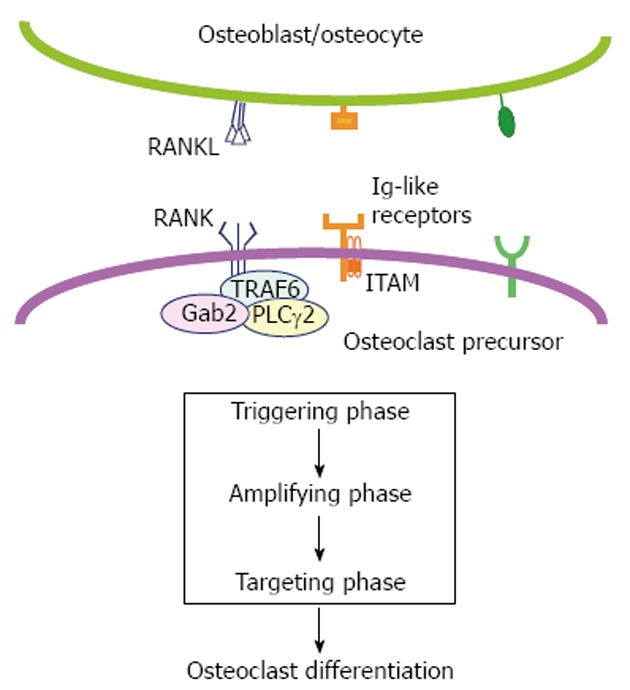
Figure 1
Figure 1
Three phases of receptor activator of nuclear factor-κB signaling during osteoclast differentiation. Osteoclast differentiation downstream of receptor activator of nuclear factor-κB (RANK) signaling is divided into triggering, amplifying and targeting phases, based on the nuclear factor of activated T-cells cytoplasmic 1 activation state. ITAM: Immunoreceptor tyrosine-based activation motif; TRAF6: Tumor necrosis factor receptor-associated factor 6; Gab2: Grb-2-associated binder-2; PLCγ2: Phospholipase C γ2; RANKL: RANK ligand; Ig: Immunoglobulin.
Figure 2
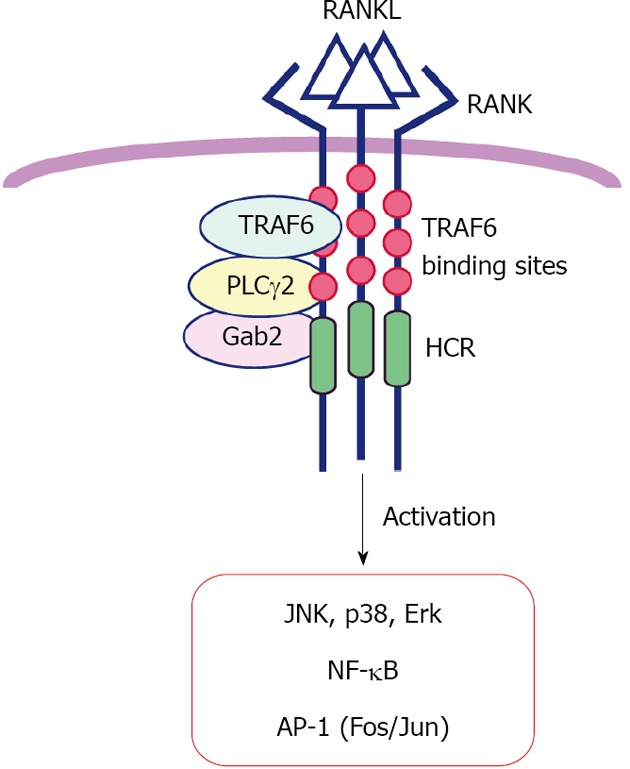
Figure 2
Triggering phase. Trimerization of receptor activator of nuclear factor-κB (RANK) by binding of RANK ligand (RANKL) immediately activates mitogen-activated protein kinases (MAPKs), nuclear factor (NF)-κB, and activator protein-1 (AP-1). An adaptor molecule complex including tumor necrosis factor receptor-associated factor 6 (TRAF6), Grb-2-associated binder-2 (Gab2) and phospholipase C (PLC)γ2 on TRAF6 binding sites of RANK is essential to induce the triggering phase. HCR: Highly conserved domain in RANK; JNK: c-Jun N-terminal kinase; Erk: Extracellular signal-regulated kinase.
Figure 3
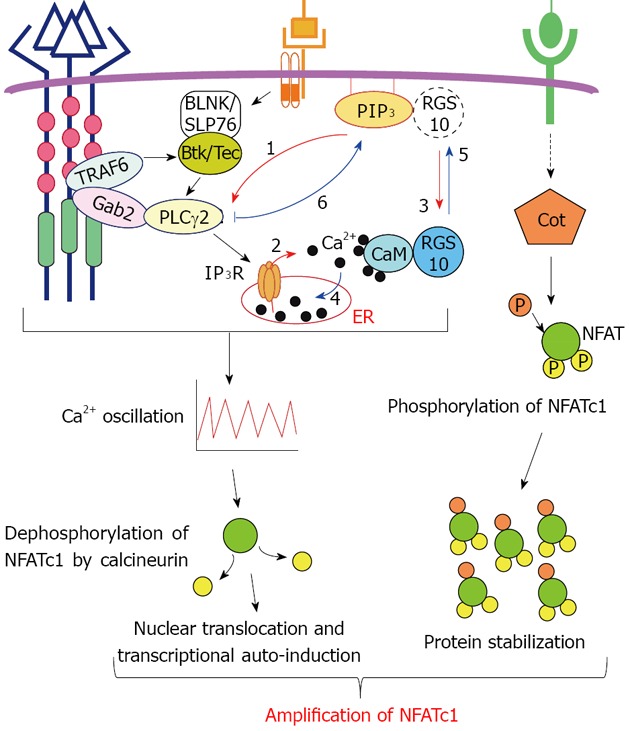
Figure 3
Amplifying phase. Both Ca2+ oscillation-dependent and -independent nuclear factor of activated T-cells cytoplasmic 1 (NFATc1) amplification are induced. Highly conserved domain in receptor activator of nuclear factor-κB (RANK)-mediated RANK signaling and immunoreceptor tyrosine-based activation motif (ITAM) signaling lead to continuous phospholipase C (PLC)γ2 activation. Regulator of G-protein signaling 10 (RGS10) determines the Ca2+ oscillation pattern through control of PLCγ2 by competitive binding of Ca2+/calmodulin and phosphatidylinositol 3, 4, 5-trisphosphate (PIP3). Sustained Ca2+ oscillation contributes to NFATc1 amplification mediated by transcriptional auto-induction. In the Ca2+ oscillation-independent pathway, Cot kinase enhances NFATc1 stabilization through direct phosphorylation and contributes to its accumulation. ER: Endoplasmic reticulum; BLNK: B cell linker protein; SLP76: Src homology 2 domain-containing leukocyte protein of 76 kD; TRAF6: Tumor necrosis factor receptor-associated factor 6; Gab2: Grb-2-associated binder-2; IP3R: IP3 receptor; CaM: Calmodulin; Btk: Bruton's tyrosine kinase.
Figure 4
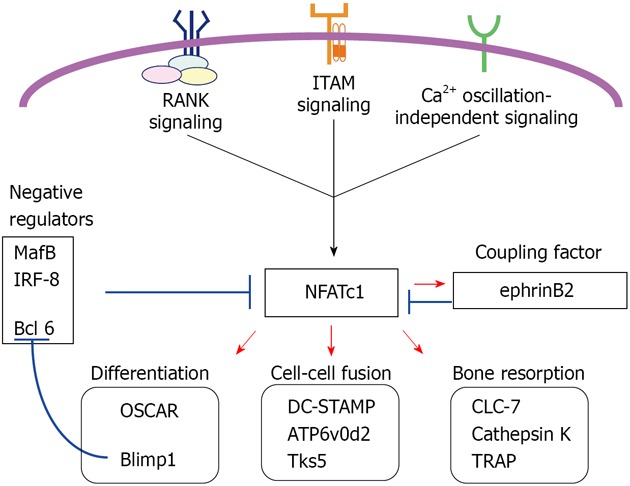
Figure 4
Targeting phase. Negative regulation of nuclear factor of activated T-cells cytoplasmic 1 (NFATc1) is indicated by blue lines and activation of its targets, shown in boxes, is indicated by red arrows. RANK: Receptor activator of nuclear factor-κB; ITAM: Immunoreceptor tyrosine-based activation motif; OSCAR: Osteoclast-associated receptor; Blimp1: B-lymphocyte-induced maturation protein-1; DC-STAMP: Dendritic cell-specific transmembrane protein; TRAP: Tartrate-resistant acid phosphatase; IRF-8: Interferon regulatory factor-8; MafB: V-maf musculoaponeurotic fibrosarcoma oncogene family, protein B; Bcl6: B cell lymphoma 6; CLC: Chloride channel.

References

    1. Teitelbaum SL. Bone resorption by osteoclasts. Science. 2000;289:1504–1508. - PubMed
    1. Karsenty G, Wagner EF. Reaching a genetic and molecular understanding of skeletal development. Dev Cell. 2002;2:389–406. - PubMed
    1. Asagiri M, Takayanagi H. The molecular understanding of osteoclast differentiation. Bone. 2007;40:251–264. - PubMed
    1. Arai F, Miyamoto T, Ohneda O, Inada T, Sudo T, Brasel K, Miyata T, Anderson DM, Suda T. Commitment and differentiation of osteoclast precursor cells by the sequential expression of c-Fms and receptor activator of nuclear factor kappaB (RANK) receptors. J Exp Med. 1999;190:1741–1754. - PMC - PubMed
    1. Dougall WC, Glaccum M, Charrier K, Rohrbach K, Brasel K, De Smedt T, Daro E, Smith J, Tometsko ME, Maliszewski CR, et al. RANK is essential for osteoclast and lymph node development. Genes Dev. 1999;13:2412–2424. - PMC - PubMed