


Course, risk factors, and prognostic factors in elderly primary care patients with mild depression: a two-year observational study
- PMID: 23330583
- PMCID: PMC3587299
- DOI: 10.3109/02813432.2012.757074
Course, risk factors, and prognostic factors in elderly primary care patients with mild depression: a two-year observational study
Abstract
Objective: The aim of this study was to observe course, risk factors, and prognostic factors in a primary care cohort aged > 60 with mild to moderate depression during two-year follow-up.
Design: Observational study.
Setting: Primary care.
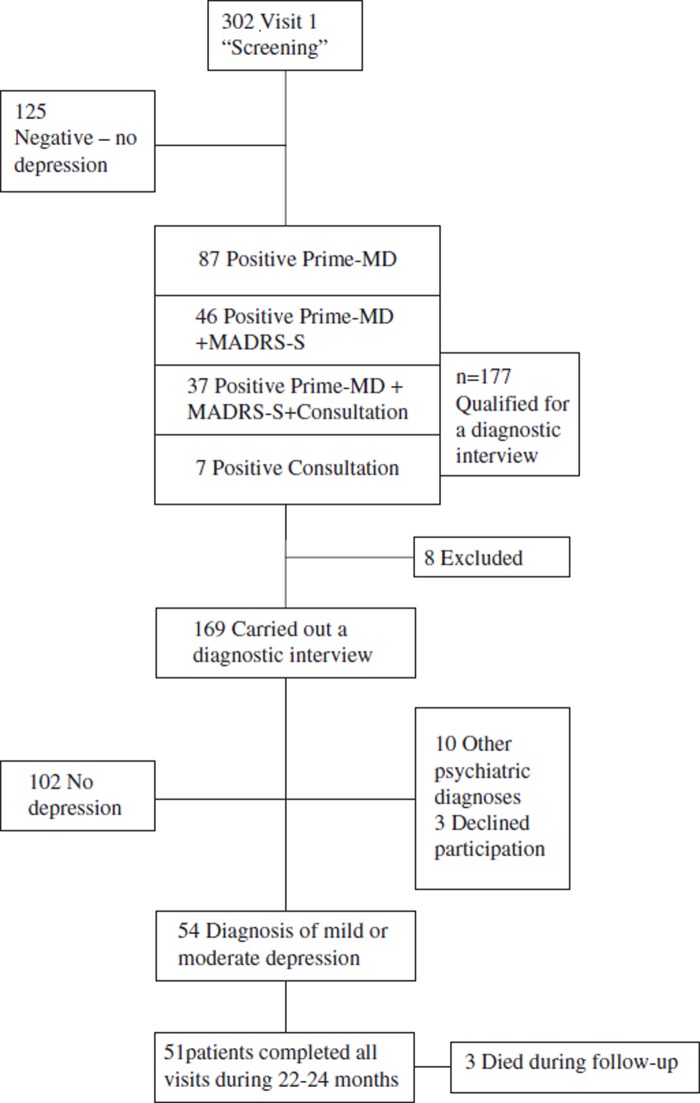
Subjects and method: During an 11-month period all (n = 302) consecutive patients aged 60 and above attending a primary care centre in Gothenburg, Sweden were screened by a nurse for depressive symptoms with the Primary Care Evaluation of Mental Disorders, Patient Questionnaire (PRIME-MD PQ) and the Montgomery-Åsberg Depression Rating Scale, self-rated version (MADRS-S) and by a GP with a patient-centred consultation model. In the second step, the GPs diagnosed depression in screen-positives by use of the PRIME-MD Clinical Evaluation Guide (PRIME-MD CEG). All patients with mild to moderate depression were followed up for two years to assess course with several MADRS-S score assessments. Main outcome measures. Risk factors, prognostic factors, and symptoms at baseline and after two years were tested with logistic regression, using the DSM-IV and MADRS-S (cut-off > 13) respectively. Course patterns were observed and described.
Results: A total of 54 patients were diagnosed with depression. Follow-up revealed declining median MADRS-S scores and three course patterns: remitting, stable, and fluctuating. History of depression, significant life events, lacking leisure activities, and use of sedatives were risk factors for depression, all previously known. An important finding was that lacking leisure activities also increased the risk of depressive symptoms after two years (odds ratio 12, confidence interval 1.1-136).
Conclusion: It is desirable to identify elderly individuals with less severe depression. Three course patterns were observed; this finding requires further study of the clinical characteristics related to the different patterns. Awareness of risk factors may facilitate identification of those at highest risk of poor prognosis.
Figures

References
-
- Katon WJ, Walker EA. Medically unexplained symptoms in primary care. J Clin Psychiatry. 1998;59((Suppl 20)):15–21. - PubMed
-
- Sheehan B, Bass C, Briggs R, Jacoby R. Somatization among older primary care attenders. Psychol Med. 2003;33:867–77. - PubMed
-
- Drayer RA, Mulsant BH, Lenze EJ, Rollman BL, Dew MA, Kelleher K, et al. Somatic symptoms of depression in elderly patients with medical co morbidities. Int J Geriatr Psychiatry. 2005;20:973–82. - PubMed
Publication types
MeSH terms
LinkOut - more resources
Full Text Sources
Other Literature Sources
