Review
. 2013;19(19):3521-8.
doi: 10.2174/13816128113199990320.

Curcumin and genistein: the combined effects on disease-associated CFTR mutants and their clinical implications

Affiliations
Review

Curcumin and genistein: the combined effects on disease-associated CFTR mutants and their clinical implications

Yoshiro Sohma et al. Curr Pharm Des. 2013.

Abstract

Genistein and curcumin are major components of Asian foods, soybean and curry turmeric respectively. These compounds have been intensively investigated for their chemical and biological features conferring their anti-cancer activity. Genistein and curcumin have also been investigated for their potentiation effects on disease-associated CFTR mutants such as ΔF508 and G551D. Recently, we investigated the combined effect of genistein and curcumin on G551D-CFTR, which exhibits gating defects without abnormalities in protein synthesis or trafficking using the patch-clamp technique. We found that genistein and curcumin showed additive effects on their potentiation of G551D-CFTR in high concentration range and also, more importantly, showed a significant synergistic effect in their minimum concentration ranges. These results are consistent with the idea that multiple mechanisms are involved in the action of these CFTR potentiators. In this review, we revisit the pharmacology of genistein and curcumin on CFTR and also propose new pharmaceutical implications of combined use of these compounds in the development of drugs for CF pharmacotherapy.


Conflict of interest statement

CONFLICT OF INTEREST

The authors confirm that this article content has no conflicts of interest.

Figures

Fig. (1)
Fig. (1). Basic structures of Cystic Fibrosis Transmembrane conductance Regulator (CFTR)
(A) Membrane topology of CFTR. MSD: membrane spanning domain; NBD: nucleotide binding domain; RD: regulatory domain. (B) Schematic presentation of structure of two NBDs in CFTR. The 551st glycine in the NBD1 signature sequence is marked by square. Note that the ABC signature sequence in NBD2 is different from consensus.
Fig. (2)
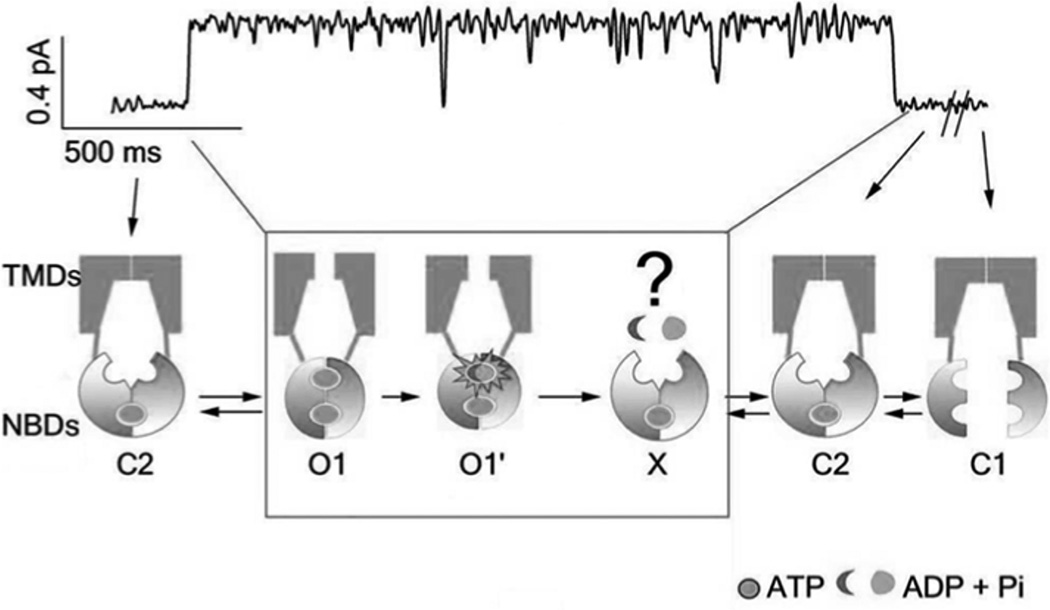
Fig. (2). Mechanism of ATP-dependent gating of CFTR channel
The latest version of consensus model for the ATP-dependent gating of CFTR channel based on the NBD dimerization hypothesis [29, 30]. The trace on top represents an opening burst of WT-CFTR. Note the MSD conformation (open or closed) in the state X is not identified whereas it is likely to be open [29, 30].
Fig. (3)
Fig. (3). Structures of (A) genistein and (B) 17-Δ-estradiol and testosterone, sex hormones that genistein might cross-react
Genistein and 17-β-estradiol share structural features of the phenolic ring and the 11.5 Å distance between its 4’- and 7-hydroxyl groups [48].
Fig. (4)
Fig. (4). Effects of genistein on CFTR channel
(A) Representative single channel currents obtained from (a) WT- and (b) ΔF508-CFTR channels in cell-attached membrane patches. The bath and pipette solutions contained 154 µM Cl. The membrane potential was clamped at +50 mV and downward deflections of the trace represent channel openings. See [77] for more detail. Reproduced from [77] with permission. (B) A molecular model showing the possible interactions between genistein and NBD1–NBD2 heterodimer of human CFTR at the five putative binding sites [62]. The genistein molecules are shown in ball-and-stick mode and the residues important for interacting with genistein are indicated. The five model-predicted potential genistein binding sites are superimposed (dashed circles). See [62] for more detail. Modified from [62] with permission.
Fig. (5)
Fig. (5). Structures of (A) curcumin and (B) major curcumin analogues
Note that curcumin is tautomeric keto-enol mixture whereas the enol form is predominant. Commercial available “curcumin” compound contains approximately 77% curcumin, 17% demethoxycurcumin and 3% bisdemethoxycurcumin [70].
Fig. (6)
Fig. (6). Effects of curcumin on CFTR channel
(A) Effects of curcumin on channel function of CFTR. Macroscopic currents obtained from insideout excised patches expressing (a) G551D- and (b) Δ1198-CFTR channels. Membrane potential was clamped to a ramp waveform from −80 to +80 mV. The channels were initially phosphorylated by ATP and PKA (control condition). See [73] for more detail. Curcumin strongly potentiated (a) G551DCFTR and also (b) Δ1198-CFTR lacking NBD2 in the absence of ATP. The inset of (b) shows the dose-response cure of the curcumin effects. Remade from [73] with permission. (B) Curcumin-induced cross-linking of CFTR molecules. Upper panel: Structures of (synthetic) curcumin and BSc3596, a curcumin analog that cannot cross-link CFTRs by being β-diketone reactive group cyclized. (a) SDS-PAGE of Δ1198-CFTR in microsome after 30 min incubation with 30 µM curcumin, synthetic curcumin and BSc3596. (b) SDS-PAGE of WT- and G551D-CFTR after 30 min incubation with 30 µM curcumin or BSc3596 or with 1mM DSS or DMSO only (vehicle). (c) Macroscopic inside-out currents showing a β-diketone-cyclized curcumin analog BSc3596 can strongly potentiate Δ1198-CFTR without cross-linking. See [47] for more detail. Reproduced from [47] with permission.
Fig. (7)
Fig. (7). Effects of genistein or curcumin in sole administration on whole-cell currents of G551D-CFTR channels expressed in CHO cells
Representative traces for G551D-CFTR whole-cell currents affected by (A) 80 µM genistein and (B) 30 µM curcumin. (C) The dose response relationship for genistein (●) (n = 11) and curcumin (■) (n = 12). Error bars represent SEM. The fold-increase in the whole cell current (IWC) was calculated by dividing the mean current at 100 mV in the presence of genistein or curcumin by the mean current in control after the leak current subtraction. Reproduced from [38] with a modification.
Fig. (8)
Fig. (8). Additive and Synergistic effects of curcumin and genistein on G551D-CFTR whole-cell current
(A) Representative traces for G551D-CFTR whole-cell currents affected by (a) 80 µM genistein without and with 30 µM curcumin (additive effect) and (b) 10 µM genistein without and with 10 µM curcumin (synergistic effect). G551D-CFTR whole-cell currents were stimulated by 10 µM FSK + 100 µM CPT-cAMP. Membrane potential was clamped to the ramp waveform shown in the inset. (a) Reproduced from [38] with a modification. See [38] for more detail. (B) Normalized current densities of G551D-CFTR expressed in CHO cells obtained from whole cell currents potentiated by various combinations of curcumin and genistein are indicated. Normalized to mean of the whole-cell current density from WT-CFTR expressed in CHO cells. Error bars represent SEM. Reproduced from [38] with a modification. See [38] for more detail.

References

    1. Gadsby DC, Vergani P, Csanady L. The ABC protein turned chloride channel whose failure causes cystic fibrosis. Nature. 2006;440:477–483. - PMC - PubMed
    1. Riordan JR, Rommens JM, Kerem B, et al. Identification of the cystic fibrosis gene: cloning and characterization of complementary DNA. Science. 1989;245:1066–1073. - PubMed
    1. Welsh MJ, Smith AE. Molecular mechanisms of CFTR chloride channel dysfunction in cystic fibrosis. Cell. 1993;73:1251–1254. - PubMed
    1. Gray MA, Greenwell JR, Argent BE. Secretin-regulated chloride channel on the apical plasma membrane of pancreatic duct cells. J Membr Biol. 1988;105:131–142. - PubMed
    1. Knowles MR, Stutts MJ, Spock A, Fischer N, Gatzy JT, Boucher RC. Abnormal ion permeation through cystic fibrosis respiratory epithelium. Science. 1983;221:1067–1070. - PubMed

Publication types

MeSH terms

Substances