


Preschool-aged children's understanding of gratitude: relations with emotion and mental state knowledge
- PMID: 23331105
- PMCID: PMC5224866
- DOI: 10.1111/j.2044-835X.2012.02077.x
Preschool-aged children's understanding of gratitude: relations with emotion and mental state knowledge
Abstract
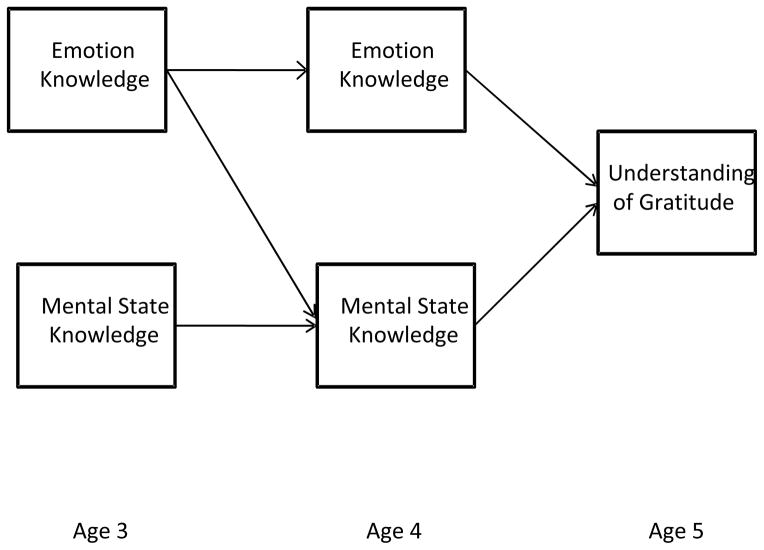
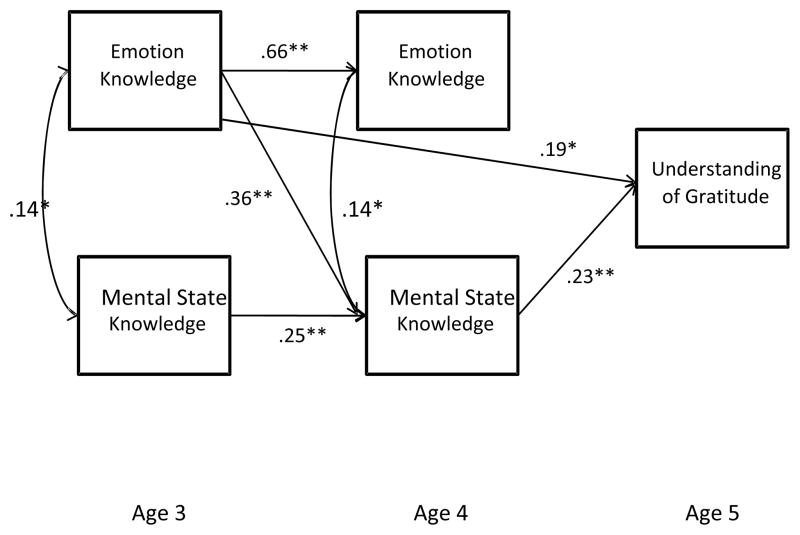
Developmental precursors to children's early understanding of gratitude were examined. A diverse group of 263 children was tested for emotion and mental state knowledge at ages 3 and 4, and their understanding of gratitude was measured at age 5. Children varied widely in their understanding of gratitude, but most understood some aspects of gratitude-eliciting situations. A model-building path analysis approach was used to examine longitudinal relations among early emotion and mental state knowledge and later understanding of gratitude. Children with a better early understanding of emotions and mental states understand more about gratitude. Mental state knowledge at age 4 mediated the relation between emotion knowledge at age 3 and gratitude understanding at age 5. The current study contributes to the scant literature on the early emergence of children's understanding of gratitude.
© 2012 The British Psychological Society.
Figures
References
-
- Astington JW, Gopnik A. Knowing you’ve changed your mind: Children’s understanding of representational change. In: Astington JW, Harris PL, editors. Developing theories of mind. New York: Cambridge University Press; 1988. pp. 193–206.
-
- Baron-Cohen S, Leslie A, Frith U. Does the autistic child have a theory of mind? Cognition. 1985;21:37–46. - PubMed
-
- Barrett KC, Campos JJ. Perspectives on emotional development II: A functionalist approach to emotions. In: Osofsky JD, editor. Handbook of infant development. 2. New York: Wiley; 1987. pp. 555–578.
-
- Bartlett MY, DeSteno D. Gratitude and prosocial behavior: Helping when it costs you. Psychological Science. 2006;17:319–325. - PubMed
-
- Bartsch K, Wellman HM. Children talk about the mind. New York: Oxford University Press; 1995.
