Effects of interleukin-1β and tumor necrosis factor-α on macrophage inflammatory protein-3α production in synovial fibroblast-like cells from human temporomandibular joints
- PMID: 23331383
- PMCID: PMC3810725
- DOI: 10.1111/jop.12040
Effects of interleukin-1β and tumor necrosis factor-α on macrophage inflammatory protein-3α production in synovial fibroblast-like cells from human temporomandibular joints
Abstract
Background: Interleukin-1β (IL-1β) and tumor necrosis factor-α (TNF-α) are key mediators of the intracapsular pathological conditions of the temporomandibular joint (TMJ). Therefore, the gene expression profiles in synovial fibroblast-like cells (SFCs) from patients with internal derangement of the TMJ were examined after they were stimulated with IL-1β or TNF-α to determine which genes were altered.
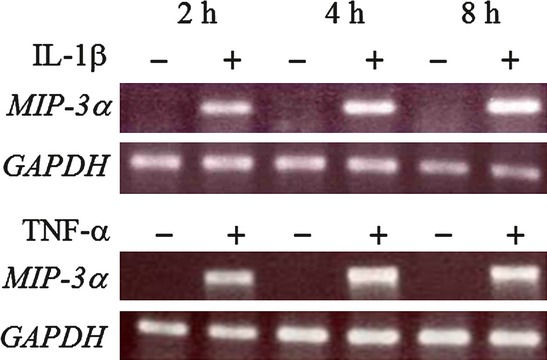
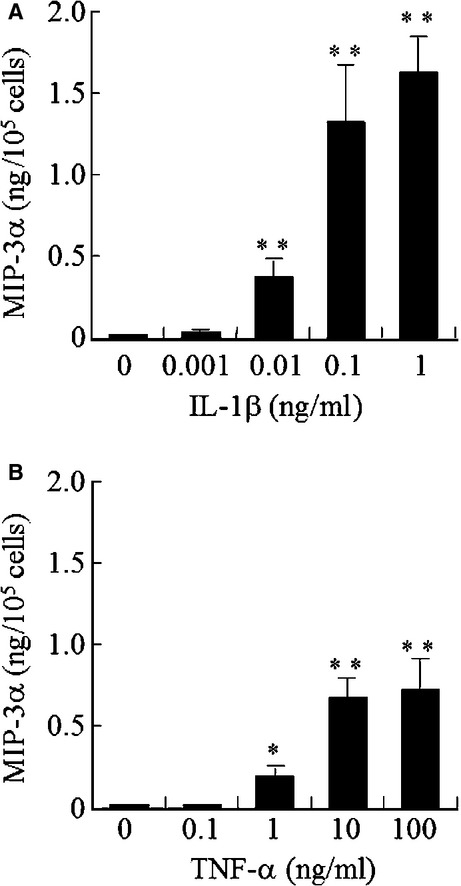
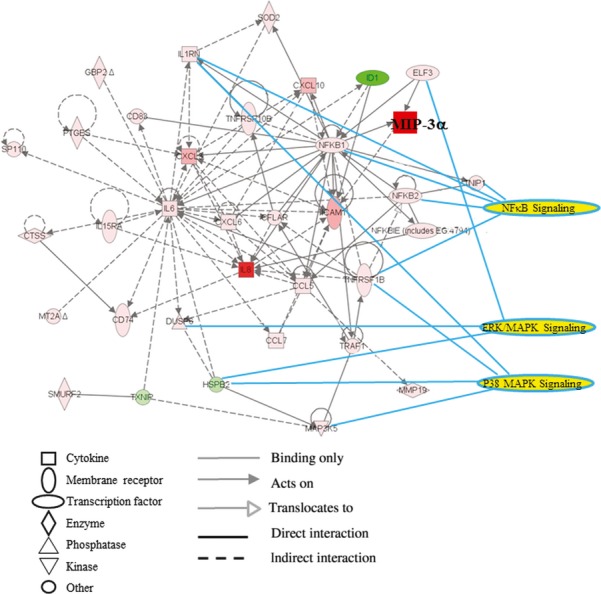
Methods: Ribonucleic acid was isolated from SFCs after IL-1β or TNF-α treatment. Gene expression profiling was performed using oligonucleotide microarray analysis. On the basis of the results of this assay, we investigated the kinetics of macrophage inflammatory protein-3α (MIP-3α) gene expression using PCR, and protein production in TMJ SFCs stimulated by IL-1β or TNF-α using an ELISA. Inhibition experiments were performed with MAPK and NFκB inhibitors. SFCs were stimulated with IL-1β or TNF-α after treatment with inhibitors. The MIP-3α levels were measured using an ELISA.
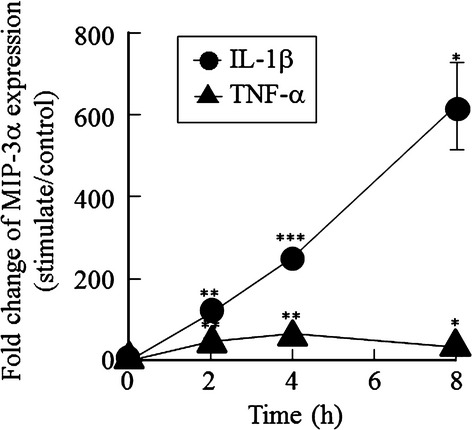
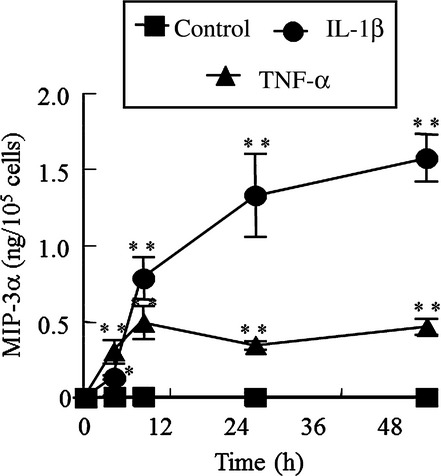
Results: Macrophage inflammatory protein-3α was the gene most upregulated by IL-1β- or TNF-α stimulation. The mRNA and protein levels of MIP-3α increased in response to IL-1β in a time-dependent manner. In contrast, during TNF-α stimulation, the MIP-3α mRNA levels peaked at 4 h, and the protein levels peaked at 8 h. In addition, the IL-1β- and TNF-α-stimulated MIP-3α production was potently reduced by the MAPK and NFκB signaling pathway inhibitors.
Conclusion: Interleukin-1β and TNF-α increased the MIP-3α production in SFCs via the MAPK and NFκB pathways. These results suggest that the production of MIP-3α from stimulation with IL-1β or TNF-α is one factor associated with the inflammatory progression of the internal derangement of the TMJ.
Keywords: interleukin-1β; macrophage inflammatory protein-3α; synovial fibroblast-like cell; temporomandibular joint; tumor necrosis factor-α.
© 2013 John Wiley & Sons A/S. Published by John Wiley & Sons Ltd.
Figures
References
-
- Dijkgraaf LC, Liem RSB, de Bont LGM. Synovial membrane involvement in osteoarthritic temporomandibular joints. A light microscopic study. Oral Surg Oral Med Oral Pathol Oral Radiol Endod. 1997;83:373–86. - PubMed
-
- Kondoh T, Dolwick MF, Hamada Y, Seto K. Visually guided irrigation for patients with symptomatic internal derangement of the temporomandibular joint: a preliminary report. Oral Surg Oral Med Oral Pathol Oral Radiol Endod. 2003;95:544–51. - PubMed
-
- Gynther GW, Holmlund AB, Reinholt FP, Lindblad S. Temporomandibular joint involvement in generalized osteoarthritis and rheumatoid arthritis: a clinical, arthroscopic, histologic, and immunohistochemical study. Int J Oral Maxillofac Surg. 1997;26:10–6. - PubMed
-
- Gynther GW, Dijkgraaf LC, Reinholt FP, Holmlund AB, Liem RSB, de Bont LGM. Synovial inflammation in arthroscopically obtained biopsy specimens from the temporomandibular joint: a review of the literature and a proposed histologic grading system. J Oral Maxillofac Surg. 1998;56:1281–6. - PubMed
-
- Kardel R, Ulfgren A-K, Reinholt FP, Holmlund A. Inflammatory cell and cytokine patterns in patients with painful clicking and osteoarthritis in the temporomandibular joint. Int J Oral Maxillofac Surg. 2003;32:390–6. - PubMed
Publication types
MeSH terms
Substances
LinkOut - more resources
Full Text Sources
Other Literature Sources
Medical