


Cognitive impairment in older adults with heart failure: prevalence, documentation, and impact on outcomes
- PMID: 23331439
- PMCID: PMC3553506
- DOI: 10.1016/j.amjmed.2012.05.029
Cognitive impairment in older adults with heart failure: prevalence, documentation, and impact on outcomes
Erratum in
- Am J Med. 2013 Jun;126(6):e25
Abstract
Background: Despite the fact that 80% of patients with heart failure are aged more than 65 years, recognition of cognitive impairment by physicians in this population has received relatively little attention. The current study evaluated physician documentation (as a measure of recognition) of cognitive impairment at the time of discharge in a cohort of older adults hospitalized for heart failure.
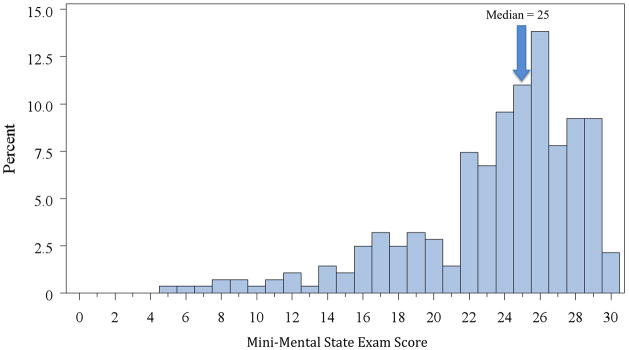
Methods: We performed a prospective cohort study of older adults hospitalized with a primary diagnosis of heart failure. Cognitive status was evaluated with the Folstein Mini-Mental State Examination at the time of hospitalization. A score of 21 to 24 was used to indicate mild cognitive impairment, and a score of ≤20 was used to indicate moderate to severe impairment. To evaluate physician documentation of cognitive impairment, we used a standardized form with a targeted keyword strategy to review hospital discharge summaries. We calculated the proportion of patients with cognitive impairment documented as such by physicians and compared characteristics between groups with and without documented cognitive impairment. We then analyzed the association of cognitive impairment and documentation of cognitive impairment with 6-month mortality or readmission using Cox proportional hazards regression.
Results: A total of 282 patients completed the cognitive assessment. Their mean age was 80 years of age, 18.8% were nonwhite, and 53.2% were female. Cognitive impairment was present in 132 of 282 patients (46.8% overall; 25.2% mild, 21.6% moderate-severe). Among those with cognitive impairment, 30 of 132 (22.7%) were documented as such by physicians. Compared with patients whose cognitive impairment was documented by physicians, those whose impairment was not documented were younger (81.3 vs 85.2 years, P<.05) and had less severe impairment (median Mini-Mental State Examination score 22.0 vs 18.0, P<.01). After multivariable adjustment, patients whose cognitive impairment was not documented were significantly more likely to experience 6-month mortality or hospital readmission than patients without cognitive impairment.
Conclusions: Cognitive impairment is common in older adults hospitalized for heart failure, yet it is frequently not documented by physicians. Implementation of strategies to improve recognition and documentation of cognitive impairment may improve the care of these patients, particularly at the time of hospital discharge.
Copyright © 2013 Elsevier Inc. All rights reserved.
Figures
Comment in
-
Geriatric assessment of older adults with heart failure: an essential tool in planning of care.Am J Med. 2013 Feb;126(2):93-4. doi: 10.1016/j.amjmed.2012.11.007. Am J Med. 2013. PMID: 23331431 Free PMC article. No abstract available.
-
Heart failure and cognitive impairment: relationships with mortality.Am J Med. 2013 Dec;126(12):e15. doi: 10.1016/j.amjmed.2013.07.035. Am J Med. 2013. PMID: 24262731 No abstract available.
-
The reply.Am J Med. 2013 Dec;126(12):e17. doi: 10.1016/j.amjmed.2013.08.014. Am J Med. 2013. PMID: 24262732 Free PMC article. No abstract available.
References
-
- Ho KKL, Pinsky JL, Kannel WB, Levy D. The epidemiology of heart failure: The Framingham study. J Am Coll Cardiol. 1993;4:A6–A13. - PubMed
-
- Jencks SF, Williams MV, Coleman EA. Rehospitalizations among patients in the Medicare fee-for-service program. N Engl J Med. 2009;360:1418–28. - PubMed
-
- Tinetti ME, Fried T. The end of the disease era. Am J Med. 2004;116:179–85. - PubMed
Publication types
MeSH terms
Grants and funding
LinkOut - more resources
Full Text Sources
Other Literature Sources
Medical
