


Specific patterns of allergic sensitization in early childhood and asthma & rhinitis risk
- PMID: 23331564
- PMCID: PMC3557802
- DOI: 10.1111/cea.12050
Specific patterns of allergic sensitization in early childhood and asthma & rhinitis risk
Abstract
Background: Specific patterns of allergic sensitization as well as quantification of the in vitro IgE response in early life may provide relevant clinical insight into future rhinitis and asthma risk.
Objective: To define relationships among established sensitization to particular aeroallergens, quantitative analyses of allergen-specific IgE levels, pet exposure and sensitization, and asthma and rhinitis risk.
Methods: Children at high-risk for the development of asthma and allergic diseases were enrolled at birth into the Childhood Origins of ASThma (COAST) study. Allergen-specific IgE was assessed at ages 1, 3, 6, and 9 years by fluoroenzyme immunoassay (Unicap(®) 100; Pharmacia Diagnostics). Current asthma and rhinitis were diagnosed at age 6 and 8 years.
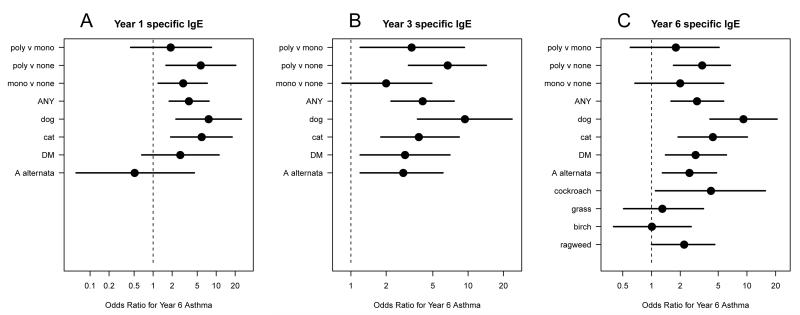
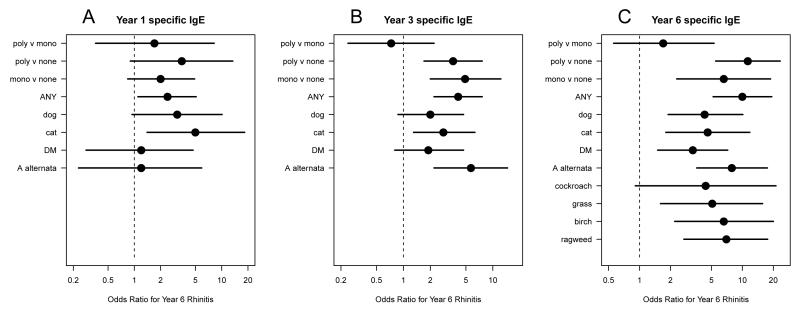
Results: Sensitization to dog was strongly associated with increased asthma risk (P < 0.0001). Sensitization to perennial compared with seasonal allergens was more strongly associated with asthma risk, while sensitization to seasonal allergens was more closely associated with rhinitis risk. Increased levels of specific IgE to perennial allergens were associated with an increased asthma risk (P = 0.05), while any detectable level of IgE to seasonal allergens was associated with increased rhinitis risk (P = 0.0009). While dog and cat sensitization were both independently associated with increased asthma and rhinitis risk, dog exposure at birth was associated with a reduced risk of asthma, regardless of dog sensitization status during the first 6 years of life (P = 0.05).
Conclusions and clinical relevance: Analysing specific patterns of an individual's allergic sensitization profile reveals additional relevant associations with asthma and rhinitis risk as opposed to the information gained from characterizing an individual as 'atopic' by the presence of any demonstrable sensitization alone. Furthermore, protective mechanisms of dog exposure with regards to asthma risk appear to be unrelated to the prevention of sensitization.
© 2012 Blackwell Publishing Ltd.
Figures
References
-
- Sly PD, Boner AL, Björksten B, Bush A, Custovic A, Eigenmann PA, Gern JE, Gerritsen J, Hamelmann E, Helms PJ, Lemanske RF, Martinez F, Pedersen S, Renz H, Sampson H, von Mutius E, Wahn U, Holt PG. Early identification of atopy in the prediction of persistent asthma in children. Lancet. 2008;372:1100–6. - PMC - PubMed
-
- Simpson A, Soderstrom L, Ahlstedt S, Murray CS, Woodcock A, Custovic A. IgE antibody quantification and the probability of wheeze in preschool children. J Allergy Clin Immunol. 2005;116:744–9. - PubMed
-
- Simpson A, Tan VY, Winn J, Svensén M, Bishop CM, Heckerman DE, Buchan I, Custovic A. Beyond atopy: multiple patterns of sensitization in relation to asthma in a birth cohort study. Am J Respir Crit Care Med. 2010;181:1200–6. - PubMed
-
- Brockow I, Zutavern A, Hoffmann U, Grübl A, von Berg A, Koletzko S, Filipiak B, Bauer CP, Wichmann HE, Reinhardt D, Berdel D, Krämer U, Heinrich J, Group GS. Early allergic sensitizations and their relevance to atopic diseases in children aged 6 years: results of the GINI study. J Investig Allergol Clin Immunol. 2009;19:180–7. - PubMed
-
- Sporik R, Holgate ST, Platts-Mills TA, Cogswell JJ. Exposure to house-dust mite allergen (Der p I) and the development of asthma in childhood. A prospective study. N Engl J Med. 1990;323:502–7. - PubMed
Publication types
MeSH terms
Substances
Grants and funding
- UL1 TR000427/TR/NCATS NIH HHS/United States
- M01 RR003186/RR/NCRR NIH HHS/United States
- T32 AI007635/AI/NIAID NIH HHS/United States
- P01 HL70831/HL/NHLBI NIH HHS/United States
- UL1 RR025011/RR/NCRR NIH HHS/United States
- UL1TR000427/TR/NCATS NIH HHS/United States
- R01 MH061879/MH/NIMH NIH HHS/United States
- P01 HL070831/HL/NHLBI NIH HHS/United States
- UL1RR025011/RR/NCRR NIH HHS/United States
- R01 HL061879/HL/NHLBI NIH HHS/United States
- M01 RR03186/RR/NCRR NIH HHS/United States
- R01 HD061879/HD/NICHD NIH HHS/United States
- R01 HL61879/HL/NHLBI NIH HHS/United States
LinkOut - more resources
Full Text Sources
Other Literature Sources
Medical
Miscellaneous
