


Smoking cessation among diabetes patients: results of a pilot randomized controlled trial in Kerala, India
- PMID: 23331722
- PMCID: PMC3560246
- DOI: 10.1186/1471-2458-13-47
Smoking cessation among diabetes patients: results of a pilot randomized controlled trial in Kerala, India
Abstract
Background: India has the second largest diabetic population (61 million) and tobacco users (275 million) in the world. Data on smoking cessation among diabetic patients are limited in low and middle income countries. The objective of the study was to document the effectiveness of diabetic specific smoking cessation counseling by a non-doctor health professional in addition to a cessation advice to quit, delivered by doctors.
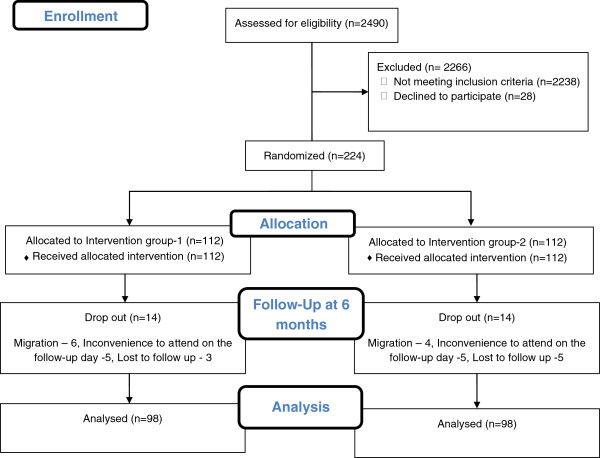
Methods: In our parallel-group randomized controlled trial, we selected 224 adult diabetes patients aged 18 years or older who smoked in the last month, from two diabetes clinics in South India. Using a computer generated random sequence with block size four; the patients were randomized equally into intervention-1 and intervention-2 groups. Patients in both groups were asked and advised to quit smoking by a doctor and distributed diabetes specific education materials. The intervention-2 group received an additional diabetes specific 30 minutes counseling session using the 5As (Ask, Advise, Assess, Assist and Arrange), and 5 Rs (Relevance, Risks, Rewards, Roadblocks and Repetition) from a non-doctor health professional. Follow up data were available for 87.5% of patients at six months. The Quit Tobacco International Project is supported by a grant from the Fogarty International Centre of the US National Institutes of Health (RO1TW005969-01).The primary outcomes were quit rate (seven day smoking abstinence) and harm reduction (reduction of the number of cigarettes / bidis smoked per day > 50% of baseline use) at six months.
Results: In the intention to treat analysis, the odds for quitting was 8.4 [95% confidence interval (CI): 4.1-17.1] for intervention-2 group compared to intervention-1 group. Even among high level smokers the odds of quitting was similar. The odds of harm reduction was 1.9 (CI: 0.8-4.1) for intervention-2 group compared to intervention-1 group.
Conclusions: The value addition of culturally sensitive diabetic specific cessation counseling sessions delivered by non-doctor health professional was an impressive and efficacious way of preventing smoking related diabetic complications.
Trial registration: Clinical Trial Registry of India (CTRI/2012/01/002327).
References
-
- Registrar General of India. Census of India. 2011. http://www.censusindia.gov.in.
-
- International Diabetes Federation (IDF) IDF Diabetes atlas. 5. Brussels: International Diabetes Federation; 2011.
-
- International Institute for Population Sciences (IIPS) Global Adult Tobacco Survey India (GATS India), 2009–2010. Mumbai: Ministry of Health and Family Welfare, Government of India, New Delhi, ; 2010.
-
- Jha P, Jacob B, Gajalakshmi V, Gupta PC, Dhingra N, Kumar R, Sinha DN, Dikshit RP, Parida DK, Kamadod R, Boreham J, Peto R. RGI-CGHR Investigators: a nationally representative case–control study of smoking and death in India. N Engl J Med. 2008;358:1137–1147. doi: 10.1056/NEJMsa0707719. - DOI - PubMed
Publication types
MeSH terms
Grants and funding
LinkOut - more resources
Full Text Sources
Other Literature Sources
Medical
